
 image: ©Nastasic | iStock
Fossils from northern Australia reveal a colossal 8-meter shark that ruled the seas 115 million years ago. This discovery proves that modern shark lineages achieved gigantic sizes far earlier than previously thought, competing with dinosaur-era marine reptiles
A groundbreaking discovery of ancient shark fossils in northern Australia has forced scientists to reassess the timeline of mega-predators in the world’s oceans. Around 115 million years ago, during the Age of Dinosaurs, a colossal shark species—an early relative of modern-day sharks like the Great White—was already stalking the seas at gigantic sizes, challenging the previously held belief that extreme size evolved much later.
The findings, published in the Nature portfolio journal Communications Biology, reveal that modern-type sharks were competitive apex predators alongside the giant marine reptiles that dominated the dinosaur-era oceans.
Shark fossils: The early giant of the tethys ocean
The focus of the new research centers on shark fossils found near the present-day city of Darwin, an area that was once the muddy floor of the vast Tethys Ocean. This body of water extended from what is now Australia to Europe. Numerous remains of prehistoric marine life have been uncovered here, including giant marine reptiles such as plesiosaurs (long-necked “sea monsters”) and ichthyosaurs (“fish-lizards”).
The most significant find, however, is a collection of five partly mineralised vertebrae belonging to an exceptionally large shark. While the earliest ancestors of modern sharks (lamniforms) began to emerge about 135 million years ago and were typically small, measuring only around 1 meter in length, this Darwin specimen was already massive.
Cardabiodontid characteristics and size estimation
The ancient shark’s vertebrae bear a strong structural resemblance to those of the modern Great White shark. However, their size is vastly different: an adult Great White typically has vertebrae around 8 cm wide, while the Darwin specimen’s vertebrae exceed 12 cm in diameter.
These features clearly link the fossils to a group of giant predatory sharks known as cardabiodontids, which were known to inhabit the oceans roughly 100 million years ago. What makes the Darwin discovery particularly astonishing is that it is approximately 15 million years older than any other known cardabiodontid, yet it had already attained the immense size characteristic of the group.
By analysing the size of the vertebrae, researchers—a collaborative team of palaeontologists, ichthyologists, and tomography specialists from the USA, Sweden, Australia, and South Africa—were able to determine that this early mega-predator reached an estimated length of 8 meters (about 26 feet). This places it among the largest marine predators of the Early Cretaceous period, sharing the top of the food chain with the era’s most fearsome marine reptiles.
Shark teeth: A window to deep time
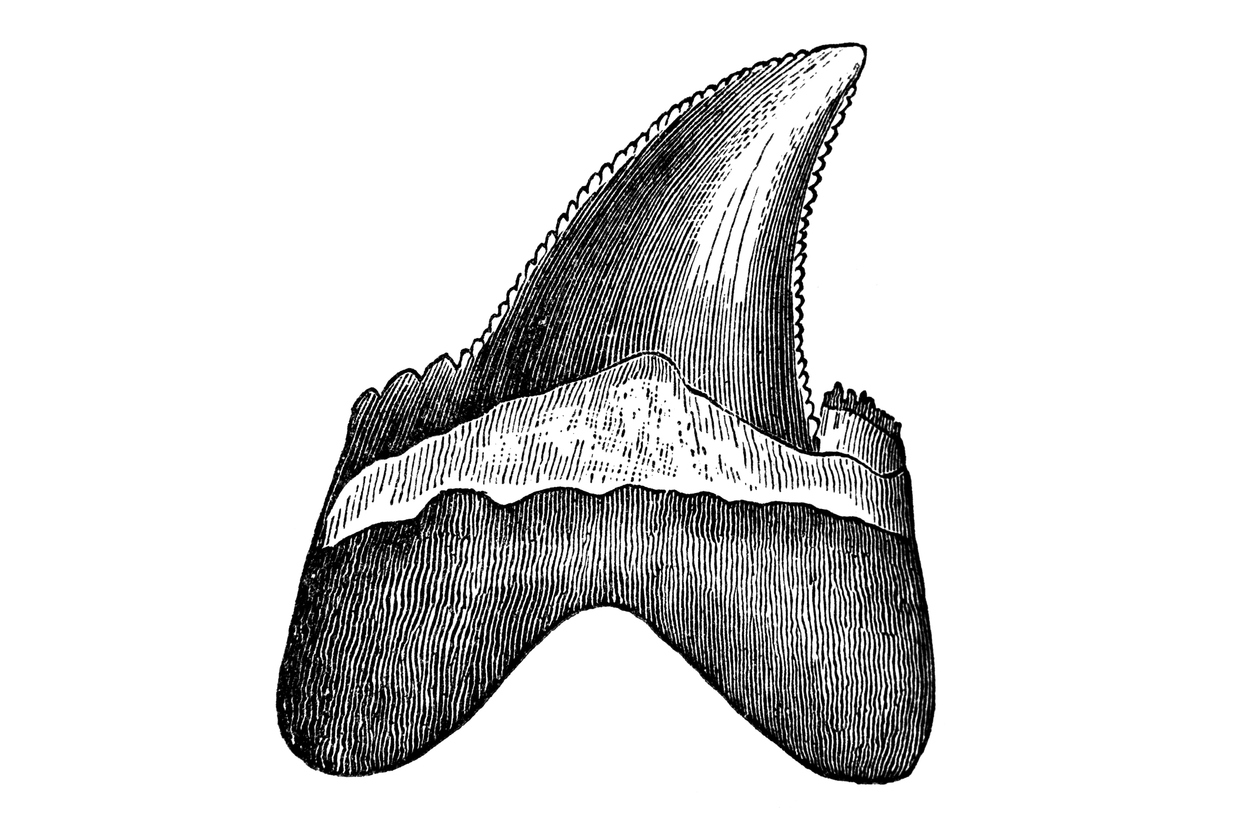
Due to their cartilaginous skeletons, shark bodies rarely survive the fossilisation process. As a result, almost all that remains of ancient sharks are their teeth, which are shed continuously and accumulate on the seafloor. This fact makes the discovery of preserved vertebrae for this giant specimen highly valuable, providing a more reliable insight into its body size.
The discovery fundamentally rewrites the early evolutionary history of modern sharks. It shows that the adaptation to gigantic body sizes—a trait that would later lead to the Megalodon (up to 17 meters long) and the modern Great White (up to 6 meters long)—began far earlier than scientists had previously understood, establishing modern shark lineages as dominant ocean forces during the time of the dinosaurs.