
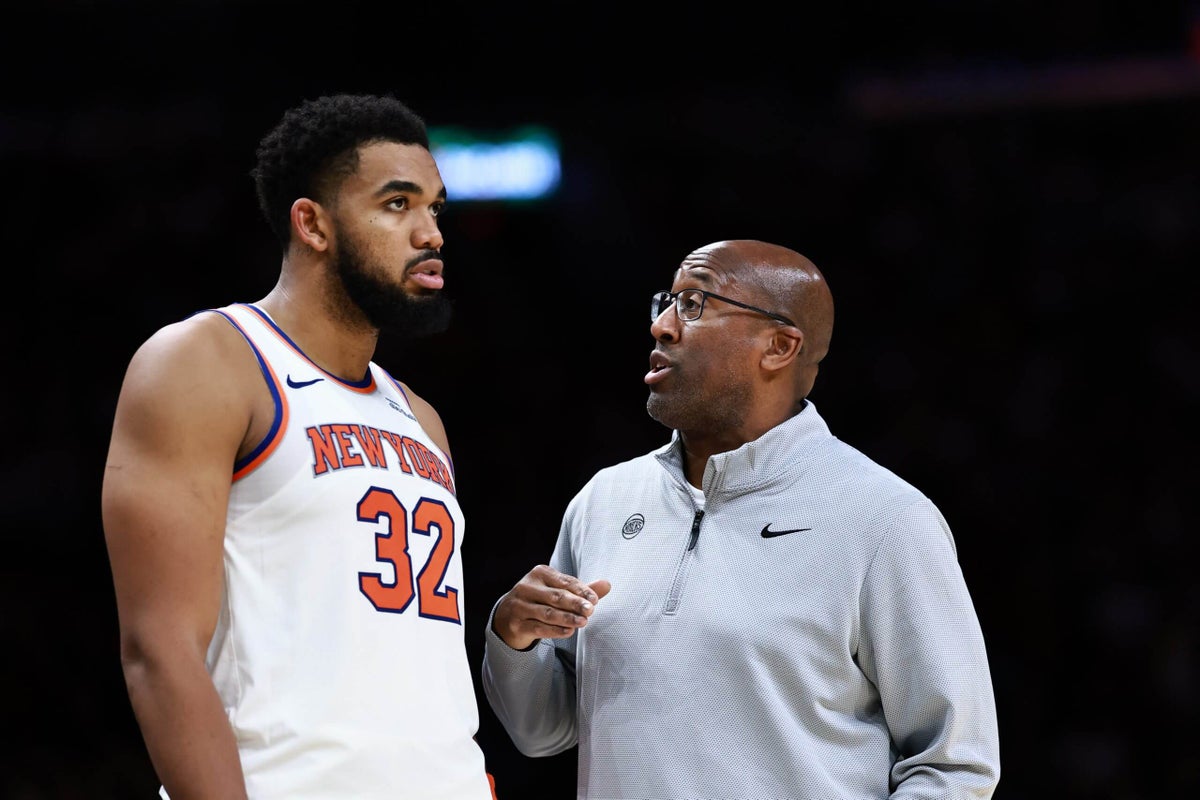
No matter the coach, the New York Knicks continue to hook people in and then take them on a winding journey.
Just like last season, New York is 9-6 through 15 games. It’s a respectable record, given that Mike Brown is still relatively early in his coaching tenure, but one that continues to leave some doubt about the group’s ceiling.
To discuss the current state, The Athletic’s Knicks beat writer James L. Edwards III and national writer Fred Katz have thoughts on where this team is at this point in the season and what it sees going forward.
What has stood out most about the Knicks through 15 games?
Edwards: There’s a lot, both good and bad, but I’ll lead with love. The offense has a real chance to remain elite throughout the entire season.
The Knicks had the NBA’s third-best offense as of Saturday night, following their loss to the Orlando Magic. They’re among the league leaders in 3-point attempts while flirting with a top-10 spot in terms of efficiency. They’re an elite offensive rebounding team and near the top in second-chance points. They generate as many open 3s as anyone in the NBA.
The most glaring issue with New York’s offense is that it doesn’t get into the paint a ton and doesn’t score inside enough. The Knicks are heavily reliant on 3-point shooting right now.
New York is doing all of this offensively with Karl-Anthony Towns currently posting career-low efficiency from both the field and 3-point range. No way that holds, right?
The offense still has some kinks to work out but remains one of the best in the NBA. That’s a good sign.
With that said, I thought the Knicks would be in a tier of their own — or in a tier with just the Cleveland Cavaliers for most of the regular season — and that hasn’t been the case. The East might be a bit better than we thought. We’ll see with a little more time. Right now, while I still believe the Knicks have the most upside for this particular season of any team in the East, there are about six teams in the conference that are as good or better.
New York is a good team with some legitimate flaws. That’s how I felt most of last season, too.
Katz: The inconsistency.
At its best, New York’s offense looks like it did during that 140-point performance against the Miami Heat a week and a half ago. The team didn’t even have Jalen Brunson, yet it went bananas. The speed, the motion Brown discusses with passion, all showed.
But at its worst, it whimpers. The Knicks don’t always sustain their speed, like during that game last week against the Dallas Mavericks. New York stomped around in mud, even with Brunson playing, and barely squeaked out a victory.
At its best, New York’s defense is menacing. Mitchell Robinson isn’t just a rim protector; he’s also become one of the league’s best pick-and-roll defenders, capable of guarding a driver with one arm while taking away a potential pass to a roller with the other. OG Anunoby is a disruptor. Mikal Bridges has been solid, sometimes elite, guarding facilitators and has been special away from the basketball. The Knicks finish possessions. They’re one of the NBA’s best rebounding squads.
But with the organization cautious with Robinson’s ankle, the backbone of the defense is usually not on the court. Whether he’s around or not, offenses infiltrate the middle too easily, which creates 3s. The results have been mixed.
Sometimes, the Knicks look like title contenders. Sometimes, they don’t.
For now, they’re a Rorschach test. You’ll see whatever your brain tricks you into seeing.
What is a stat you find interesting, good or bad?
Edwards: I led with love, so I’ll be a bit of a grinch here.
The Knicks’ defense ranked 17th in the NBA as of their last game. On the surface, that’s not good, but it’s not terrible. However, when you dig a bit deeper, there is reason to be concerned.
New York has a bottom-half defense and has played 13 of its 15 games against offenses that rank 12th or worse. Nine of those games were against offenses that ranked 18th or worse (again, as of Saturday night).
In short, the Knicks’ defense is below average against below-average or worse offenses. That is worth biting your nails over.
The team gives up a lot of 3s, and teams shoot efficiently on those 3s. Last week, the Mavericks — who don’t shoot a lot of 3s or make a lot of 3s — took 44 3s against New York and made 36 percent of those shots. The Magic, another team that doesn’t shoot the 3-ball well, hit 39 percent of their attempts over the weekend.
New York, with or without injuries to key players, has struggled mightily with its on-ball defense. The pick-and-roll defense fails with communication at times. Brown’s shift/gap-help defense has done a good job of keeping teams out of the paint (outside of the latest game against Orlando), but rival teams have been comfortable all season kicking out to 3-point shooters and shooting contested or uncontested 3s with unbothered confidence. Opponents step into a lot of warm-up 3s against New York.
I’ve got real concerns about the defense and its ability to guard the ball. I’ve got concerns about the size of the backcourt and the backline defense when Robinson isn’t on the floor.
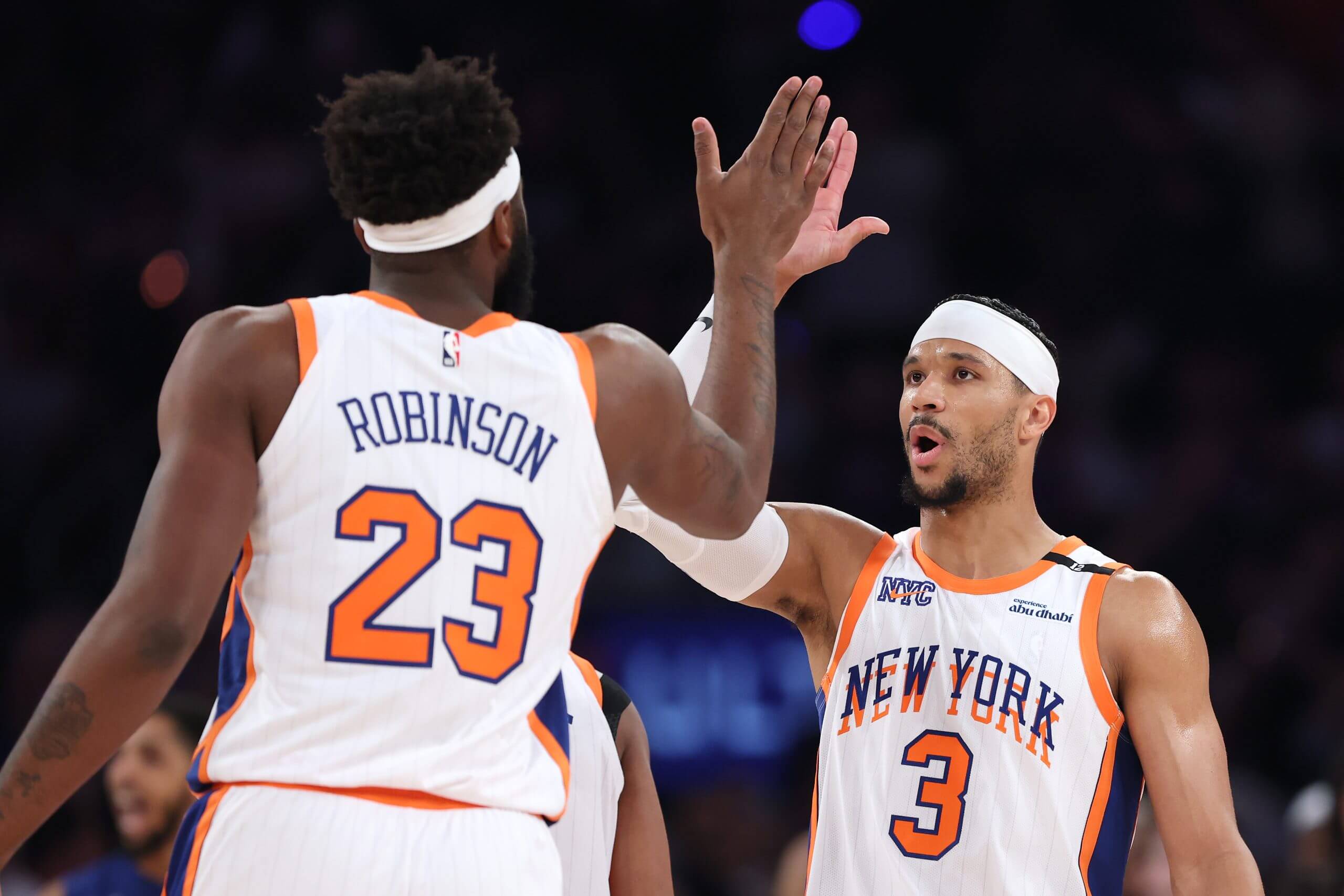
Mitchell Robinson’s size and defense has been a huge asset for the Knicks this season. (Sarah Stier / Getty Images)
If the defense doesn’t improve tremendously, the offense must be unstoppable for the Knicks to win a championship.
Katz: I will add to James’ point with a more specific statistic: 1.047. That’s how many points the Knicks’ defense allows per drive this season. Any shot, pass, drawn foul or turnover directly out of a drive counts toward that number, which ranks 21st in the league.
The scheme is supposed to take away the lane to the basket. Brown builds his defenses from the paint out — and it’s working. The Knicks don’t give up many shots around the hoop. But they aren’t bothering ballhandlers, especially big wings who like to bolt to the bucket, such as the Magic’s Franz Wagner, who annihilated them Saturday.
They foul too often or get caught out of position in those scenarios. The scheme calls for defenders on the perimeter to sink into the lane and cut off drivers, then to hustle out to primary assignments to take away jump shots. The Knicks know they will give up 3-pointers in bunches. They’re willing to live with that. An NBA defense can’t take away everything. Even the Oklahoma City Thunder, whose defensive efficiency looks like an ERA, allows droves of corner 3s. Like OKC, the Knicks choose paint defense as their main mission.
But it’s too common that their help from the perimeter is unrefined.
Anunoby injuring his hamstring makes life far more difficult. The shifting James mentioned, the way off-ball defenders wade into the lane at opportune moments, accentuates Anunoby’s and Bridges’ greatest skills. They’re long, quick and instinctual. The strategy is built around them. If one of them — especially the guy who is the top perimeter stopper on the squad — goes down for an extended period, the Knicks look worse.
But at the moment, whether Anunoby is present or not, whether Robinson is on the bench because of a minutes restriction or because it’s the second night of a back-to-back, the Knicks aren’t always cohesive.
Every once in a while, Brunson, while he’s hiding on a standstill shooter, will drift too far toward the basket, then be too late on a closeout. Or, Towns will end up in the wrong spot while defending the back end of a screen, which allows a dribbler a clear path. The Knicks are willing to concede 3s, but they have to be the right 3s. The ones that come after these types of mistakes are not the right 3s.
I’ll provide an important caveat: It is early. After half a decade of running the same stuff, the Knicks are learning to work within a new environment.
They switch up their defensive strategies more than they did under Tom Thibodeau. Watching them test out a zone against the Heat felt like a fever dream, even while knowing most of Miami’s opponents zone up that group’s screen-less, scrambling offense. The Knicks have run 70 possessions of zone defense so far this season, per Second Spectrum. In five years under Thibodeau, they ran 16 total.
The team had barely practiced the one Brown implemented against the Heat, but he wanted to try it. Brown is experimenting, which can lead to results that are not always indicative of what’s to come.
Speaking of which …
What are your thoughts on Mike Brown so far?
Edwards: I like the job he’s done.
A coach can’t put the ball in the basket for his players, but he can create an offense that generates good looks. The Knicks have done that.
New York still isn’t playing fast, but it’s playing faster and with more movement than it did last season.
Furthermore, I feel like Brown has instilled confidence in players like Landry Shamet, who may miss some significant time after injuring his shoulder over the weekend, and Jordan Clarkson — two players who could swing a playoff series.
Brown’s got to figure out the defense, given some of the limitations on that end of the floor with this roster. He’s got to help find a way to get Towns going.
Brown was thrown into a tough situation: coaching a team that just made the Eastern Conference finals and publicly declared anything short of a championship isn’t good enough. The record might be identical after 15 games to last season’s, but I do watch this team and see a vision offensively. Defensively, again, there’s still a lot of work to do.
Katz: Brown receives an incomplete — and given his lean into experimentation, I bet he would agree with that.
We know the concepts Brown values today. He wants the Knicks to play fast, not just on the break but also with pace in the half court. He wants cutting and an egalitarian system in which the best shot isn’t for the stars but for the open man. He wants to take away shots at the basket. The way he will implement it, as well as who he relies on most in moments that matter, is still a question mark.
Brown is running tests all over — with lineups, with X’s and O’s, with who he trusts late in games.
Last week, during a narrow loss in Miami, Miles “Deuce” McBride ran more offense than he had all season. McBride may be the size of a point guard, but his habits over the years have been those of an off-ball wing. Now, he’s speeding on full-court drives more than ever. With Brunson out against the Heat, McBride headed more of the attack than the norm.
By the end of the game, with the Knicks down a point, McBride was the guy who had to make a play against Miami pest Davion Mitchell, who stuck with the 24-year-old and forced him into an uncomfortable, possibly ill-advised midrange shot. Seconds later, McBride missed another shot, a floater on one of those long-runway drives that fell short.
The Knicks lost, but that was a learning experience for McBride. If he’s in a pinch and wedged into a similar situation later in the season or even during the playoffs, maybe going through those end-of-game moments on a night when he otherwise played well, going for 25 points, helps.
Brown has been accountable. He admits when something doesn’t work, then moves on to another venture. Early in the season, Josh Hart couldn’t catch a rhythm. He went to Brown, told his coach that he was routine-oriented, that he would be more comfortable if he knew when his minutes were coming. Brown added consistency to Hart’s role immediately. Hart knows when he will enter games and when he will leave them, and he generally understands that won’t change. Now, he looks like himself again.
Not every strategy has to work in the first 15 games. Brown just has to find the ones that do by spring. So far, he’s shown he’s willing to self-correct.