
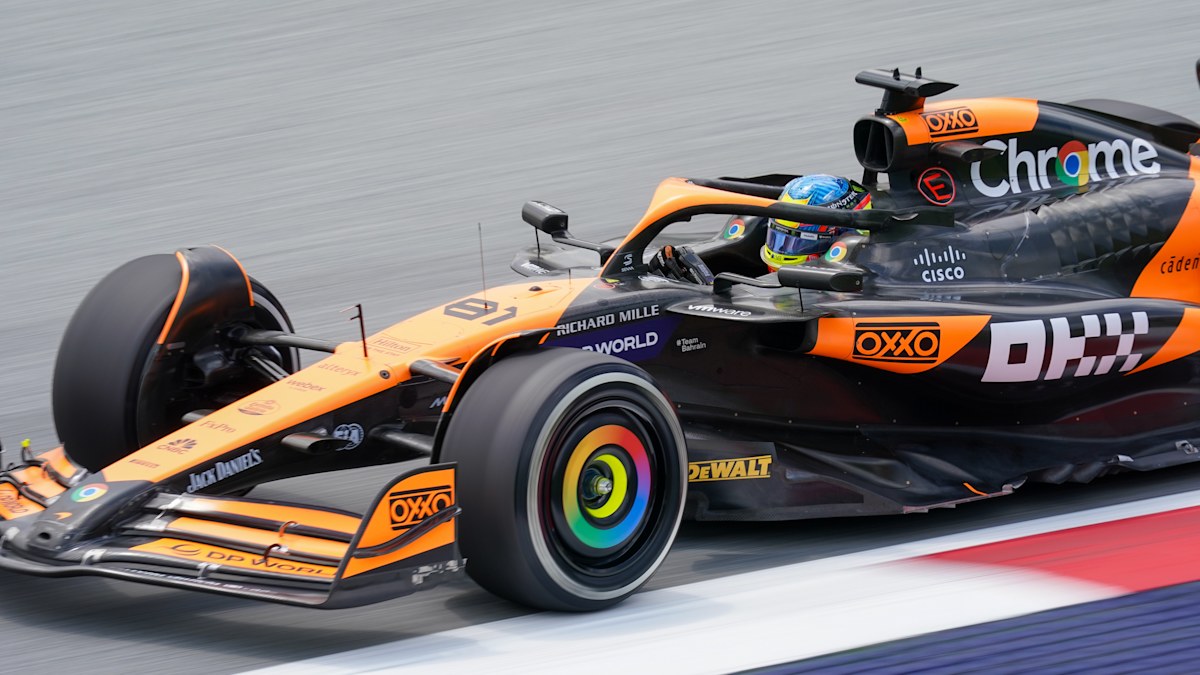
Tyre wear has historically plagued the Losail Circuit.
To manage this for the Qatar Grand Prix, official tyre supplier Pirelli has implemented a mandatory two-pit stop rule, completely upending every team’s strategy and adding another layer of intrigue to the championship battle being waged between McLaren drivers Oscar Piastri and Lando Norris, and Red Bull’s Max Verstappen.
While last year’s grand prix ran smoothly with a largely one-stop strategy, thanks in part to revisions of the kerbs, 2025 will see the introduction of a new operational limit.
READ MORE: ‘Violent’ Everton star sent off for slapping teammate
READ MORE: Former AFL ‘prodigy’ wins league contract after code switch
READ MORE: ‘Maybe we got that wrong’: Coach admits Boland mistake
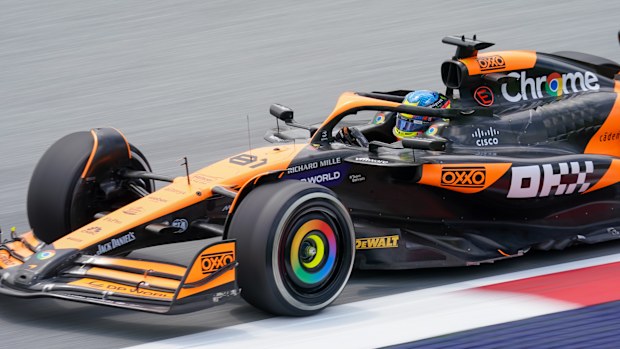
Australian Oscar Piastri driving his McLaren. NurPhoto via Getty Images
For this year’s grand prix, cars will be limited to a maximum of 25 laps per stint for the 57-lap race. This effectively mandates a two-pit stop strategy while still allowing for a degree of strategic variation.
This is the second time a maximum lap stint has been mandated for the Losail race. The 2023 edition capped stints at 18 laps — a measure introduced after kerbs caused micro-lacerations in the tyres, leading to punctures.
This year’s Monaco Grand Prix also had a two-stop mandate to try to make the race more exciting for viewers. However, this is because the narrow street circuit makes overtaking extremely difficult.
The mandatory two-stop rule transforms the Qatar Grand Prix into a series of three shorter sprints where a driver’s raw speed and pit stop execution will be more crucial than the traditional ability to manage their tyres.
The 25-lap limit may play to Piastri’s strengths, allowing the Australian to utilise his speed and aggressive driving style without the high-stakes risk of over-heating his tyres for a full-length, one-stop race.
Since each stint is capped, he can extract maximum performance knowing he has a guaranteed stop coming up.
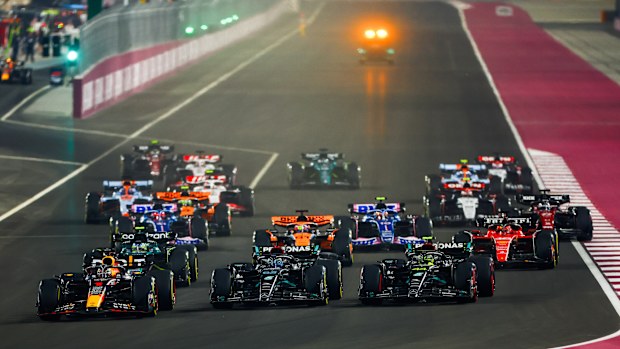
The race start at the Qatar Grand Prix. Mark Thompson via Getty Images
The decision was ultimately made in agreement with Formula 1, the FIA and all the teams. However, Haas team principal Ayao Komatsu believes the rule will “destroy” the grand prix.
Komatsu pointed to races like Brazil and Mexico as examples of successful, exciting grands prix where tyre performance naturally created a genuine strategic challenge for teams, who had to choose between a one-stop, two-stop, or three-stop approach.
“I don’t agree with those artificial limits,” he said in Las Vegas.
“I guess it’s just Pirelli scared from last year, right? One-stop race, and Pirelli probably thought, ‘Surely they’re not going to go this time. Oh no, they’re going’. So they just put this artificial limit so that it’s impossible to do a one-stop race.
“But for me, I don’t think it’s right that we have to do that in a sport. You know, we’re talking quite a lot about, you know, avoiding one-stop races, but to put something artificial, like you saw in Monaco and you saw in Qatar one year, I think it will destroy the race.”
Rather than imposing limits that remove strategic choice, Komatsu argued that Pirelli should focus on designing tyres that naturally create a situation where multiple strategies can succeed.
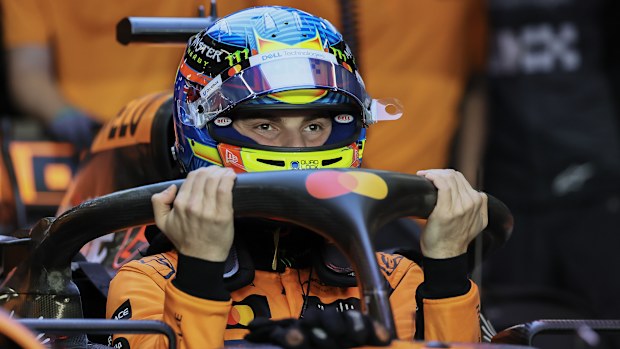
Oscar Piastri gets into his McLaren ahead of the 2024 Qatar Grand Prix. Getty
“For me, the issue is not just the one-stop. The issue is that, well, you saw Brazil and Mexico. You don’t need to look any further than that to see what kind of exciting race you could have when the tyre performance is on the edge of one or two stops, or two or three stops,” he said.
“When the two strategies could work, that’s when an exciting race happens. So, for me, that’s what Pirelli needs to aim for.”
Though the 2023 grand prix saw differing pit times, the variance ultimately failed to dramatically alter the outcome of the race.
“That race was bad, wasn’t it?” Komatsu said of 2023.
“You know, everybody’s pit stop window is exactly the same. So, whenever you do something artificial… Nobody’s stupid, right? People come to basically the same conclusion.”
“So, I don’t think it’s going to work, those things. You saw that in Monaco this year as well,” he said.
“You know, you’re trying to really artificially force something, then you made it worse.”
With the Qatar sprint race set at 19 laps, a pit stop is not required.