
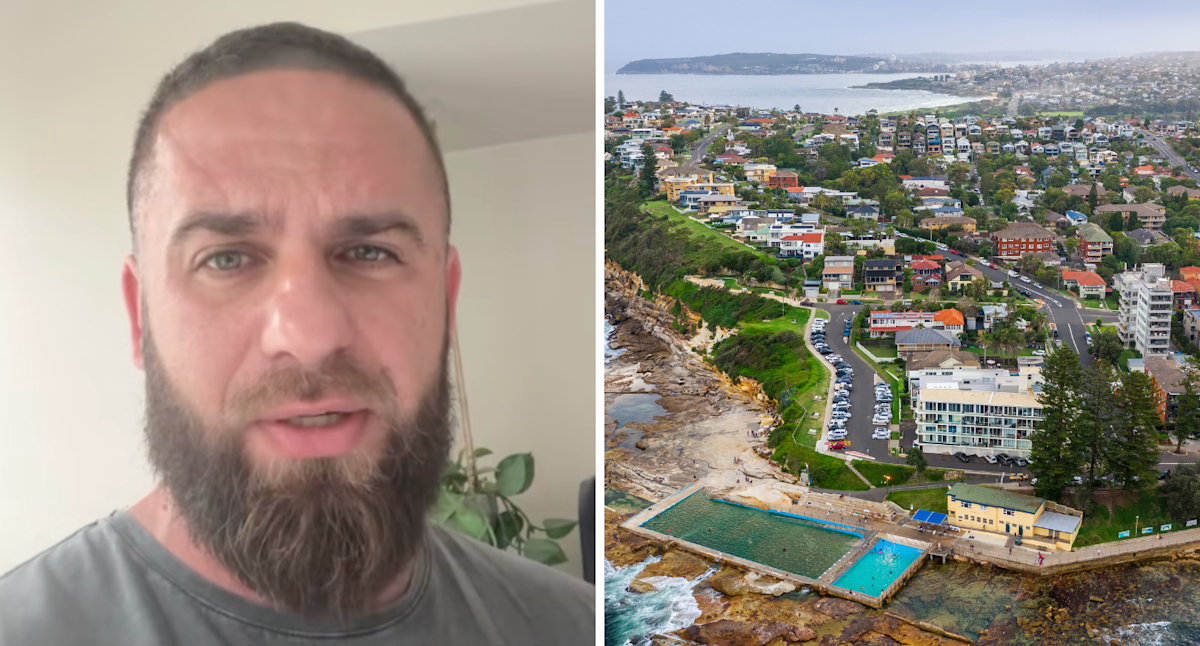
 Bora Tuncoglu believes you can’t live on $100,000 a year anymore, especially in Sydney. (Source: TikTok/Getty)
For many Australians, earning a $100,000 salary used to mean you had “made it”. But as the cost of living and property prices climb ever higher, the concept of what constitutes a “good” salary has become a point of contention.
Australian broker Bora Tuncoglu works with people applying for mortgages and financing every day and has settled more than $1.5 billion in loans. It may sound “sad”, but he says you “can’t really live on $100,000 a year” anymore. Especially in a pricey city like Sydney, where the median home value is more than $1.2 million.
“When we start actually breaking down the numbers, $100,000 a year income equates to net roughly $6,000 a month,” Tuncoglu told Yahoo Finance.
“The repayments on a million-dollar mortgage are roughly $6,000 a month. And you see what you can get for $1 million in Sydney is not too much, unfortunately.”
RELATED
The Bmoney founder said this meant you would be spending your entire salary just on your mortgage repayments, which he described as a “reality wake-up call” for most middle and high income earners.
Even if you had two couples earning $100,000 each, he noted you would be putting one income purely towards a mortgage while the other would go towards living expenses.
“Then what’s left for saving at the end of it all? Probably not much. That’s having a $1 million mortgage. That means to buy a $1.2 million property, you have to save $200,000, which is quite hard,” he said.
Realistically, on a $100,000 salary, Tuncoglu said you would be able to borrow about four and a half times your income. So that means you may only qualify for a mortgage of between $450,000 and $500,000, which wouldn’t get you very far in Sydney.
Do you have a story to share? Contact tamika.seeto@yahooinc.com
Tuncoglu said there was a common idea that the “right track” was going to school to get an education, going to university to get a job and eventually earning six-figures. But it won’t offer the “lavish lifestyle” you might think, he said.
Tuncoglu explained that he failed school himself and worked “dead end jobs” hoping to one day earn $100,000 a year. But he soon realised the salary goal wouldn’t offer him the type of lifestyle he wanted to live.
He eventually started a lending business and owned an ANZ franchise for 10 years, before selling it to launch Bmoney group in 2020.
Story Continues
“People work to one day earn six-figures, which is great. But six-figures isn’t as big as it seems, not in Sydney anyway,” he said.
When inflation is taken into account, a $100,000 salary in 1990 would be worth about $241,000 today. While a $100,000 salary in 2000, would be equivalent to around $194,000.
It’s important to recognise that a $100,000 salary is above the average in Australia. The latest Australian Taxation Office (ATO) statistics for the 2022-23 financial year found the average taxable income for Australians was $74,240, while the median was lower at $55,868.
AJ Financial Planning founder Alex Jamieson agreed there was still an “automatic assumption” in society to some degree that if you were earning $100,000 or more then money should be “free flowing”.
“But probably what hasn’t been recognised is that model of income to pay a mortgage now versus previous generations and how much it’s consuming on a single person,” he told Yahoo Finance.
“Once you’re handing over a decent chunk of that to tax, it’s actually quite a fair bit of a smaller amount leftover.”
Financial adviser Alex Jamieson said it was difficult for single people to buy homes if they didn’t have help from the Bank of Mum and Dad. (Source: AJ Financial Planning)
Jamieson said it was difficult for single people to buy their first home if they didn’t have any assistance from the bank of mum and dad, particularly in places like Sydney.
“If you’re thinking of a single person … it really is an incredible struggle to achieve that goal if you’re not getting any assistance from extended family being parents or if you’re not prepared to live somewhere that’s quite a fair distance from Sydney CBD,” he said.
“That’s possibly why you see a lot of people leaving Sydney in terms of outflows to other states, just because it is very challenging to get in front, especially $100,000 when you look at the actual after-tax money and then you look at the mortgage they would need to take on and you think about that with that conversation around mortgage stress.”
Renters can find it difficult on a $100,000 income, too, with a report by Everybody’s Home earlier this year finding a single person now needed to earn at least $130,000 to comfortably afford a typical unit and not be spending more than 30 per cent of their income on rent.
A Finder report found the average Australian believed $153,000 was the minimum annual amount to have a good pay packet, while $165,000 or more was needed to live “comfortably”.
Jamieson said he would recommend Aussies understand the first-home buyer programs available in their state and consider federal government schemes like the First Home Super Saver scheme.
“If you can stay within the first home buyer programs, then you often will get stamp duty free, which is a tremendous cost in a lot of states. And then you’re also able to tap into that the [5 per cent deposit] loan scheme,” he said.
Jamieson said it was important to recognise your first home probably won’t be their “forever home” and you may need to make sacrifices depending on what you can afford.
In terms of budgeting, Jamieson said the three bucket system could be a good strategy to consider. That’s where you automatically split your play into non-discretionary spending (like rent and utilities), discretionary spending, and then savings.
The “old rule of thumb” was to evenly split these buckets, but Jamieson said this had become more difficult given the higher costs of rent and mortgage payments, so it will depend on what your budget allows.
Tuncoglu urged Aussies to “zoom out” and not to just assume the traditional path of getting a good HSC result, going to university, to get a job and a good salary would offer financial success.
“There’s more to life than just that. There’s more options out there, whether starting a business, whether a trade,” he said, cautioning that in the “long run” you may find the $100,000 or $120,000 salary you earn “isn’t as glamorous as you may think”.
Get the latest Yahoo Finance news – follow us on Facebook, LinkedIn and Instagram.