
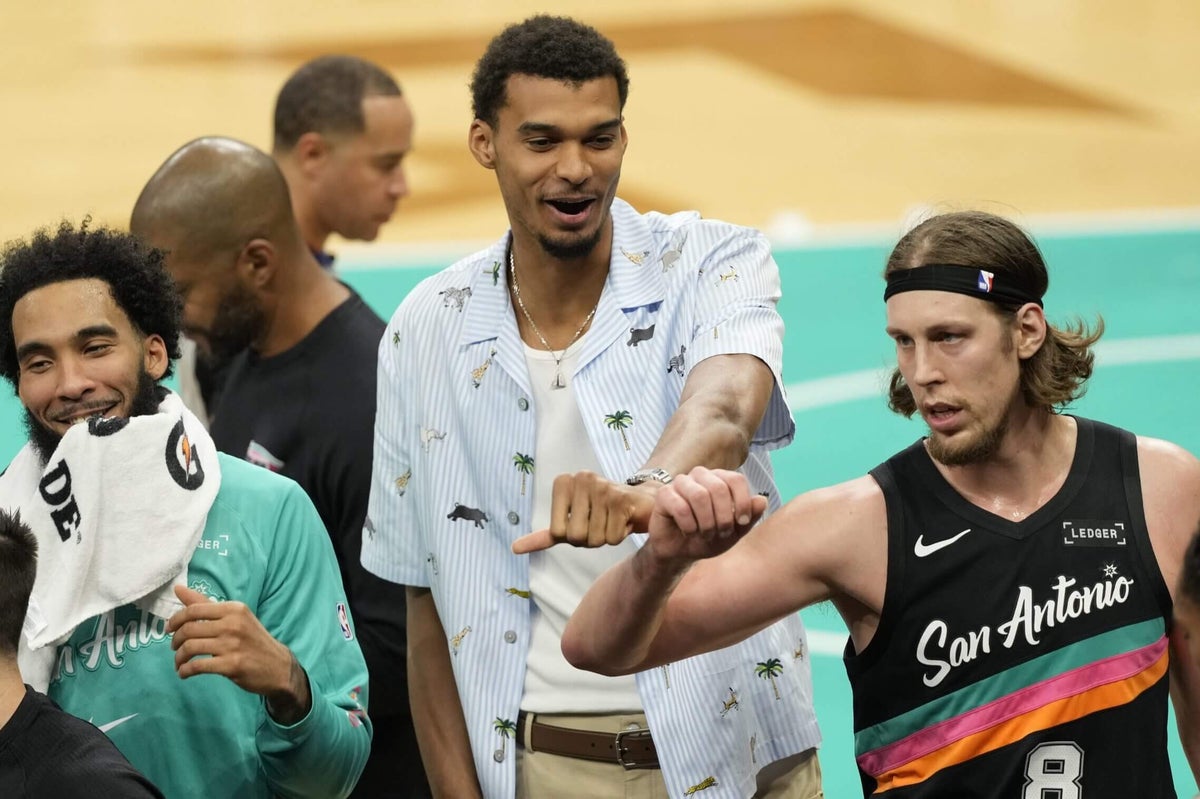
Do all of the NBA’s stakeholders — its team governors, its players (and their union), its teams and their armies of analysts, its broadcast partners, its major advertisers, and the league itself — really care about the on-court product?
Like, really care?
Do they care enough to take a real, extended look at the game to try to find out why there have been so many injuries to star players at the start of this season? And if there’s an obvious answer, or answers, what would they be prepared to do about it?
From Victor Wembanyama to Joel Embiid to Anthony Edwards, Trae Young to Jalen Williams to Zion Williamson, Ja Morant to Anthony Davis to Giannis Antetokounmpo — on top of the season-long losses (or close to it) of Jayson Tatum, Tyrese Haliburton, Damian Lillard, Kyrie Irving and Fred VanVleet — many of the league’s marquee players have broken down in the first month of the season. Those are the guys that fill arenas, home and away. And those are the guys that ESPN, NBC and Amazon Prime want and need to anchor their game broadcasts, as those networks begins their 11-year, $77 billion media rights deal with the NBA.
“There has to be investment in understanding the human anatomy,” Hall of Famer Swin Cash said last week on NBA on Prime’s “NBA Nightcap” show. “And we’re talking about pace. We’re talking, also, how players are going to do their part. But we have to also provide them the information to be prepared. The league is getting younger. … Practices are different in college than they are here.”
There’s no one injury that’s taken the stars all out, but they’re not playing nearly as much to open this season, as longtime NBA writer Tom Haberstroh delineated last week in a piece for Yahoo! Sports. The league’s “star” players, as the league now defines that term, have played significantly fewer games and minutes through the first month of this season than they did two years ago.
Yes, athletes get hurt playing sports, no matter the level, or how many safeguards are put in place to protect them. And some of these stars have a history of injury. But at the NBA, where billions of dollars are at stake, a deep dive is needed, and there shouldn’t be guessing at root causes. All of the partners need more data and must discuss the potential financial sacrifices involved to find out why this is happening.
But when that data is collected, all the tectonic forces that dominate the sport have to be willing to give a little.
That means the league has to really look at its 82-game schedule. Would lessening it by 10 or 12 games help, especially if the league can eliminate all sets of back-to-back games, giving teams more time to actually practice and recover during the regular season, rather than just hopping from game to game every 48 hours? But it also means the players’ union has to be willing to look at whether going back to a longer training camp, and potentially more preseason games, might better prepare its members’ bodies for the start of a season — even if some notable injuries inevitably happen in those games.
It means the league’s new broadcast partners have to be willing to pull back from squeezing the NBA’s biggest superstars into every national television window. If they all didn’t clamor to have Stephen Curry or LeBron James on every week, and sometimes twice a week, Steph and LeBron could occasionally chill on a Wednesday or Friday or Saturday.
And it means the pre-NBA, grassroots basketball community has to realize that its unending schedule of games during the spring and summer months, while certainly helping elite players get ready to play at higher levels, may still be contributing to overuse injuries for all the young players who go through the system. Just about every basketball player of consequence in the United States between 10 and 18 participates in that system, despite reforms and recommendations made in the last few years.
The current focus is on play style. The pro game has never been played at a faster pace. Per Lev Akabas of Sportico, the Heat, at 106 possessions per 48 minutes, are playing at the fastest pace of any NBA team since the 1991-92 season. Twenty-five of the league’s 30 teams average more than 100 possessions per 48 minutes; a decade ago, that number was … zero.
“We have all the data,” Kerr said last week. “Players are running faster and further than ever before, so we’re trying to do the best we can to protect them, but basically have a game every other night and it’s not an easy thing to do … (The medical staff) believe that the wear and tear, the speed, the pace, the mileage, it’s all factoring into these injuries.”
But, other teams, and their army of medical staffs, don’t share that view.
“I personally don’t believe it’s because we are running too much, I believe it’s because these guys don’t run enough,” one general manager told The Athletic. “We haven’t had any soft tissue injuries and our loads aren’t exceeding past numbers like other teams might be experiencing.”
Another executive pointed out that most NBA players’ offseason on-court workouts focus almost solely on shooting and/or ballhandling, rather than the increased stop and start defensive actions required in today’s game. Who practices slides and hard closeouts all summer?
And, despite the Achilles injuries that Tatum, Haliburton and Lillard suffered during last season’s playoffs, none of the stars injured so far this season have had Achilles injuries. Jeff Stotts, who runs the website instreetclothes.com, which tracks player injuries, noted last week that calf injuries — which have often (but not always) led to Achilles tears — aren’t any more prevalent so far this season than they have been the past five seasons.
The league has continued its work in trying to reduce the number of back-to-back games that every team plays. A decade ago, most teams played 20 or more sets of back-to-back games. This season, according to a league source, the average of back-to-back sets per team is at 14.3, slightly down from last season’s 14.9 per team. (Before the COVID-19 outbreak, the number was as low as 12.5 sets per team, but the introduction of the NBA Cup in 2023 has taken away nine to 10 days of the schedule; the league doesn’t schedule other games during the Cup’s semifinals and finals, leaving fewer potential days for other teams to play.)
The league has even found creative ways to reduce travel during long road trips. For example, the Spurs’ yearly “Rodeo Trip,” taken over multiple weeks in February while San Antonio’s Frost Bank Center hosts the annual San Antonio Stock Show and Rodeo, will be long again this season, at nine games. But this year, the trip will include consecutive “home games” for the Spurs in nearby Austin, about an hour away from San Antonio, as part of the Spurs’ “I-35” Series.
And yet, the stars are still falling.
Committees, in the main, are the wisdom teeth of problem solving: almost always useless, often creating more obstacles rather than removing them. But some kind of group that includes representatives from the league’s biggest stakeholders has to be put together and empowered to start making sense of what’s going on, both in the short and long term, to the bodies of NBA players.
The league has so many off-the-court issues. But it could always mitigate the damaging impact from its worst problems by bringing everyone’s attention back to the floor, where the greatest, best-conditioned athletes in the world juggled your synapses with some sort of otherworldly control and skill, that put the ball in the basket, or prevented the same. Those superstars are far less influential in street clothes, no matter how fly the style, or how bright the bling.