
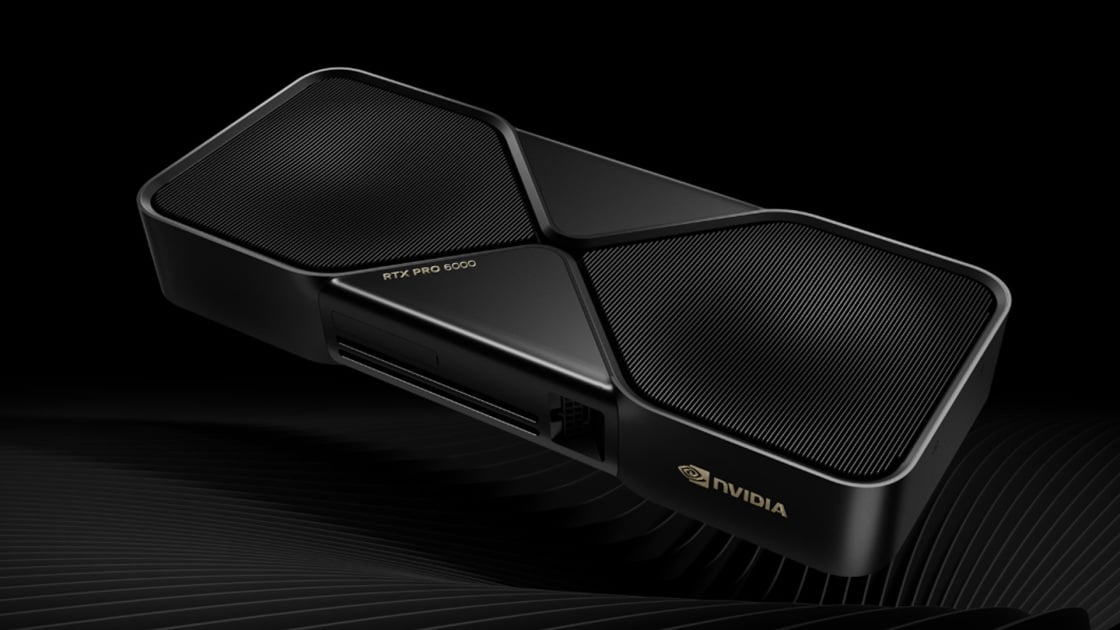
An Nvidia RTX 6000D workstation graphics card has popped up on Geekbench with fewer CUDA cores and less memory than the flagship RTX Pro 6000. This follows the GB20 and RTX 5090D launches, which featured less powerful hardware for China, according to VideoCardz.
Nvidia’s relationship with China has been fractious for some time. Ongoing trade wars and tariff uncertainty have lead China to refocus its efforts on subsidizing local industry and cutting back on buying Nvidia hardware. Nvidia, meanwhile, has had to comply with US demands to only sell weaker hardware to China, but does China want second best anymore? With a smuggling industry and a growing domestic chip pipeline, there are some questions about whether Chinese companies would have much interest in a stripped-down RTX 6000D.
The card comes with 84GB of GDDR7 and a 448-bit memory interface, which is 12GB and 64-bits narrower than the RTX Pro 6000. It also sports 156 compute units (Streaming Multiprocessors in Nvidia talk). With 128 CUDA cores in each of those, that works out to 19,968 CUDA cores for this card. That’s 4,096 fewer CUDA cores, or a 17% cut to CUDA core totals.

Not all Chinese-first GPUs are workstations. Some fun gaming designs also made their way to market. (Credit: Gainward)
That means the RTX 6000D is a cut-down GB202 GPU used in the standard RTX Pro 6000 cards, which makes sense considering what Nvidia is looking to build. It can use defective GPUs to craft this very specific GPU for its targeted market.
But it all depends on whether Chinese buyers are able to buy it, and even then, whether they’d want to. The US and China are coming at the problem from different angles, but both are making it harder for domestic Chinese firms to purchase the latest Nvidia hardware. When higher-spec options can be smuggled, companies that want to thwart Chinese governmental orders not to use American hardware may just go the black-market route to more effective GPUs.
Recommended by Our Editors
Still, this card easily outpaces the RTX Pro 5000, which offers only 14,080 CUDA cores and 48GB of GDDR7 memory. It’ll also outperform the modified RTX 4090s and RTX 5090s currently available in China, which feature enhanced memory configurations—although those cards remain very capable for AI workloads.

Get Our Best Stories!
Your Daily Dose of Our Top Tech News

Sign up for our What’s New Now newsletter to receive the latest news, best new products, and expert advice from the editors of PCMag.
Sign up for our What’s New Now newsletter to receive the latest news, best new products, and expert advice from the editors of PCMag.
By clicking Sign Me Up, you confirm you are 16+ and agree to our Terms of Use and Privacy
Policy.
Thanks for signing up!
Your subscription has been confirmed. Keep an eye on your inbox!
About Our Expert

Jon Martindale
Contributor
Experience
Jon Martindale is a tech journalist from the UK, with 20 years of experience covering all manner of PC components and associated gadgets. He’s written for a range of publications, including ExtremeTech, Digital Trends, Forbes, U.S. News & World Report, and Lifewire, among others. When not writing, he’s a big board gamer and reader, with a particular habit of speed-reading through long manga sagas.
Jon covers the latest PC components, as well as how-to guides on everything from how to take a screenshot to how to set up your cryptocurrency wallet. He particularly enjoys the battles between the top tech giants in CPUs and GPUs, and tries his best not to take sides.
Jon’s gaming PC is built around the iconic 7950X3D CPU, with a 7900XTX backing it up. That’s all the power he needs to play lightweight indie and casual games, as well as more demanding sim titles like Kerbal Space Program. He uses a pair of Jabra Active 8 earbuds and a SteelSeries Arctis Pro wireless headset, and types all day on a Logitech G915 mechanical keyboard.