
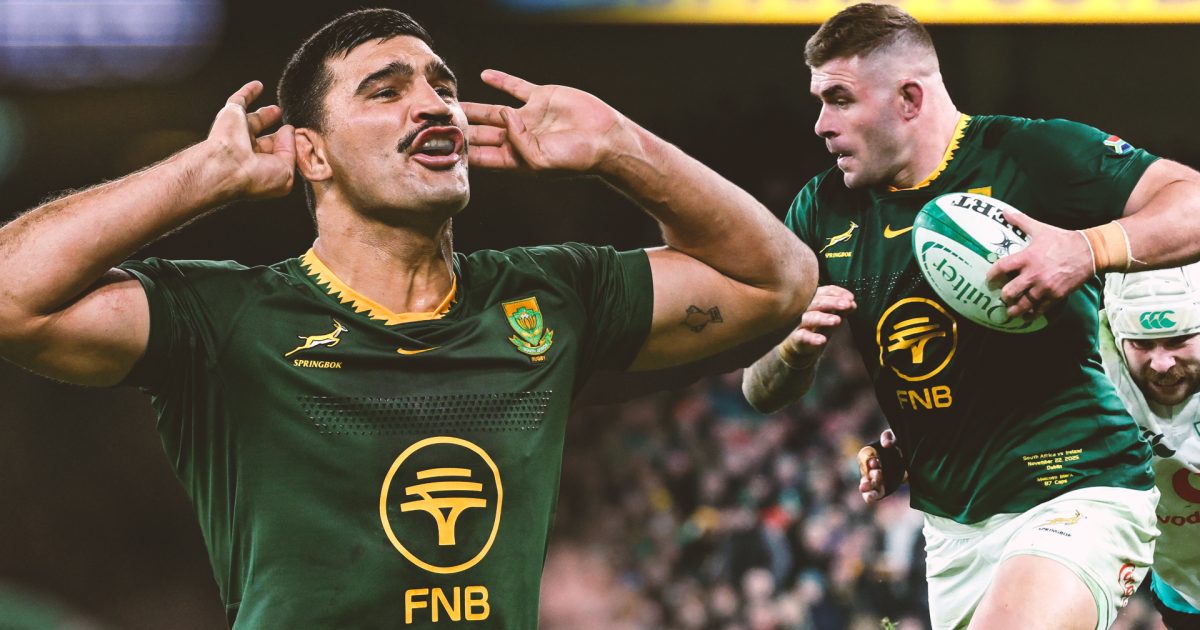
The Springboks’ impressive two-year stretch continued in 2025 with their second straight Rugby Championship title and a world class 12-2 win-loss record.
After an 11-2 season in 2024, the Springboks are finally dominating like true world champions, something completely absent following their cakewalk schedule into the 2019 Rugby World Cup final.
They won no Rugby Championships over the four-year period from 2020-2023 and had a 66 per cent win rate leading into the 2023 Rugby World Cup.

Rassie Erasmus on losing some big names ahead of Wales Test
Rassie Erasmus on losing some big names ahead of Wales Test
What they have done in 2024 and 2025 is worth much more than both Rugby World Cup campaigns in real terms. Winning consistently at home and away, and against everyone, is the standard set by the All Blacks through the 2010s. If the Springboks want to be measured against that, they have to continue to operate at the level they have admirably now done for two years.
We are seeing Bok-flation running at record highs now. Six players were selected in the World Rugby Men’s 15s Dream Team of the Year. Three of the four nominations for the Player of the Year were South African.
A round table of rugby writers from The Telegraph floated on their podcast that ‘South Africa is No.1 and no one is second’. Journalist Paul Cully wrote that the Boks are ‘set to take over from McCaw’s All Blacks as the greatest team ever’ after ‘obliterating opponents’ this year. The narrative is growing rapidly that this team is untouchable, and it’s not from the South African cheerleading press.
Are we destined for a third consecutive Rugby World Cup for the Springboks? Should we hand the trophy out now? Or is this mid-cycle peaking, a story we’ve seen plenty of times before.
This two-year stretch of 23 wins and four losses by South Africa is even bettered by England in 2016-17 under Eddie Jones.
Would you believe that England went 23-1 over that two-year period? It’s true. They even extended that to 25-1 in the early stages of 2018 before Scotland burst their bubble at Murrayfield.
Flying high into 2018, England hit severe turbulence, losing three in a row to finish the Six Nations, followed by a humiliating loss to the Barbarians, and a 1-2 series loss to the Springboks in South Africa. Coincidentally, the first year of Rassie Erasmus’ reign was spent trying to rebuild a broken team that had been smashed 57-0 the year before by the All Blacks.
For England, the wheels suddenly came off for a team looking untouchable, one year out from the Rugby World Cup. They were able to regroup, rejuvenate and finish as runners-up at the Rugby World Cup 2019. But they didn’t win, and 2018 was a painful year in between.
Across 2021 & 2022, Ireland went 17-4 in 21 Tests. At the start of 2023, they completed a Grand Slam Six Nations campaign, taking their three-year record to 22-4.
Three more wins in the Rugby World Cup warm-up games took them to 25-4. An undefeated pool stage campaign, including a 13-8 win over South Africa, took their three-year record to 29-4. Winning at 88 per cent, above this current Springbok side’s 85 per cent.
England and Ireland were two international teams, dominating in periods through that cycle, heading into the 2019 and 2023 Rugby World Cups.
And neither got the job done, only to see lowly South Africa lope their way in on the back of a weak schedule in 2019 and a chancer run in 2023, skating by on one-point wins and handouts in the form of an early red card in the final.
To win all the way through the cycle, bookended by Rugby World Cup wins, has only been done by the 2011-15 All Blacks, who went 42-3 between World Cup victories.
This Springbok team is only halfway there. They are not taking over anyone yet. They may, in fact, be peaking early in their pursuit of doing so.
This is the part of the cycle where the hype is so high that keeping grounded is nearly impossible. Adulation flows in from all corners, lofty predictions and praise shower down for having seemingly conquered everything. Blinded by how they won the first two, the third looks in the bag.
A lot can happen in two years. Siya Kolisi is 34, Eben Etzebeth is 34, Franco Mostert is 35, Pieter-Steph du Toit is 33. Jean Klyn and Lood de Jager are both 32. The mileage is high on those locks. Kwagga Smith is 32, and Malcolm Marx is 31.
Cobus Rienach, who has had an incredible year since taking the starting halfback role off Grant Williams following the Eden Park loss, is 35 years old right now. Can he play like this at 37 at the next World Cup?
There are a bunch of young, exciting backs emerging with the Springboks, playing behind a battle-hardened veteran pack. Right now, it might be the perfect mix, and the results are showing that.
But what happens when that aging pack finally hits the wall and front foot ball doesn’t come any more for young Sacha Fienberg-Mngomezulu? When the ball is so slow that the rush defence is in his face before he has the ball? When he has to rely on Grant Williams again for service?
Are they going to continue to play this fresh, great brand of attacking rugby at the Rugby World Cup with a pack pushing 35 and over? Or will they have a new pack of players that don’t have the cumulative experience of these veterans?
No.8 Duane Vermeulen parachuted in at 37 years old through the run last time, but no other starting forward was over 32. This time will be very, very different.
The All Blacks were in this situation in 2017, two years away from a third consecutive Rugby World Cup. After the 2015 win, they were even better. They built one the most prolific All Black sides in history in 2016 with World Player of the Year Beauden Barrett. Again in 2017, they were coasting, racking up a 57-0 scoreline over South Africa and Barrett claimed back-to-back gongs.
A third Rugby World Cup looked very much on the cards at the halfway point. The All Blacks were in a more commanding position than the Springboks are now. By late 2018 problems emerged and by 2019 they just weren’t the same side.
Be careful, Bok-flation is running high, and this green and gold bubble is peaking; you just don’t know it yet.