
DAZN had been unable to find distribution channels for its Belgian coverage.
“No company should be forced to operate at a loss,” DAZN Belgium managing director Massimo D’Amario said in a statement. “That’s simply not a sustainable business.”
The streaming company had previously tried to renegotiate the French contract, which was worth €400 million a year for six years, after disappointing subscription numbers and issues with piracy.
A Foxtel Group spokesperson did not address specific questions from this masthead on whether the company would try to renegotiate the AFL deal, and referred questions about DAZN to the UK company.
“The AFL has been a valued broadcast partner of Foxtel Group for more than 25 years. The 2025 season marked the beginning of a new era in our partnership and delivered our highest-ever season viewership,” the spokesperson said.
“There have been no discussions on changes to our contract with the AFL, and we look forward to delivering live, 4K coverage of every game, of every round for many years to come.”
The 2025 season was the first in the new AFL media deal.
The NRL’s $1.7 billion agreement with Foxtel and Nine, owner of this masthead, expires in 2027.
DAZN is majority owned by Ukrainian-born, American-educated billionaire Sir Leonard (Len) Blavatnik.
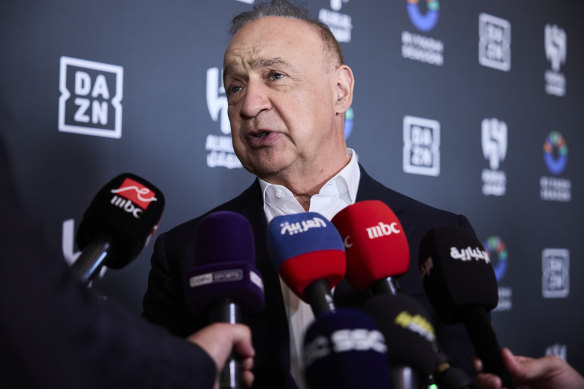
DAZN is backed by British-Ukrainian billionaire Sir Leonard Blavatnik.Credit: Getty Images
Last month Blavatnik injected $891 million into DAZN, after the company posted a substantial financial loss. His company, Access Industries, has invested more than $11 billion into DAZN in the past decade.
Under the new AFL deal, Foxtel and Kayo have exclusive rights to Saturday football in Victoria and use their own commentators for all matches rather than taking the Seven call for games that are on both networks. However, there was a backlash among fans who objected to Saturdays going behind a paywall.
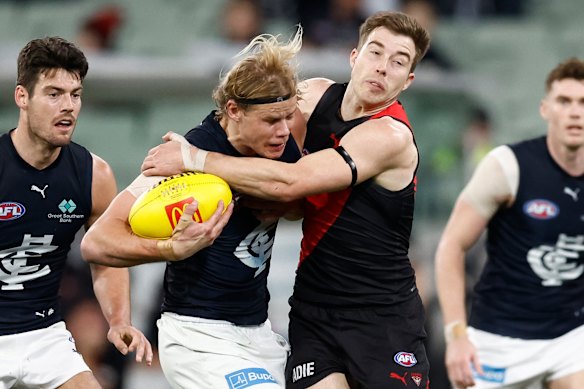
Carlton and Essendon were banished from free-to-air TV in round 24.Credit: AFL Photos via Getty Images
There was also frustration about fixturing, particularly after the AFL handed Carlton and Essendon prime-time matches on Thursday and Friday nights despite both teams falling from finals contention.
Seven’s football ratings dwindled towards the end of the home-and-away season – the free-to-air broadcaster elected not to show the round 24 Carlton-Essendon Thursday night dead rubber – but received a significant boost at the start of the finals.
Loading
The AFL last month announced the introduction of a wildcard weekend, which would see two more games added to the fixture; seventh on the ladder would play 10th, and eighth would play ninth.
During the announcement, AFL chief executive Andrew Dillon said the decision to add the wildcard weekend was for the fans.
“Our fans love finals games, so we think it provides opportunities and hope for our fans,” Dillon said.
“Our fans love finals and they love games of consequence.
“We know those games are the best-attended and most-watched on television.”
Loading
Adding two more high-profile games will help Seven, which can sell advertising around them, but the extra content does not necessarily translate into more subscriptions for Foxtel.
Two sources who were part of negotiations for the AFL deal, who spoke on the condition of anonymity because of the confidential nature of the discussions, said Foxtel executives had been under pressure to ink the agreement before taking Foxtel to market for sale, which had meant the league had additional leverage.
News, results and expert analysis from the weekend of sport are sent every Monday. Sign up for our Sport newsletter.