
![NASA Europa Clipper Captures Distant Image of Uranus During Cruise to Jupiter [PHOTO]](https://www.newsbeep.com/au/wp-content/uploads/2025/11/CubeSat_splash-1900x1024.jpg)
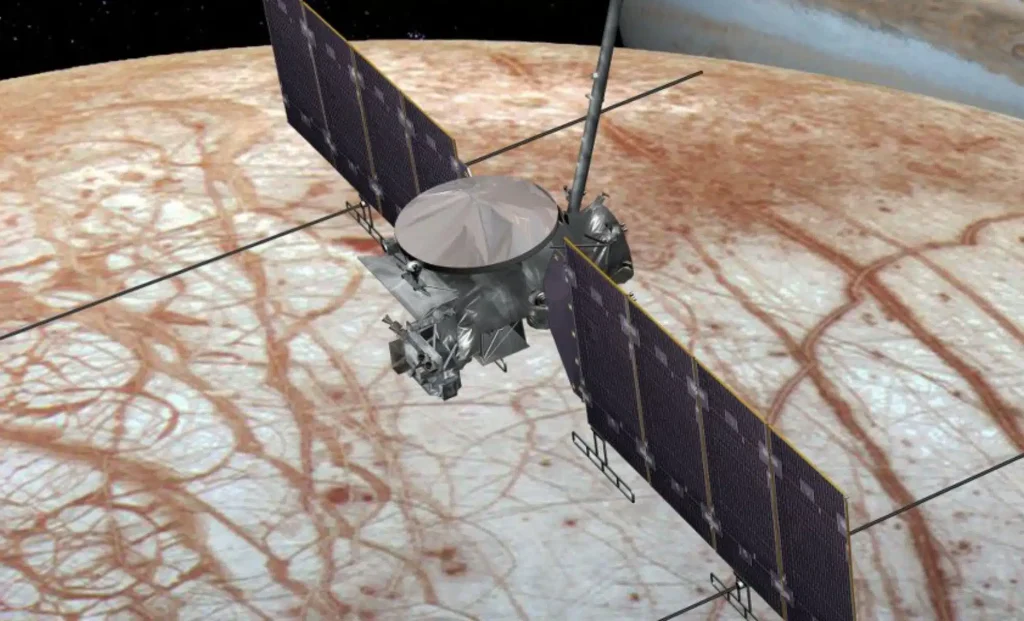
Earlier this month, the NASA Europa Clipper captured a breathtaking image of Uranus as it travelled through space. This image was taken to test the star-tracking cameras that the mission will use to investigate one of Jupiter’s most intriguing moons.
 Credit: NASAAn Image Of Uranus Taken As NASA Europa Clipper Journeys To Its Destination In Space
Last year, the NASA Europa Clipper mission launched into space aboard the SpaceX Falcon Heavy rocket. The destination of this mission is Europa, Jupiter’s most intriguing moon, and it is estimated to arrive here by 2030.
Once it arrives at its destination, the NASA Europa Clipper will perform over 50 flybys of the moon’s surface. However, while we await this arrival, the space vehicle has already made the headlines after imaging Uranus while being about 2 billion miles away from the planet.
This image was captured using the star-tracking cameras on the space vehicle that are only able to capture 0.1% of the full sky. With this viewing limitation, many might not expect the NASA Europa Clipper to be able to capture Uranus while being billions of miles away from it.
The star-tracking cameras will also be responsible for taking images of Jupiter’s moon Europa. They will also help guide the space vehicle as it navigates towards Jupiter.
The Search For Life On One Of Jupiter’s Moons
The NASA mission heading for Jupiter’s moon Europa has a series of scientific objectives that it will complete. These include measuring the thickness of Europa’s icy shell, analysing its surface interaction with the ocean, and lastly investigating the geological composition of the ocean.
All these objectives are geared towards discovering whether the subsurface ocean on Europa can support life. This mission will expand our understanding of Jupiter’s moon Europa.