
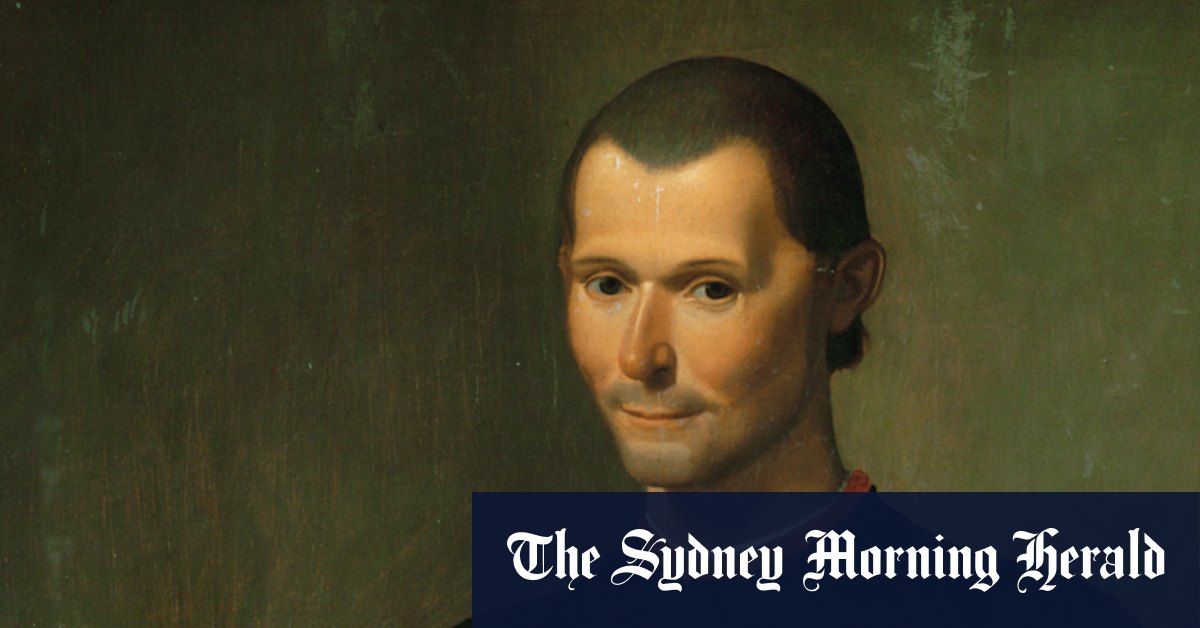
Palmer is particularly keen to remove the gilding that academic and popular culture has applied to the Renaissance, to subvert the myth of a heroic and transformative golden age and springboard for modernity. She calls out “a well-kept secret about so-called golden ages: a time that left us golden treasures was not necessarily a golden time to be alive. A deep dive into Machiavelli’s life, and the lives of his friends, acquaintances, bosses, and enemies, will show us how the same circumstances nurtured both matchless art and deep despair, in an era well characterised by the old saying desperate times call for desperate measures.”
Her real subject is the “invention” and mythologisation of the Renaissance – the creation of a “golden age”. But I’m not sure that Palmer hasn’t created a straw knight for an easy joust. Her invocation of Machiavelli, whose pragmatism and realism evolved in response to the chaos of the age, rather gives the game away.

Historian and author Ada Palmer.
Not even the Swiss historian Jacob Burckhardt, who more or less invented the heroic Renaissance, was prepared to deny the curate’s egg-like reality of the 15th century: “Intrigues, armaments, leagues, corruption and treason make up the outward history of Italy at this period.”
The idea of a gilded age that was simultaneously dark and brutal is not new. We see the kind of balanced perspective that Palmer is claiming as a needed correction to golden age myth-making in Mary Shelley’s Valperga, set in the Italian renaissance and written 200 years ago. “Lombardy and Tuscany, the most civilised districts of Italy, exhibited astonishing specimens of human genius; but at the same time they were torn to pieces by domestic faction, and almost destroyed by the fury of civil wars.
Loading
Inventing the Renaissance is, as per its author’s puff, fun – in a freewheeling self-referential kind of way. The authorial voice, a marriage of scholar and influencer, is clearly an attempt to reach a young undergraduate audience. But it’s a performance with a high degree of difficulty that in clamouring for cool seems at times to be trying too hard.
In one particular strand, where Palmer writes candidly of her research into the reading of Latin poet Lucretius during the Renaissance, the self-centric tone works nicely. Lucretius is the author of the didactic 1st century BC Epicurean poem On the Nature of the Universe, and star of Stephen Greenblatt’s The Swerve. An international bestseller and Pulitzer winner, The Swerve’s central claim is that the rediscovery of Lucretius in early 15th-century Florence forged the Renaissance and made modernity.
In the archives, Palmer finds that early Renaissance readers of Lucretius weren’t particularly attuned to his radical atheistic and materialistic message, and “the directions thinkers moved after rejecting orthodoxy were all over the place, not a homogenous step towards a secularising future. Instead, they dabbled in all kinds of radicalisms”. These took various forms: Platonism, Hermeticism, mysticism.
Busting the myth of the Lucretian Revolution and replacing it with a more nuanced reading of Renaissance intellectual culture is a genuine public service. And that’s pretty cool.