
Normal text sizeLarger text sizeVery large text size
Russell Crowe isn’t an actor inclined to sit and wait to be told what to do. When writer-director James Vanderbilt was able to say that his film Nuremberg was finally going ahead, Crowe said he had some ideas about what to do with the film’s culminating scene, when Hermann Goering is tried in an international court for war crimes.
“He would say, ‘I’ve been reading the transcripts. Do you want to come over and talk through it?’” Vanderbilt recalls when we meet in San Sebastian, Spain, where the film has its European launch. “And I’d say, ‘Yeah, let’s just do it.’”
Crowe would be playing Goering. Michael Shannon was cast as Robert H. Jackson, the lead prosecutor who went on to become a US Supreme Court judge. All the dialogue was taken from the trial transcripts, but Goering was cross-examined for hours; in the film, the courtroom scene runs for 17 minutes.
“So, you know, Russell and Michael and I sat round a table at Russell’s house, going through all of it,” says Vanderbilt, whose intricate script for Zodiac, a police procedural directed by David Fincher in 2007, established him as one of Hollywood’s great writers. “I’d written it, but we were going through saying, ‘Is there something we’re missing? Is there a piece here we can use?’ That was incredibly important.”
The first of the Nuremberg trials, where 24 senior Nazis were indicted for war crimes, was indelibly dramatised in Stanley Kramer’s Judgment at Nuremberg (1961). Kramer also used court transcripts as a source, but put them in the mouths of fictionalised characters. Vanderbilt – who reveres Kramer’s film, even watching it for inspiration immediately before he started shooting his own – cranks up the realism by using real names, documented events and an aspect of the story that had barely made it to the history books: the US Army’s preliminary psychiatric evaluations of their Nazi prisoners.
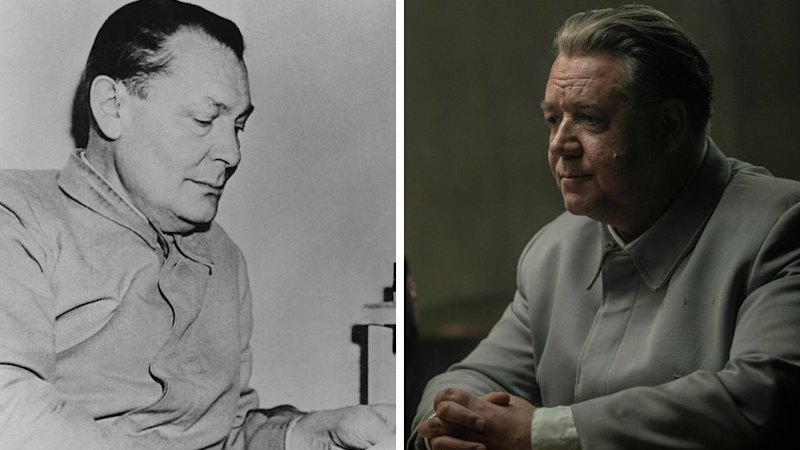
His source was The Nazi and the Psychiatrist by Jack El-Hai, published in 2013. The eponymous psychiatrist was Douglas Kelley (Rami Malek), whose official task was to ensure that the accused were mentally capable of standing trial. His real job, as far as the Allied high command was concerned, was to get information that would ensure conviction, but he also had his own agenda. For him, this was a heaven-sent opportunity to write a smash-hit book about the madness of mass murderers. Hermann Goering, second in command to Hitler and the Allies’ star prisoner, was his golden ticket.
Malek plays Kelley with a frayed edge of weirdness; Goering, as portrayed by Crowe, is a self-satisfied narcissist who tells Kelley that nobody has ever outwitted him. Although the film culminates in the trial, the focus over the first 90 minutes is on their meetings in Goering’s cell. Vanderbilt, who snapped up the book for adaptation when it was still no more than a six-page proposal, was captivated by the idea of their psychological duel.
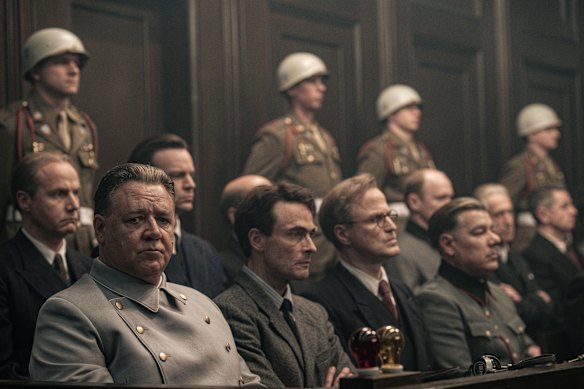
Russell Crowe as Hermann Goering in Nuremberg.
“It was the quickest I’d said yes to anything in my life,” he says. “These two men are very, very different, but each of them is trying to get something out of the other one. As a storyteller, something in me was saying, ‘I want to see this movie.’”
Crowe committed to it, Vanderbilt estimates, seven years ago, after a single reading of the script. “Usually it’s not this easy to get a movie star in your movie! But he was incredibly important, he stuck with it,” the director says. “A movie like this, they’re hard to make. It’s not a giant studio movie. The money comes in and the money falls out and every point in time where he could have gone, ‘Right, see you later, guys, and good luck’, he was always like, ‘No, man, tell me when we’re going and I’ll go.’”
Other major actors came on board because Crowe was already there. “There is a domino effect,” Vanderbilt says. “And then when it came to actually playing the part, that is not an easy headspace to live in, being that guy. He never shied away from it, he embraced it, he learned the German, he did all the things you would expect an actor of his calibre to do.”
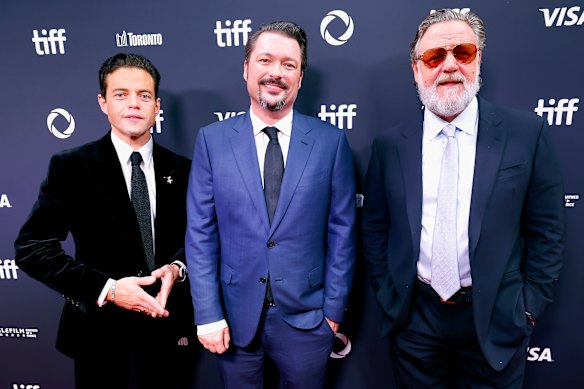
Writer-director James Vanderbilt (centre) with his stars Rami Malek (left) and Crowe.Credit: Getty Images
Kelley clearly comes to like Goering, even agreeing to deliver letters in secret to the Nazi’s wife and daughter. That seems scarcely believable, but these are clearly strange times among the rubble of war; old certainties seem to have been cut from their moorings. There was no precedent for an international trial of a country’s leaders: legally, Jackson was flying blind. There was also considerable opposition to this show of due process from those who thought these villains should just be shot by firing squad and be done with it. Goering himself would have preferred that: a respectable military death.
For the proponents of courtroom justice, however, the trial was both a demonstration of democratic values and an opportunity to explain to the world exactly what the Nazis had done. As well as testimonies, there was an hour’s footage from the camps – a cavalcade of skeletal prisoners and corpses being swept into piles – shown in court. About six minutes of that original footage is included here, a hideous reminder of what humans can do; Vanderbilt wrote this film for similar reasons.
“I think justice is very important. That’s one of the things that drew me to this originally,” he says. Although he won’t be drawn on modern parallels, the Spanish audience responded with whoops to Kelley’s warnings that any future government, even in the United States, might well go the same way unless the people remained vigilant. To that end, Vanderbilt was equally keen to show what happened to the audiences of today.
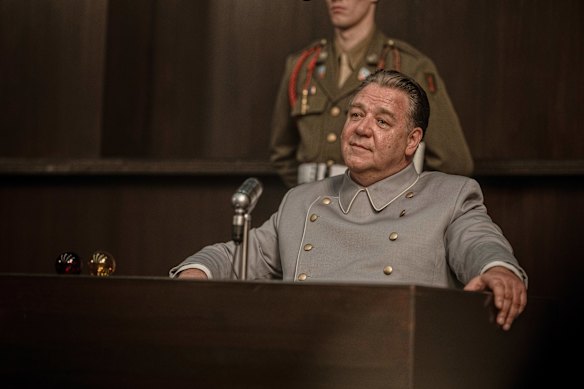
Crowe as the charismatic Goering. Credit: AP
“Both of my grandfathers were in World War II; this was always a period of time that my generation could touch,” he says. “We knew people who had lost family members in the camps, it was real to us. But I talk to my children about it and it’s like talking to them about the American Revolution. Bringing that past back to life again was something very important to me.”
Loading
The end result – a handsome, stately and distinctly old-fashioned film – has received mixed critical responses, but Crowe’s performance as the gargantuan Goering has been lavishly praised.
“People described Goering as the best dinner party guest you could ever have,” Vanderbilt says. “He was famously charismatic, so I wanted someone who could seduce us the way that Goering seduces Kelley. And there are a lot of wonderful character actors out there, but I wanted somebody who had that movie star quality, who could pull you in, in that incredible way that only Russell can.”
Many directors, Vanderbilt says, are afraid of actors. “Because the actor has more power, especially a movie star. But actors, they want to perform. They want to please you. And also, the reason they’re called plays is because it’s play. At the end of the day we’re just making this thing together and wouldn’t it be fun if I just tried this? That’s where the great stuff comes from.”
Loading
For that to work, you need actors with ideas. “You hire Russell Crowe for his instincts, his experiences, his brains. Same with Rami and Michael: these are people who have done so much. You put a scene on its feet with two actors and they say, ‘What if we did this?’ That’s what I love about the whole process.”
Nuremberg opens on December 4, with preview screenings this weekend.
Must-see movies, interviews and all the latest from the world of film delivered to your inbox. Sign up for our Screening Room newsletter.