
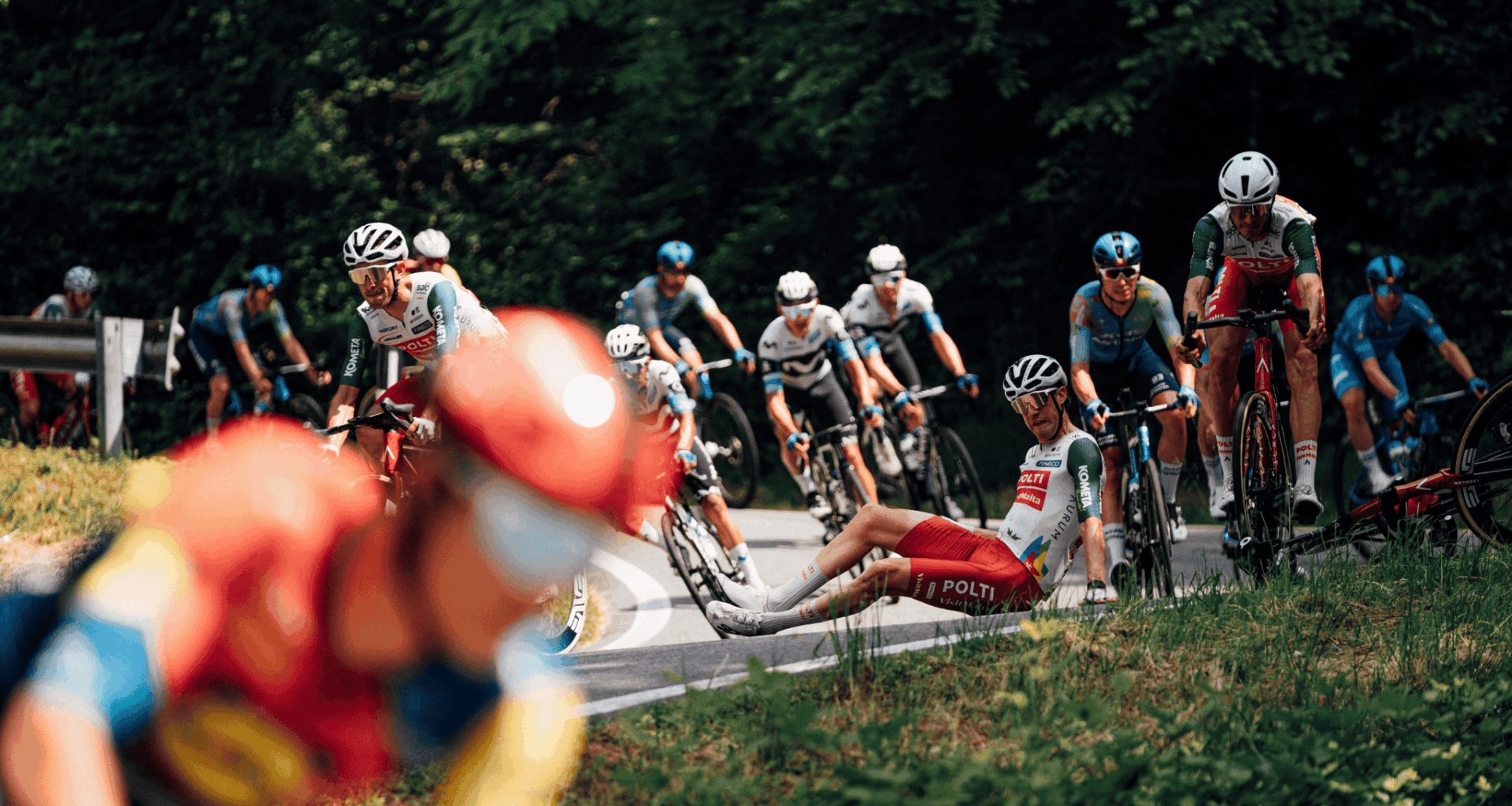
Safety is a topic that’s never far from the minds of all cyclists. More so than any other sport, cyclists interact with the real world when we carry out our activity. We encounter wet roads, potholes, roundabouts and traffic islands to name a few factors in the spaces we do our sport. And that’s all before you add in 100 odd riders jostling around you in a race. Crashes are inevitable and they are becoming more common, an issue which the former Hour world record holder, Dan Bigham is frank about.
“I have a two-year-old, and I would actively discourage them from getting into competitive cycling. I don’t feel it’s a safe sport to get them into, and probably a lot of parents feel the same,” said the Head of Engineering at Red Bull-Bora-Hansgrohe, on stage at Rouleur Live.
“We’ve had deaths in the sport, and inexcusable deaths, like Muriel Furrer at the World Champs just a couple of years ago. Not having a medical response for well over an hour is just simply unacceptable, and that shouldn’t be par for the course.
“But will it take a superstar of our sport to have a life changing or life ending injury before we take it seriously? I genuinely hope not, but unfortunately, that might be the case before we actually act in a way that is meaningful and will create the change needed for the sport,” said Bigham.
‘Trust in science’ — the need for an expanded database
Bigham, forever a numbers person, called for a more detailed database of all the facts behind a crash because without one it isn’t always clear what’s causing the accident.
“I think the big piece that we’re missing at the moment is the understanding of what is the root cause of an increase in crashes. We can accept that increase has happened, the data supports it, people are crashing more, but why? And before we say ‘we need to do this’ or ‘we need to do that’, the first thing is understanding what’s causing crashes.
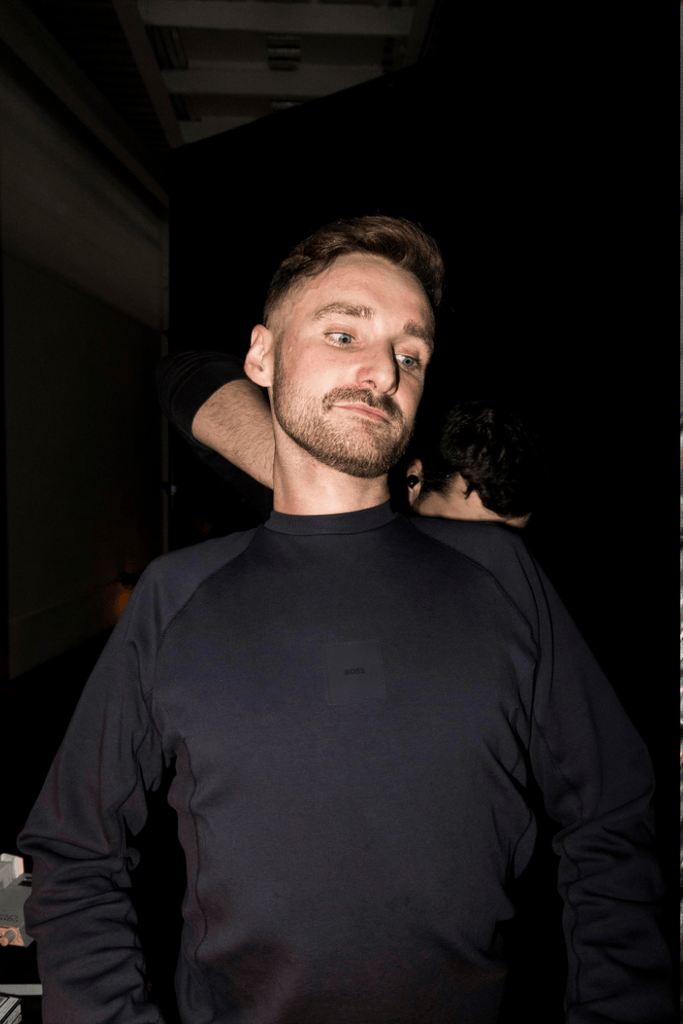
Bigham at Rouleur Live 2025 (Image: Sean Hardy)
“When you know why something happens, you can then discuss and propose solutions and have a genuine, proper discussion on how we can improve it,” said Bigham.
The cause could be tracked fairly easily with the tools we already have available — TV cameras, GPS tracking, maps, and the devices on the riders’ head units.
Read more: ‘Only 10% of pros know how to race properly’ – Adam Blythe on the evolution of cycling tactics
“We see a crash in a picture or maybe a video, but we don’t know what happened before it. Was there a concertina effect? Was there some road furniture? How fast were the riders going? Who else was around them? Was there something on the road? None of that context is in the database,” said Bigham.
Bigham also proposed that the database would include information on the rider’s recovery, injury and the type of course the accident occurred on.
“None of that’s tracked. We have no idea. First and foremost is to get that to a good level, because the data will tell us: trust in science. It will say ‘this is causing accidents, sort this out’,” explained Bigham. The need for an accurate record of why the crashes happened is clear because the causes can get muddled.
‘A 5% faster peloton since Covid’ — Is speed causing crashes?
Everything about the cycling world moves quickly and that’s not just the velocities the riders reach on the roads, but the speed of evolution in technological advancements that enable them to ride so quickly. We know about how tech has continued to speed up the peloton, as every bike, helmet, sunglass lens, arm sleeve is more aerodynamic than ever before.
“Especially post-Covid, there was a lot of time for people to take a step back, look at what we were doing, reassess, come up with new ideas, and the sport has just accelerated in the last three years. I think it’s something like 5% faster on average over the entire WorldTour. It’s pretty amazing the speed increase we’ve seen now, whether that matters for safety, is a whole other discussion.”
It seems a reasonable assumption that the faster people travel, the more likely accidents will occur. However, Bigham isn’t convinced: “It’s probably one where I think it’s not well understood. So I think we can generally accept that being faster doesn’t mean you’re safer in most scenarios. However, it doesn’t necessarily mean that speed is the cause of a decrease in safety or more crashes.”
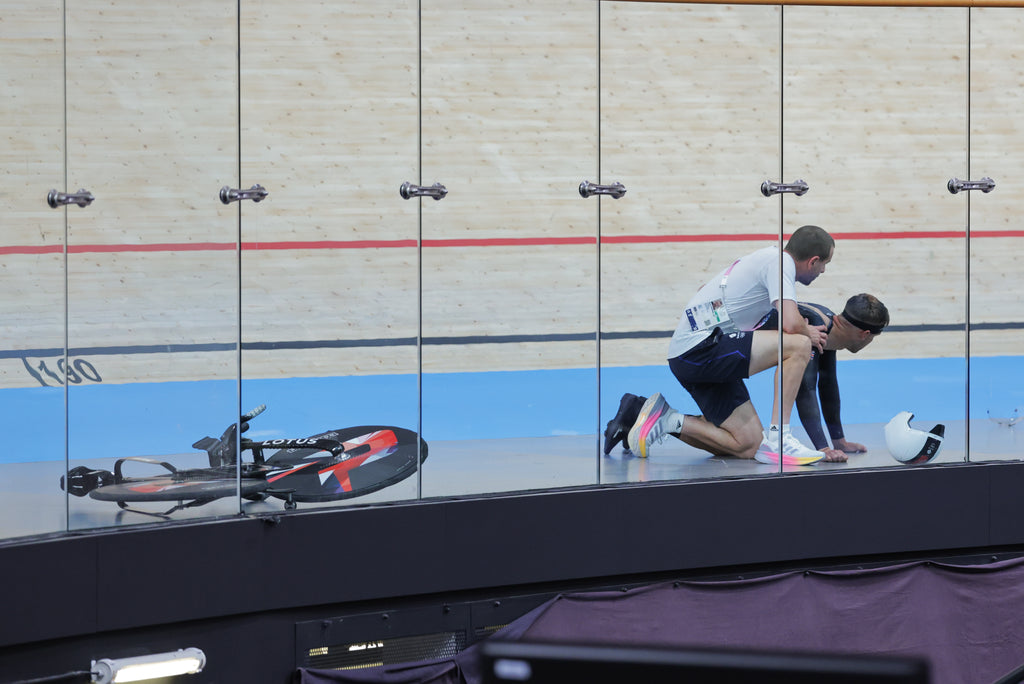
Bigham after crashing during training in the lead up to the Paris Olympics in 2024 (Image: Alex Whitehead/SWpix.com)
“So when people talk about speed, I love to use the analogy of Formula One as they’ve looked at it and it has an impact on safety, but it’s actually orders of magnitude less important than other things. They looked at track safety, car design, run offs, impact structures, and at medical responses, which are probably the same things we should be doing.”
‘Don’t expect riders to behave perfectly’ — Route design, behaviour and gear ratios
One of the easiest and quickest things to change would be the route design. Bigham’s proposed database would include the route as a potential parameter.
“Is it course design? Should we do more circuits and less point to point races? Should we go around towns rather than through towns?” Bigham asked hypothetically.
“Because road infrastructure is designed to have friction. It’s the whole idea. We want to slow cars down as they come into towns. That’s the exact opposite of what you want as a bike race, but that’s a hard thing to change, you can’t just go through every single town and pull up every speed bump and everything else that gets put down. So how do you create a safe environment?”
Bigham proposed not having so many city centre finishes. But changing route designs is not without its caveats. Cycling is a business. The very things that make claustrophobic flat finishes more dangerous — the roundabouts and traffic islands — is what keeps the sport viable because finish towns and cities pay a lot of money to race organisers to have the finish line by their cathedrals, squares and civic centres.
However, for Bigham it is a necessary change, more so than bringing in more behavioural regulations like the yellow card system, which hasn’t always been applied consistently since it was introduced this season.
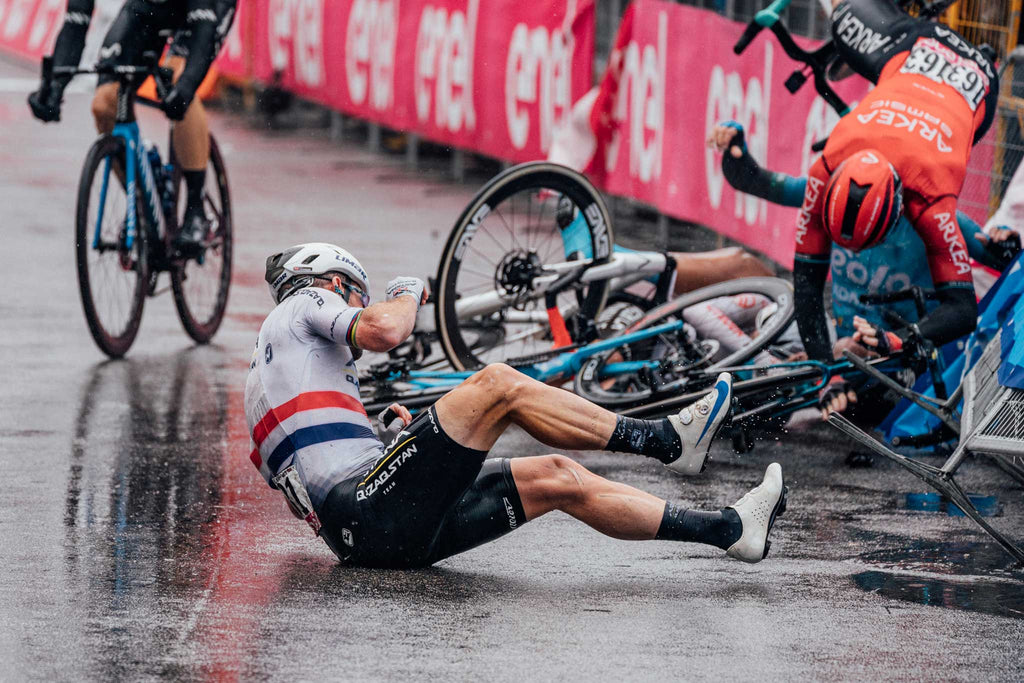
Cavendish hitting the deck at the 2023 Tour de France (Image: Zac Williams/SWpix.com)
“You can’t expect riders to just behave perfectly all the time,” explained Bigham. “It’s a race to be the best, and if it’s going to give you an advantage, you’ll go for that gap. I think it’s on the regulators in the UCI to create environments where it’s safe to do it. We can’t remove all risk, that’s impossible. We can’t wrap everything in bubble wrap for an entire stage, but we can create environments that are more safe for these things to happen, where we can descend quickly without falling over a cliff edge, for argument’s sake, or we can ride through a city centre without speed bumps and road furniture every single turn. I think creating that environment is the first step in this entire process.”
Like with rider behaviour, Bigham isn’t convinced by the idea that technological restrictions, like limiting gear sizes, are the answer: “I would describe it as an unwelcome distraction because it crowds out genuine discussion on topics. The point that I really try to drive home is that we should learn from history, and we’re not the first sport that’s had safety problems.”
And that’s why Bigham is out there talking about it: “It’s not a nice place to be when it’s a sport that I truly love and have gained so much from. So hence why I’m in a situation where I want to try and give back, and want to be more vocal and try and push for change.”
Bigham wants to encourage learning from history to make the future a better place, one which is safer for all.