
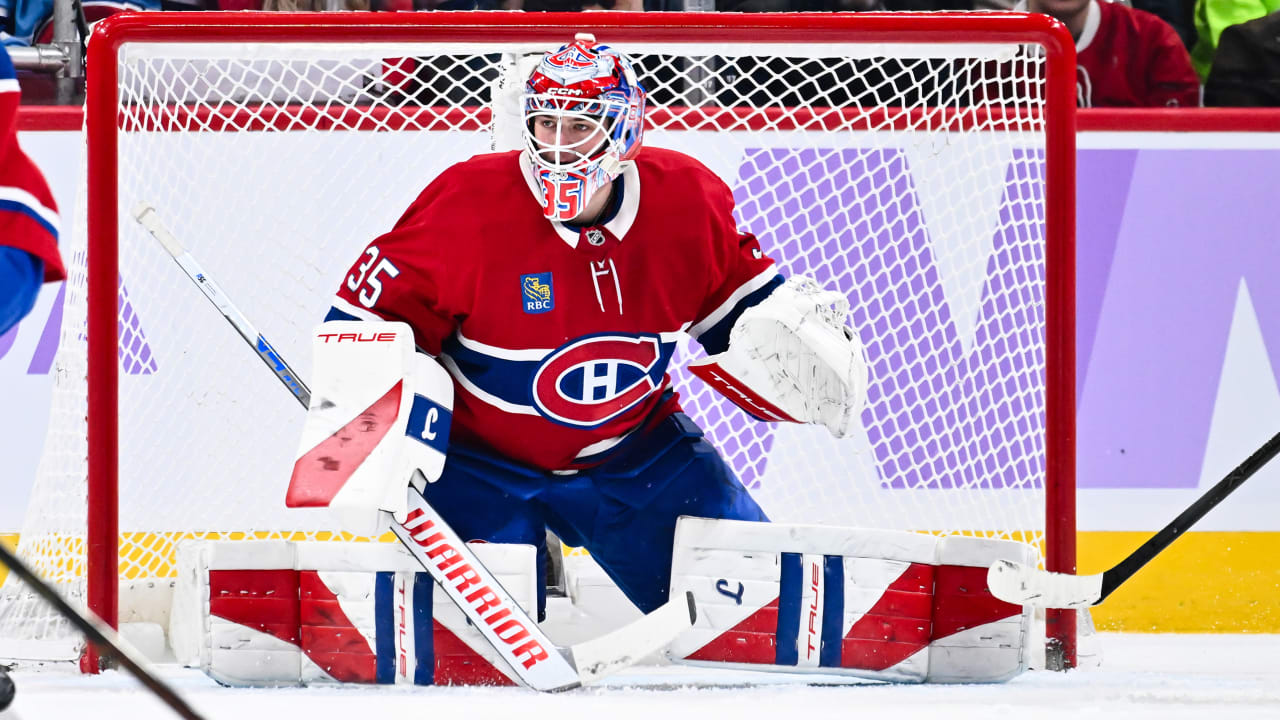
The butterfly posture has become synonymous with goaltending at every level of the game, but there is a cost to dropping repeatedly and forcefully into a position the human hip wasn’t designed to accommodate, which is why several NHL teams measure the number of times their goalies do it.
Some refer to it as a “drop rate.” Others a “down count.” Each is a measurement of the number of times during practices and games a goalie drops into the butterfly position, with their knees on the ice and their legs splayed out to the sides at varying degrees to take away the bottom half of the net from shooters.
“I don’t know the word but every time we go down, I think it counts,” goalie Sam Montembeault said of the tracking done by his Montreal Canadiens. “Last year, I played 62 games, obviously the most in my career and we did that a lot, too. I talked a lot with our strength coach off the ice and our goalie coach and we were really trying to manage that with all the technology too so you can see more of your workload.”
In the NHL, that data is most often used for that type of load management, to monitor and perhaps limit how many times a goalie drops to the ice in a practice after hitting a certain threshold in a game. But some believe it should be more widely applied to younger goalies the same way a pitch count is applied to limit pitchers in youth baseball.
“If my son were to play goal, I would definitely have that long-term view,” said Seattle Kraken goalie Matt Murray, a 11-season NHL veteran who had double hip surgery a little more than two years ago and missed most of the 2023-24 season as a result.
“I probably did the most damage, at least from what my surgeon said, when the majority of bone growth happens between the ages of 12 to 16 and that’s when I was on the ice every day, sometimes a couple times a day,” Murray said. “And every time you’re dropping into that butterfly, the femur bone is rubbing against the pelvis and your body thinks it’s a micro-fracture, so the body’s response is to create more bone to strengthen it, and that’s what creates that massive bone growth that caused really bad pain, at least in my case.”
NHL goalies don’t have to worry about still-growing bones being affected negatively when they drop into a butterfly as adults, but it remains a motion worth monitoring for many in the League. That’s because of the combination of unnatural internal hip rotation that comes from the legs spreading out to the side, and the amount of force in each drop.
“We’re talking somewhere around two times your body weight and that’s dependent on the goaltender and their drive to close the five-hole,” said Dr. Ryan Frayne, an associate professor at Dalhousie University who has specialized in goalie biomechanics for 13 years.
That’s roughly 400 pounds of force every time a 200-pound goalie drops to the ice, which may sound dramatic but it’s not much more than the impact from running.
“It sounds benign when I compare it to running impact forces,” Frayne said. “People run all the time and they’re fine, but the difference is you’re doing the loading and running in a flexed state and can absorb the energy, whereas in a butterfly you’re dropping directly onto your knee and you’re loaded and your hip is internally rotated. It’s the loading during that compromised hip position that really hammers it and makes it a problem.”
It’s something worth monitoring, especially when a goalie can drop into the butterfly more than 100 times in a single game, and a lot more than that in a practice preceded by a goalie-specific training session. Thanks to wearable tracking technology from a company called Catapult, more than 80 percent of NHL teams now do monitor it.
In addition to the butterfly drops, the technology measures total workload, either per minute or across an extended period, as well as asymmetry and whether a goalie spends too much time working one side compared to the other, which can also lead to overuse injuries.
“We track it all,” Kraken No.1 goalie Joey Daccord said.
While no one envisions coaches calling for the backup goalie from the bench like a baseball manager signalling to the bullpen because the starter hits a drop threshold in a game, knowing the total can help with practice planning the next day.
“Practice is where you need to take advantage of that,” said Paul Schonfelder, goaltending coach for the Carolina Hurricanes. “The problem is in baseball you just take them out. In practice you don’t really have that option all the time. But when we run three goalies (in the NHL at the same time), it’s a point of discussion to cut our butterflys down.”
USA Hockey hasn’t gone so far as a butterfly count the way youth baseball does a pitch counts, but there is an emphasis on having more goalies sharing the net within games and practices and trying to get away from having just one goalie per team.
“There’s a couple things baseball does well to protect their pitchers: One is pitch count, but two is the bullpen, and I think that’s what we’re really trying to figure out, is how can we get hockey to start seeing the future of goaltending being led by committee?” said Steve Thompson, manager of goaltending development for USA Hockey. “A future where you have three goalies on a roster and each play a period and that’s good, that’s accepted, instead of what you have to play the full game if you’re ever going to be a goalie. We’re adamant we need to change things about the goaltending position, to protect kids from themselves. We’ve got too many kids getting surgery, too many adults getting surgery.”
As one of those goalies, that’s something Murray wants to hear if his son ever decides to play the position. As an established veteran in the NHL, Murray is mindful of how many butterfly drops he makes in a practice and has developed ways to limit them.
“As I get older, and now being post-hip surgery, in practice I definitely am conscious of it and I just stand up a lot more,” Murray said. “Every goalie knows the first couple of drills of practice are just guys coming down the pipe ripping the puck, so I’m basically standing up on all those whereas early in my career, I’d be playing those for real on 100 pucks a day and that’s probably what accelerated the deterioration of my hips.
“I play game-like situations in practice normally, but those 100 reps of guys just coming down the pipe, ripping it high and hard, I’m standing up on those ones for sure and I think that’s how you honestly should approach it nowadays, just to save your hips as much as possible.”