
What does it take to secure a contract with a WorldTour team? Single-digit body fat? Through-the-roof endurance? Muscles chiselled from granite? All these are useful, but what about something more specific and measurable? For that, we turn to an old metric, a new term and a recent revelation.
“Our experience suggests that the rider’s performance after 3,000kJ of work done is where we should be looking to identify quality juniors who could make it at WorldTour level,” says John Wakefield, director of development at the Red-Bull-Bora-Hansgrohe under-23 development team. “That’s a higher number than we expected when we started this project.” On a professional level, this development will help scouts refine data search. At recreational level, discovering the impact of kilojoules – that is, spent energy – on your performance will help you beat fatigue and race stronger. All in all, it’s time to talk workload, durability and why 3,000 is the magic number – for budding professionals, anyway.
Race-winning metric
Remco Evenepoel’s transfer from Soudal Quick-Step to Red Bull-Bora-Hansgrohe for the 2026 season somewhat eclipsed the team’s signing of four other riders, including the Belgian’s Quick-Step team-mate Mattia Cattaneo, and Gianni Vermeersch from Alpecin-Deceuninck. The latter duo, at 34 and 32 years old respectively, are proven on the WorldTour, unlike young guns, Brit Callum Thornley and Aussie Luke Tuckwell, both stepping up from the German outfit’s under-23 development team, the Red Bull-Bora-Hansgrohe Rookies, which launched at Continental level earlier this year. At time of writing, Thornley had won twice in 2025 – at the British National under-23 TT Championships and the time-trial stage at the Sibiu Cycling Tour in Romania. Tuckwell’s best result was second on GC at the Giro Next Gen. But beyond race results, what made these two riders such promising prospects in the eyes of the team’s selectors?
Best picks for you
VO2max and power-profile data remain important, of course, but energy spent – measured in kilojoules – has become the magic number in talent-spotting. The epiphany came at the World Championships in Zurich last year, when Italian Lorenzo Finn of the Red Bull junior team, Grenke Auto Eder, won junior road race gold. The analytics team would later discover that when he rode away from Spain’s Héctor Álvarez with 20km to go, Finn had already burnt through 3,000kJ. “Until then, the research had suggested around 2,000kJ was the threshold for identifying good junior and under-23 talent,” says Wakefield. “But this performance told us 3,000kJ was the benchmark we should be looking at.”
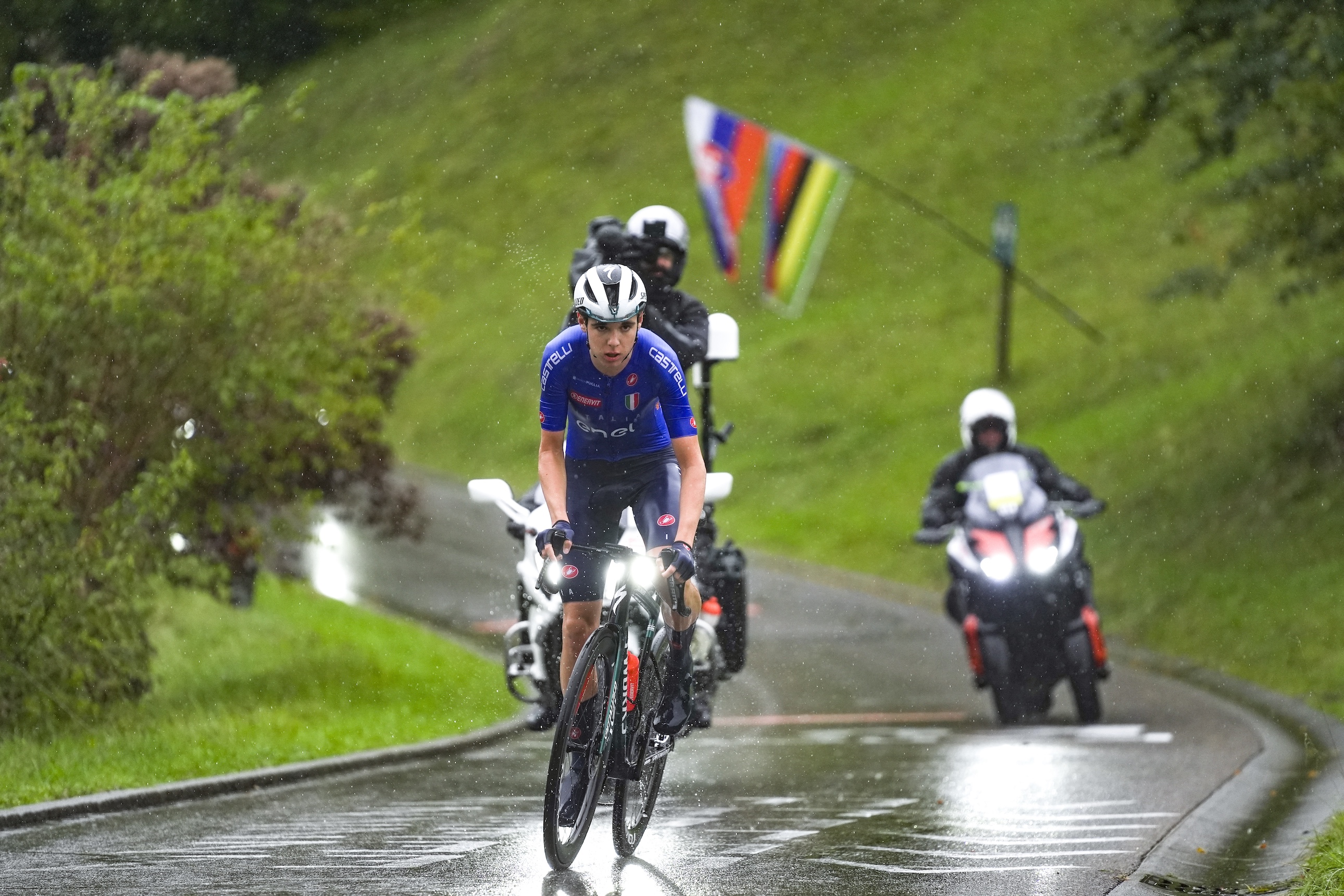
Lorenzo Finn made a splash at last year’s Worlds, winning junior race road gold
(Image credit: Zac Williams/SWpix.com)
Hours before the real race starts. Take Evenepoel’s 2023 Liège-Bastogne-Liège triumph. The Belgian completed the 257km parcours in 6:16.11, averaging 41.3kph (25.7mph) at a cadence of 93rpm, having burned 5,965kcal. How does this relate to kilojoules? One kilocalorie equals 4.184kJ, so Evenepoel’s 5,965kcal equates to 24,975kJ of total energy expended. But viewed through a cycling lens, that figure assumes 100% efficiency – as if every joule burned became forward motion. In reality, cyclists are only 20-25% efficient, with most energy lost as heat. Assuming midpoint efficiency of 22.5%, Evenepoel’s true mechanical output comes out at 5,615kJ. We don’t have access to his power file from LBL, but we do know that the Belgian’s race-winning move came with 33km to go on the Côte de la Retoute, meaning he delivered a peloton-breaking burst of power after he’d already done 5,000kJ of work. If you want to drop the world’s best, that’s what it takes.
Going hard, then harder
How does this knowledge of work done translate to training objectives? To find out, we turn to another Liège winner, Dan Martin. “At the start of my career, we’d separate long rides and shorter, interval-heavy rides,” he says. “But later that changed to long, hard rides with intense efforts at the end – to mimic the intensity patterns of races. My coach and I achieved that via training to kilojoules for goal races.” The focus switched to developing performance after a huge amount of work had already been done. “Liège in 2013, when I won, was the first year I’d really focused on matching kilojoule count in training to the race itself,” Martin adds. “While my competitors might have been doing six or seven hours easy, I’d ride pretty hard for four hours followed by two hours of motopacing with sprints at the end.” Martin’s benchmark as a top WorldTour pro was 5,000kJ, beyond which he’d repeat hard two- to three-minute efforts to match the demands of the Ardennes Classics. “I’d train harder than the profile demanded, in search of that bit extra.”
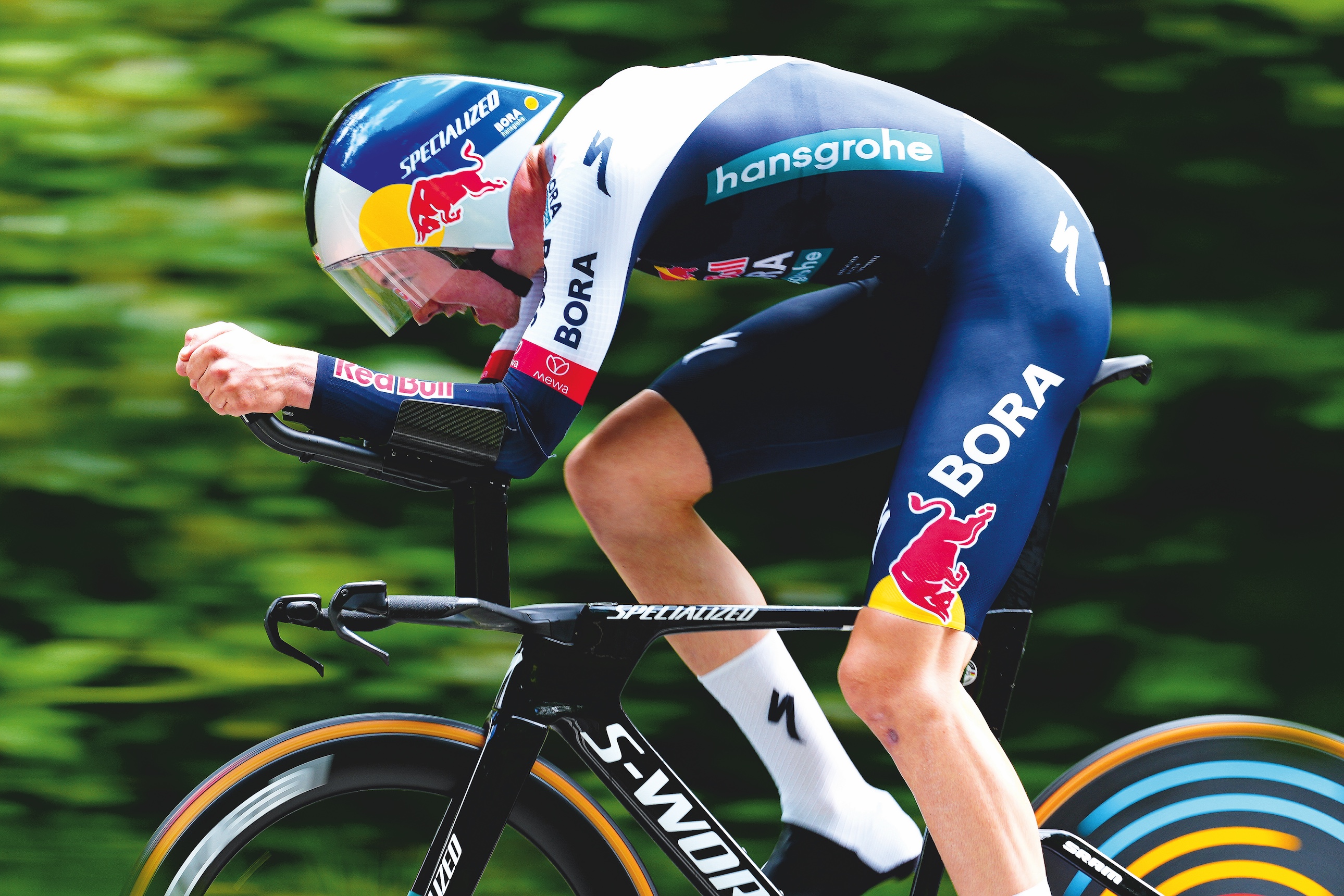
Callum Thornley is a young talent under development in the Red Bull-Bora-Hansgrohe Rookies team
(Image credit: Olly Hassell/SWpix.com)
Ambitious US riders would train harder than their local races demanded, explains Allen. “There was no choice,” he says. “Once they’d secured a contract in Europe, their races would be longer and more competitive… Our US riders are used to doing 2,500 to 3,000kJ of work [in a race], whereas the European events can be over 5,000kJ. That’s a huge gap, so we had to do a tremendous amount of additional work to prepare them for Europe.” Does this mean we should all be focusing on kilojoules? “The problem with kilojoules in isolation is that it doesn’t take into account intensity,” says Allen. He points out that doing 3,000kJ of work by pootling along at 10mph is very different from doing 3,000kJ-worth of tempo.
Being able to perform after having ripped through 3,000kJ represents excellent durability – the concept of maintaining power after prolonged physical exertion. At the highest level, this counts for more than a rider’s performance when fresh. “It’s a fancy name for the concept we’ve used for years: stamina,” says US coach Hunter Allen, co-author of the best-selling Training and Racing with a Power Meter, “but whether you call it stamina, fatigue resistance or durability, it’s all about matching the demands of a race. Certainly at the professional level, you’re often riding at tempo or sweetspot for three, four or even five hours before the real race starts.”
How amateurs can use kilojoule benchmarks
So what does this mean for amateur riders – how can you use kilojoules as a useful benchmark? To start with, you’ll need a power meter. Then perform two tests: one when fresh, and one when fatigued. For the fresh test, warm up for 20-30 minutes, then ride a 20-minute max effort, akin to a time trial. Record your average power output for this effort. On another day, ideally in similar conditions, ride steadily in zones two to three until your head unit shows 2,000kJ of work (or 2,500kJ if you’re very well trained). For most riders, that’s around two-and-a-half to three hours of riding. Spin easy for five to 10 minutes, then repeat the 20-minute effort, noting your average power for this 20 minutes. Now compare your fresh versus fatigued 20-minute power. A difference of 5% or less means you’re very durable; 5-10% is moderate durability; a drop of over 10% between the two shows your durability needs some work.
Bear in mind that weight is a major factor here. A lighter rider is likely to have to ride for longer to hit their kilojoules benchmark. A heavier rider might hit 2,000kJ in two hours at endurance pace, whereas a smaller rider might take three hours. A small female rider who weighs 50kg, for example, might be better off setting herself a 1,500kJ target. “Age is also a consideration,” adds Allen. “As you grow older, your VO2max drops, making it harder to sustain the higher watts needed to rack up a workload of 2,500kJ.”
Broadly speaking, recreational riders who do less than five hours of training a week are likely to find their durability challenged after 1,500kJ of work. An amateur racer who trains at least eight hours a week should be able to perform quite well beyond 2,000kJ. High-level amateurs and budding professionals should be targeting that magical 3,000kJ figure. At the top level, the best WorldTour pros are able to produce race-winning efforts even after 5,000-6,000kJ of work.
How to up your limit
How do you raise your kilojoules bar for greater durability? First, by understanding that kilojoules are basically a proxy for aerobic capacity. Tolerating heavy workloads requires you to do big volumes of Zone 2 work – as popularised by Tadej Pogačar. However, this advice comes with an important caveat from Allen. “Your training needs to take into consideration time restraints,” he says. “The professionals train 20-30 hours a week, which means they’re doing around six hours of intervals each week. That’s a lot.” He believes amateurs doing six to 10 hours a week should not aim to replicate the 80/20 split of high and low intensity. “Most amateurs simply don’t have the luxury of riding at Zone 2 for that much time. Instead, you need to spend more time at tempo and sweetspot pace, just beneath your threshold, as well as VO2max and FTP intervals. This will boost your ability to burn fat, sparing glycogen [stored glucose] for the harder parts of your race.”
Nutrition also comes into the kilojoules equation, namely on-the-bike feeding. A major limiter of performance beyond muscular fatigue is fuel availability from glucose and glycogen. If you’re not sufficiently fuelled, the body shifts more toward fat oxidation, which is great for endurance pace but not great when looking to hit threshold or sprint efforts. That’s why, on longer rides, you should consume 60-90g of carbohydrates per hour.
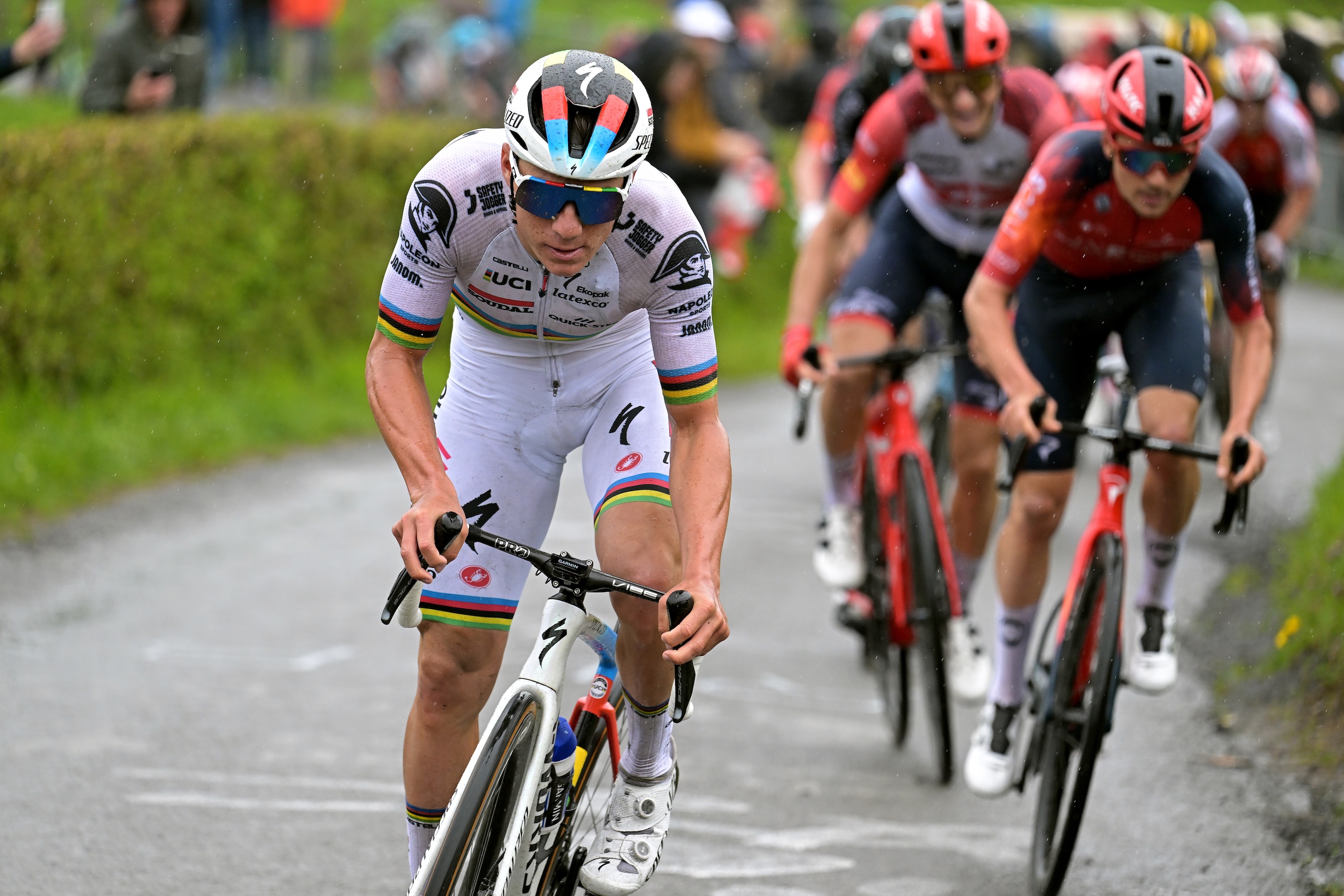
Evenepoel’s race-winning move at 2023’s Liège-Bastogne-Liège came after he’d already ripped through 5,000kJ
(Image credit: Getty Images)
Being able to belt out high power after a hefty amount of work – whether it’s 2,000kJ, the magic 3,000kJ for aspiring pros, or 5,000kJ for superstars like Evenepoel – is the essence of race-winning performance. Understanding and tracking your kilojoule workload brings clarity to what used to be guesswork, revealing how long you can truly perform before fatigue sets in. Whether you’re chasing road race success or simply want to put your mates to the sword in the final miles of long rides, the principle is the same: build the engine, fuel it well, and teach it to keep firing when the tank feels empty. Get that balance right, and you’ll not only raise your kilojoule ceiling – you’ll redefine what you thought was possible on the bike.
Monster workloads, mega numbers
71,500kJ: Estimated total mechanical energy expenditure of a Tour de France rider across the 21 stages
76,000kcal: Estimated total metabolic energy expenditure of a Tour de France rider across the 21 stages
6,000kJ: Approximate amount of work done by a rider at the sharp end of a one-day Classic such as Paris-Roubaix
6.5%: Drop-off in 20-minute TT performance by well-trained amateurs after a defined prior workload, versus 12.5% for weaker riders – according to a 2025 study by Barsumyan et al.
60g: Amount of carbohydrates per hour needed to extend your durability
5,000KJ: Workload beyond which the world’s best riders are still able to launch and sustain efforts at close to their ‘fresh’ FTP
The full, original version of this feature was published in the 30 October 2025 print edition of Cycling Weekly magazine – available to buy on the newsstand every Thursday (UK only) while digital versions are available on Apple News and Readly. Subscriptions through Magazine’s Direct.