
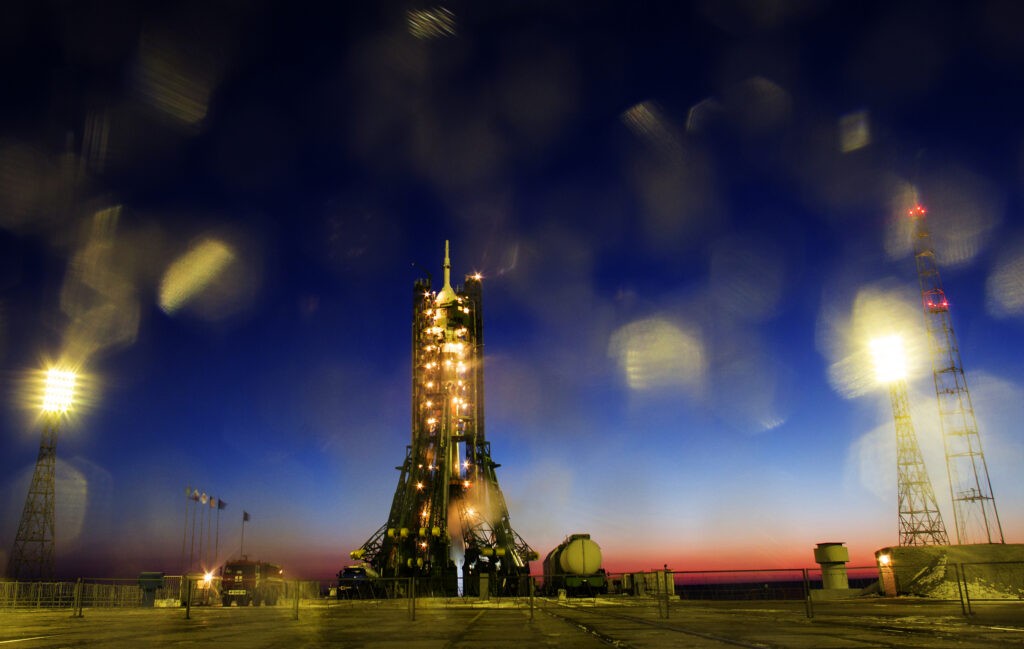
Two Russian cosmonauts and one American astronaut floated through a hatch into the International Space Station on Thursday, beginning an eight-month stay after arriving on a Russian spacecraft that launched from the Baikonur Cosmodrome in Kazakhstan.
The Soyuz MS-28 craft that docked at the station, or ISS, on Thursday carried Russian commander Sergey Kud-Sverchkov on his second trip to space, as well as Russian Sergey Mikayev and Christopher Williams of NASA. Mikayev and Williams are on their first mission as part of a longstanding collaboration between NASA and Russian space agency Roscosmos that has kept the ISS continuously inhabited for 25 years. The first arrivals were in November 2000.
Live video showed Kud-Sverchkov, Mikayev and Williams, who will conduct scientific experiments and spacewalks during their stay, being greeted with big smiles from the astronauts and cosmonauts already on board the ISS. There are now a total of 10 people on the station.
Williams, who has worked as a clinical physicist and cancer researcher, recently talked about his relationship with his fellow travelers from Russia on a NASA-run program called Houston We Have a Podcast.
“It’s a really great crew,” Williams said. The two Russians, he said, “are both just absolutely wonderful people, really kind, super interested, super intellectually curious, which is really fun. Had a lot of really, really great discussions, just talking and talking about things. And it’s been been wonderful to both spend some time with them over in Star City, and also to be able to spend some time with them in Houston through our training.”
Star City is a facility in the Moscow area where cosmonauts train. Houston is home to NASA’s Johnson Space Center.
“And so when I’m over there in Star City, we’re doing a lot of Soyuz simulations together,” Williams said. “So we’re spending a lot of time, sort of the three of us in a small capsule for, you know, several hours at a time, you know, in suits… running through sort of mock scenarios of of what would happen on launch, on rendezvous, on on on departing the station, as well as in the ISS trainers.”
The training also included emergency scenarios that could unfold on the International Space Station.