
A Martian mystery that sparked years of debate — an alleged lake buried beneath miles of ice — now looks far less watery than scientists hoped.
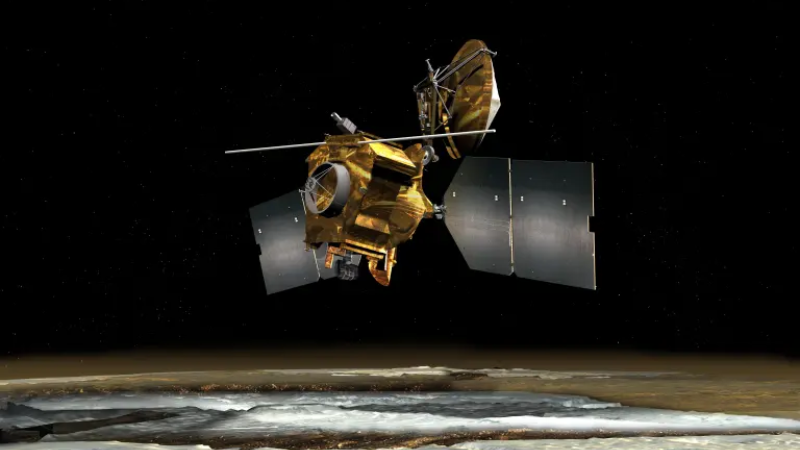
A new radar study from NASA’s Mars Reconnaissance Orbiter (MRO) revisits the strange signal detected in 2018 by the European Space Agency’s Mars Express (MARSIS), and the result isn’t what anyone expected. With a sharper, more powerful radar technique, scientists at last got a clean look beneath the planet’s south polar ice cap — and the evidence for an underground lake is slipping away.
A stronger radar, a weaker signal
The fuss began seven years ago, when the MARSIS instrument picked up an unusually bright radar reflection under 1,500 meters of polar ice. The signature resembled liquid water — or at least a briny lake, the only type that could remain unfrozen under Martian conditions.
To test whether the 2018 signal was really liquid water, scientists needed to check it with NASA’s SHARAD, MRO’s onboard radar. But SHARAD’s equipment couldn’t see deep enough to pick up the signal… until now.
In a recent study published in a peer-reviewed journal, Geophysical Research Letters, SHARAD scientists Gareth Morgan and Than Putzig describe how a newly developed maneuver — a “very large roll,” rotating the spacecraft 120 degrees mid-orbit — finally gave the radar enough power to probe the depths.
“We’ve been observing this area with SHARAD for almost 20 years without seeing anything from those depths,” Putzig said. But once the roll maneuver aimed the antenna directly at the ice, the radar dug in deeper than ever before.
What the equipment found was the opposite of the 2018 claim: a faint return, not a bright one. And when MRO repeated the experiment over the adjacent region, the supposed signal disappeared entirely.
“The lake hypothesis generated lots of creative work, which is exactly what exciting scientific discoveries are supposed to do,” Morgan said. “And while this new data won’t settle the debate, it makes it very hard to support the idea of a liquid water lake.”
If not water, then what?
Observations so far have shown Mars’ south pole to be geologically messy: craters, buried terrain, and odd patches that reflect radar differently depending on their composition. Morgan and Putzig suggest a simple possibility — the spot where MARSIS saw the “lake” might just be an unusually smooth slab under the ice, perhaps even an ancient lava flow.
This would still explain the bright signal without requiring a reservoir of liquid water in one of the coldest, harshest regions of the planet.
The technique itself might be the real breakthrough
Even if the lake evaporates under closer scientific scrutiny, the new radar method is a win for future Mars exploration. The very large roll maneuver gives MRO a way to hunt for buried ice, rock layers, and subsurface resources that could support future human explorers.
One target is already on the wishlist: Medusae Fossae, a massive equatorial formation that barely reflects radar at all. Some scientists say it’s ash. Others think there might be deep, ancient ice hiding inside.
“If it’s ice, that means there’s lots of water resources near the Martian equator, where you’d want to send humans,” Putzig said. “Because the equator is exposed to more sunlight, it’s warmer and ideal for astronauts to live and work.”
What comes next
MRO has been circling Mars since 2006, and with this new capability to see deeper beneath the surface, it may start re-examining old mysteries across the planet. Mars Express’ original signal isn’t entirely explained yet — the faint SHARAD return confirms something unusual is down there, just not liquid water.
For now, a once-promising Martian lake has likely turned into dust and rock. But the method that disproved it might end up being the tool that uncovers something even better.
Sources: NASA, Geophysical Research Letters, Science
Read the original article on GEEKSPIN.
Affiliate links on GEEKSPIN may earn us and our partners a commission.