
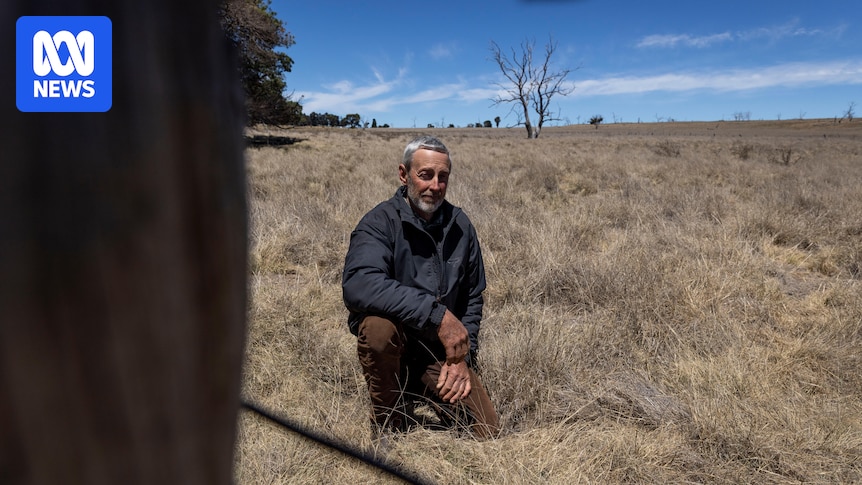
If Ross Sherlock could travel 50 years back in time, he would give a grave warning to New South Wales Snowy Mountains landholders about the straw-like plant that had started popping up.
The impact of African lovegrass on the landscape is profound.
The merino and beef cattle farmer knows people who have given up working on the land after the invasive weed choked out native grasses and rendered paddocks unproductive.
Mr Sherlock spends about $100,000 each year spot-spraying the weed to keep it under control on his 1,700-hectare property north-west of Cooma.
“Anywhere that there’s the slightest chance of bare ground, it’s there,” he said.
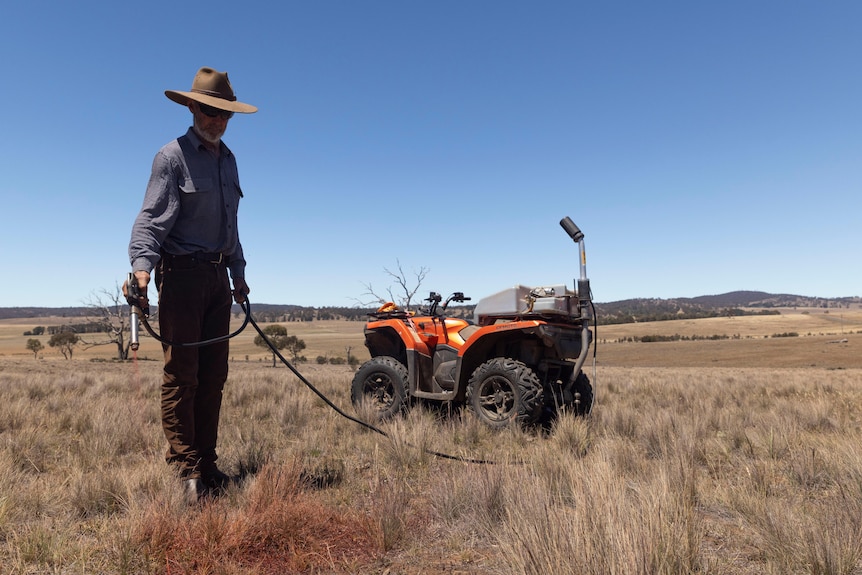
Ross Sherlock says controlling African lovegrass is a costly and time-consuming process. (ABC Landline: Floss Adams)
“We have one employee who spends pretty much all his time — unless it’s pouring with rain or blowing a gale — just spot-spraying African lovegrass.”
Spot-spraying a hectare of land costs Mr Sherlock about $350 a year, but this cost is 10 times greater than the profits from his merino sheep.
“It’s not sustainable … there’s got to be another way or we’ll just go broke doing it,” he said.

Vehicles and animals facilitate the spread of African lovegrass. (ABC Landline: Floss Adams)
The invasive African lovegrass was introduced to Australia in the late 1920s as a way to stabilise road sides, and it is now found throughout NSW, south-east Queensland, Victoria and parts of South Australia.
Mr Sherlock said about 150,000 hectares of land in the Monaro was covered by the weed, which he believed could increase to 250,000 by 2030.
He also runs a second property that he has managed to keep completely free of African lovegrass through the complex and strict quarantining of animals and vehicles.
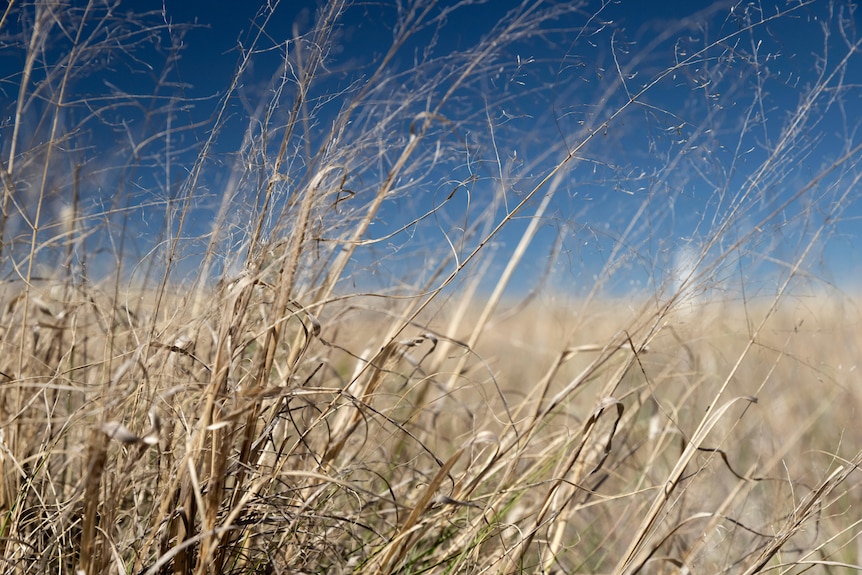
The weed is particularly rife in the region between Canberra and Cooma. (ABC Landline: Floss Adams)
Major fire risk
The NSW Rural Fire Service (RFS) also has concerns about African lovegrass, as the fine grass makes a “readily combustible” fuel, leading to confronting blazes.
“On days of cool temperatures and no wind, we see lovegrass fires that start, and take off very readily and run at reasonable speed,” RFS Inspector Langdon Gould said.
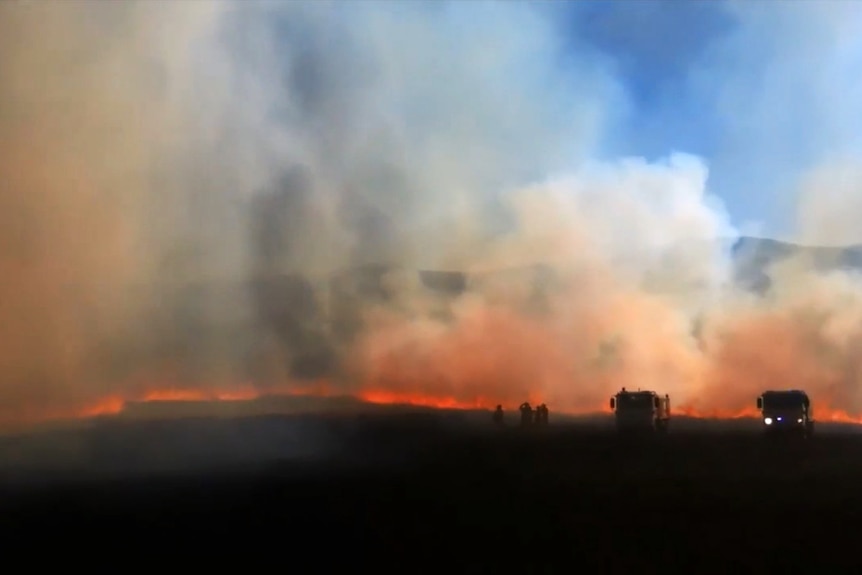
Crews fighting a fire burning through African lovegrass in the Monaro. (Supplied: NSW Rural Fire Service)
“You’ll see a greater intensity, you’ll see greater flame heights, you’ll see greater spread.
“Often you’re sending more [fire] trucks than you would otherwise send.”
Inspector Gould said African lovegrass was nearly 10 times as likely to catch alight as other grasses in the Monaro during the last bushfire season.
“There’s nothing to love about African lovegrass,” he said.

Langdon Gould has concerns for the safety of his crews attending African lovegrass fires. (ABC Landline: Floss Adams)
Stick vs carrot approach
African lovegrass was on the state’s noxious weeds list until 2017, which meant landholders previously faced fines if they did not eradicate it.
“It cost council a huge amount of money and resources to try and fund compliance work, and it’s just not viable anymore,” Snowy Monaro Regional Council biosecurity officer Brett Jones said.
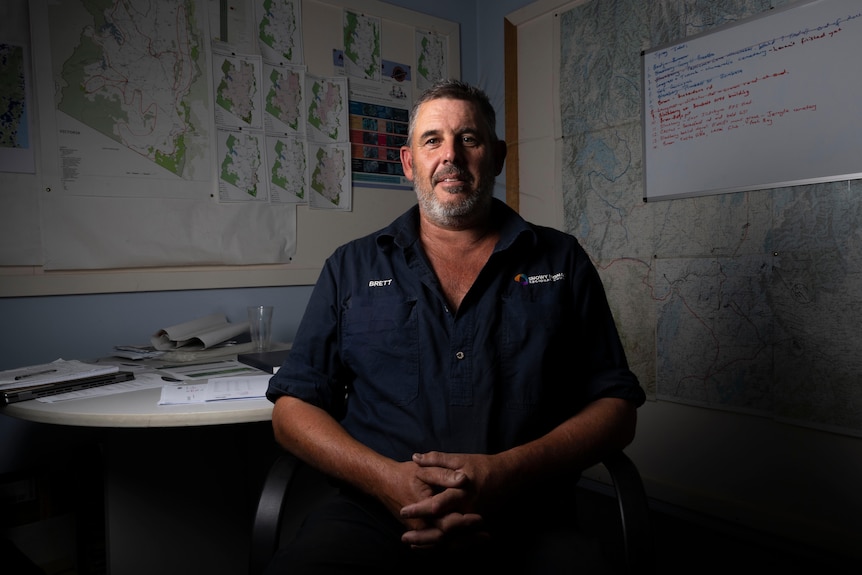
Brett Jones says the “stick” approach for African lovegrass compliance has divided the community. (ABC Landline: Floss Adams)
The council is now focused on eradicating new weed incursions and educating landholders on management.
But Mr Jones said the mental impact on landholders was the most confronting part.
“I have had people say that it’s had that much of a social impact, that they’ve considered going for the gun cabinet,” Mr Jones said.
“That’s scary, the fact that a weed can do that to somebody’s wellbeing.”
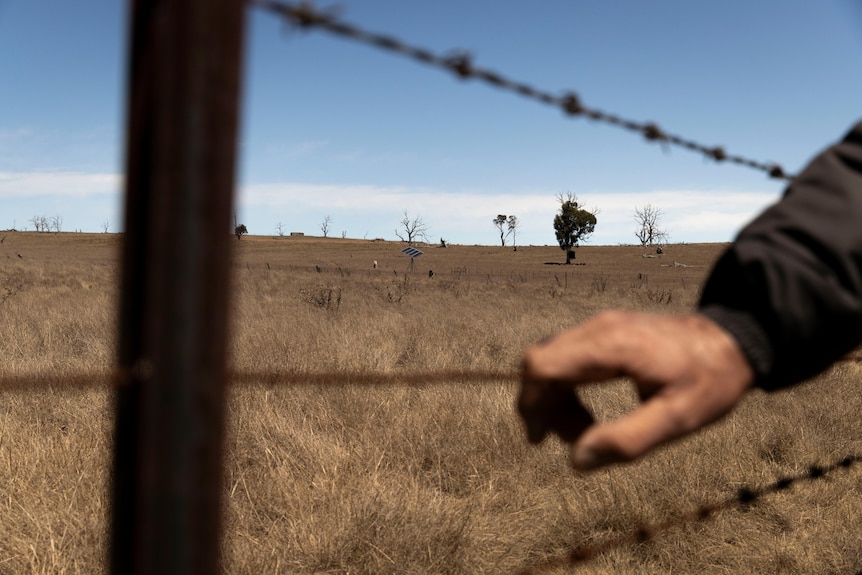
Brett Jones says many farmers are at a loss with the weed. (ABC Landline: Floss Adams)
If you need someone to talk to, call:Calls for legislative review
The native grasslands in the Monaro are listed as critically endangered.
Landholders are therefore not allowed to conduct widespread control of African lovegrass — such as boom spraying or controlled burning — when it appears on these high conservation native grassland areas, unless the weed takes over more than 50 per cent of that area.
University of Sydney adjunct senior lecturer Lachlan Ingram said most producers could control the weed with spot-spraying, before it took over about 5 per cent of the paddock.
“After that, it rapidly expands out, so you’re going to be looking at more broadscale control … and then after that, it gets to take over an entire paddock, like a monoculture,” he said.
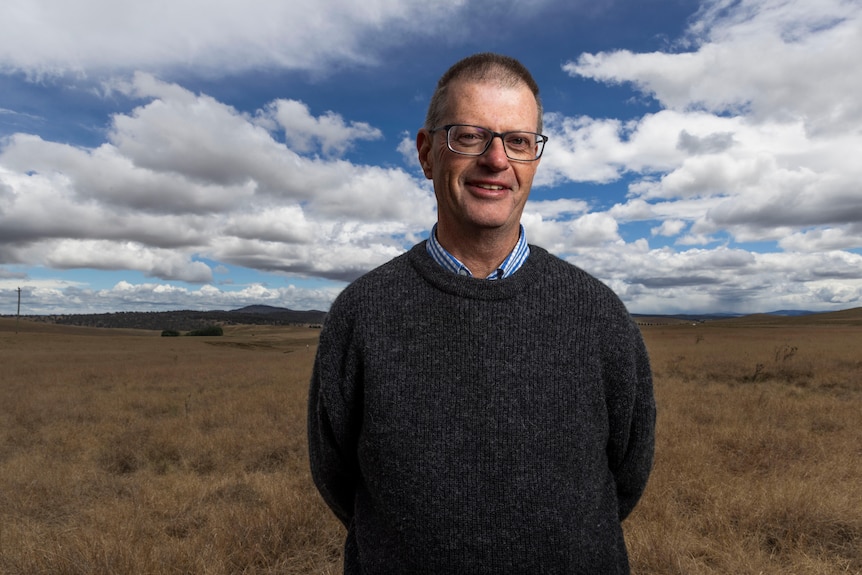
Lachlan Ingram says the weed will continue to spread. (ABC Landline: Floss Adams)
The chair of the local African lovegrass Action Group, Narelle Davis, said the laws were aimed at protecting critically endangered native grasslands, but the weed would take over those precious areas if landholders could not conduct widespread control earlier than this threshold.
The group wants to see that biodiversity legislation is changed.
“We will have to lose some native grass area [in the short term] to save what’s really valuable,” she said.
“Landholders probably have the best answers to how we can actually manage the continued conservation of their native grasslands.”
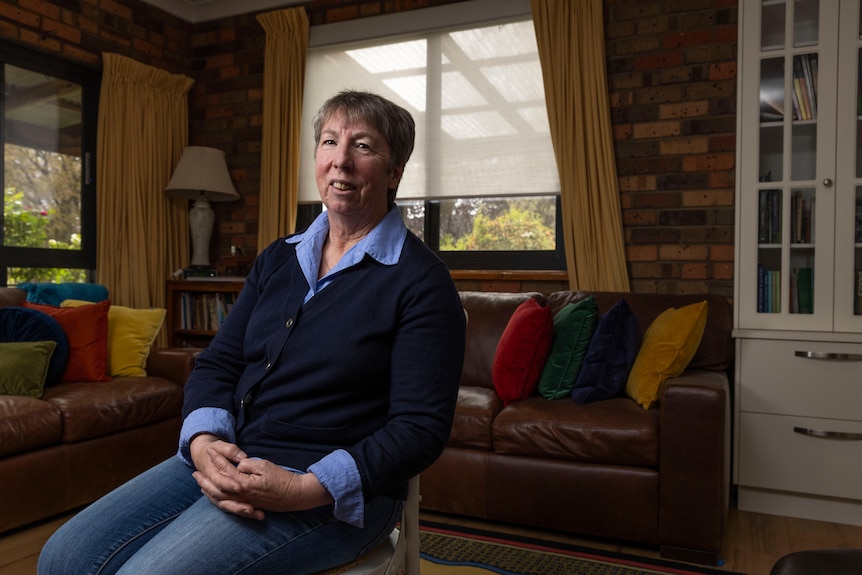
Narelle Davis says some native grass will be lost in the short term. (ABC Landline: Floss Adams)
Mr Sherlock, also in the group, drafted his own individual farm management plan, which he hopes the government will consider.
The plan proposes different management techniques for the four sections of his land, but he would be breaking laws if it were enacted upon now.
“The dilemma is, do we go ahead and break the law and try to conserve some of our native grasslands, or do we comply with the law and lose the lot,” Mr Sherlock said.
The NSW and federal governments warned Mr Sherlock after he was caught boom-spraying part of his native grasslands two years ago.
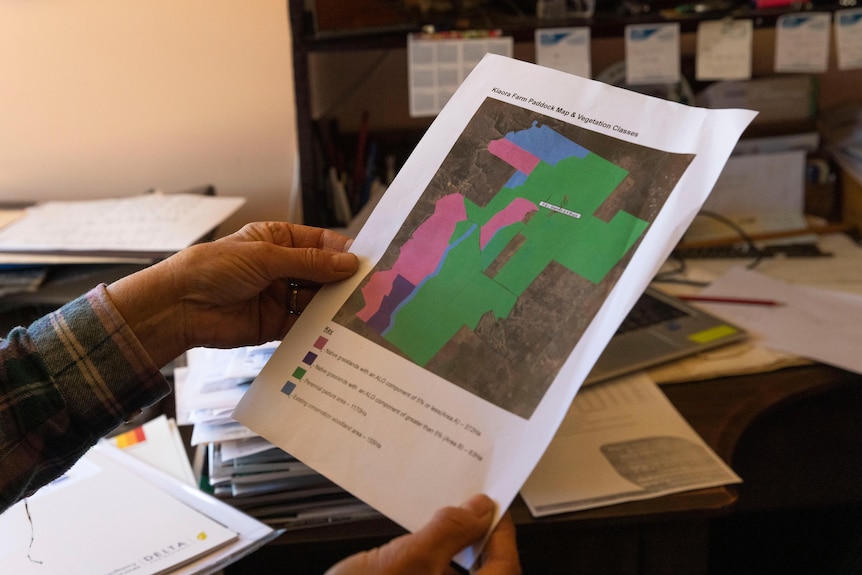
Ross and Liz Sherlock’s proposed property management plan. (ABC Landline: Floss Adams)
The state government told Landline that it “shares the concerns held by landholders about the spread and impact of African lovegrass” and is “open to addressing regulatory settings”.
“The NSW government appreciates that navigating native vegetation regulations can be challenging for landholders when it comes to grasslands,” a Local Land Services spokesperson said in a statement.
The government also tasked the Natural Resources Commission to review grassland regulations this year, with recommendations set to be made public at a later date.
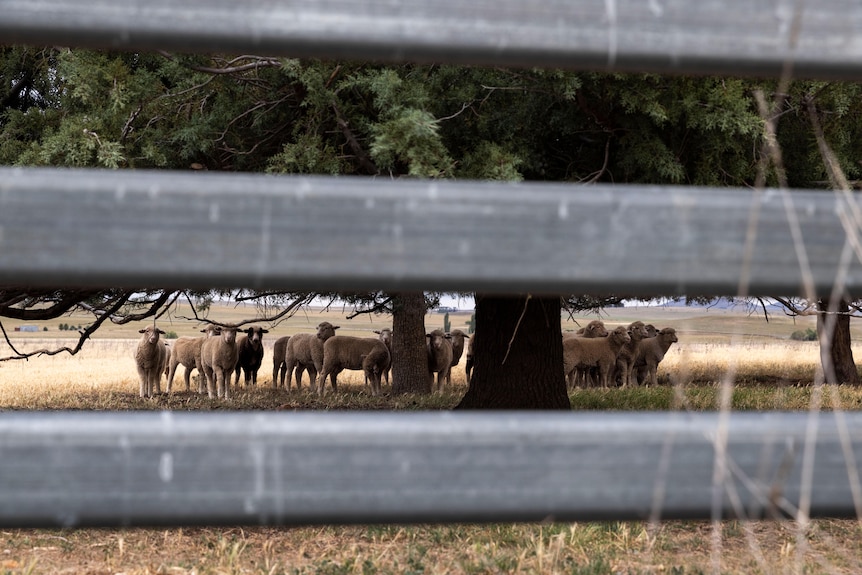
Livestock does not commonly eat lovegrass, as it is nutritionally poor and tough to eat. (ABC Landline: Floss Adams)
A hopeful future
The nearby Snowy River Landcare group decided to launch a pilot program to fund about 10 local property owners to test untried management ideas.
“We need to look outside the box and try and come up with a non-traditional solution, a citizen science-type project,” president Kate Heeley said.
Small-scale merino and beef cattle producer Tineke Tamis wanted to get involved, as she had started aerating her soil and wanted to sow native grasses to try to push out the lovegrass.
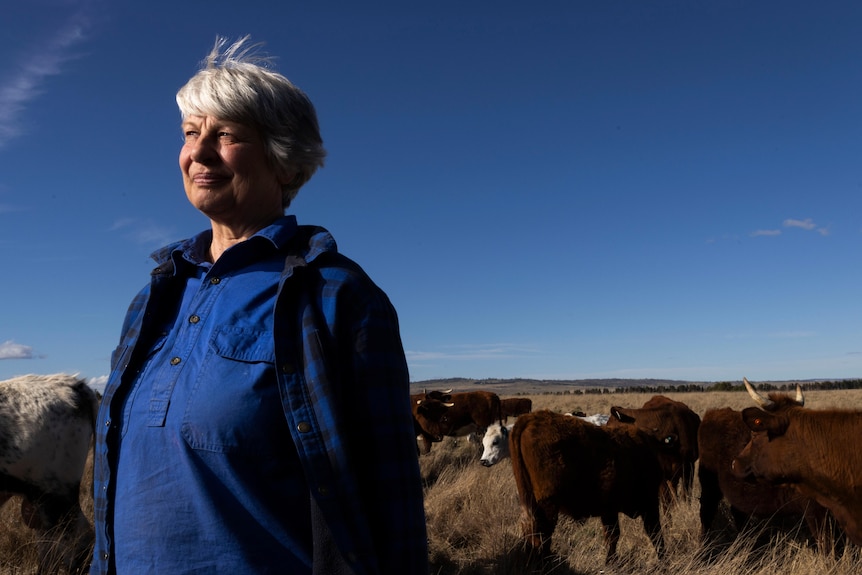
Tineke Tamis is experimenting with feeding her cows a mineral mix to help them better consume the weed. (ABC Landline: Floss Adams)
She sold off one-third of her property in 2021 after the weed took over.
“I was at my absolute wits’ end. I had no system, that I was aware of, that would control it,” Ms Tamis said.
Howard Charles, one of the trustees at research farm Coolringdon, said he had yet to see anyone win the war against African lovegrass.
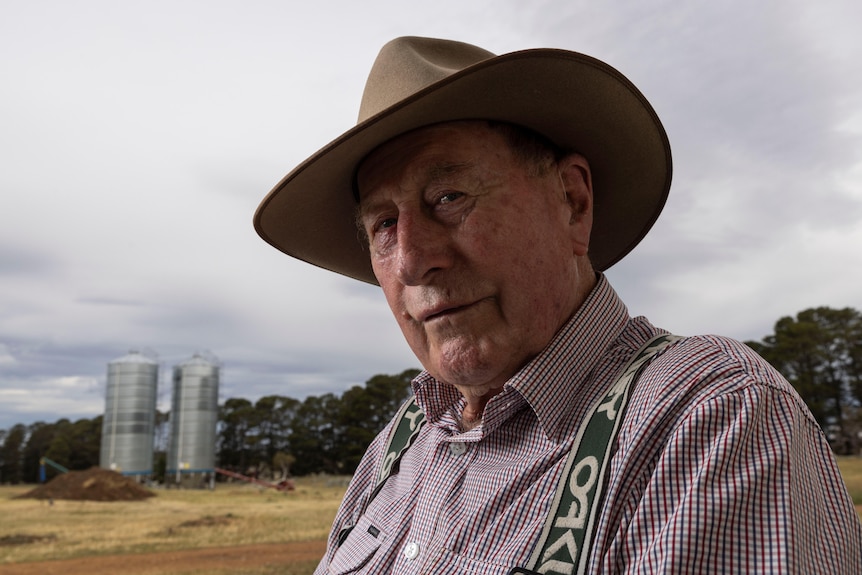
Howard Charles wants government departments to listen to farmers. (ABC Landline: Floss Adams)
Mr Charles believed the weed could be managed with traditional control methods, but reinforced that farmers needed support through legislative change and financial backing.
“You can get it to a stage where you can live with it because you’ve got it only in a few spots and you’re not letting it re-infest the rest of the property,” he said.
“I’m always hopeful … I’m not sure we can [manage it]. I’m certainly not sure we can, but I hope we can.”
Watch ABC TV’s Landline at 12:30pm AEST on Sunday or stream anytime on ABC iview.