
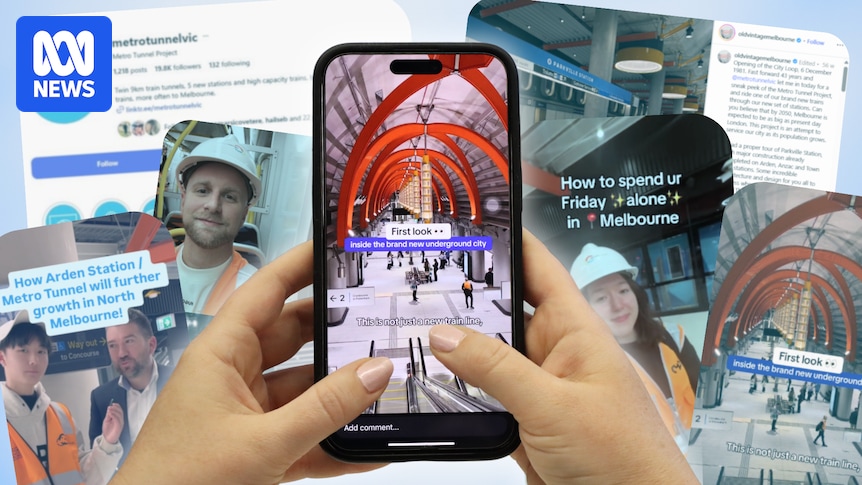
Online influencers and train lovers are being used to promote the $15-billion Metro Tunnel ahead of its opening on Sunday.
The Victorian government has been escorting influencers and train enthusiasts — known as gunzels — underground for “sneak peak” tours of the five new stations and 9 kilometres of tunnel.
Documents obtained by the ABC under Freedom of Information laws show the government targeted dozens of influencers whose accounts are dedicated to trains, art history, photography, experiences in Melbourne and even food recommendations.
“Gunzel influencers are our strongest champions, their content was the most publicly engaged with,” the documents said.
Loading Instagram content
The documents calculated that posts from one tour involving more than 30 influencers garnered more than one million views.
“Audience size is not necessarily a good indication of impact,” the documents said.
“Creators with smaller audiences (<3K) tended to be more enthusiastic about the opportunity and publish more content in the aftermath than those with larger audiences.”
The documents encourage staff to “proactively suggest creators tag the project accounts” and check in with influencers post-tour to “mention that you’ve seen their event content and comment on it”.
“This opens the door for the creator to come back with metrics/discuss performance,” the documents said.
Metro Tunnel has been heavily debated since it was announced in 2015, with the project plagued by cost blowouts.
It will only operate for five hours a day for the first two months, with trains running every 20 minutes outside peak periods.
The full service between Footscray and Caulfield will open on February 1, with the government saying trains will then run as frequently as every four minutes and add an extra 1,000 services to the the Sunbury, Cranbourne and Pakenham lines.
The tours for content creators have been running for more than a year, although have ramped up with a flurry of videos and posts days out from the tunnel’s opening.
The vast majority of influencers were not paid to join the tours, with the document suggesting “paid promotional opportunities would be managed differently”.
Loading Instagram content
The Metro Tunnel’s Instagram account features four “paid partnership” videos with online content creators, although the government refused to say how much those posts had cost.
Asked about its strategy to engage with influencers, a government spokesperson said: “We make no apologies for communicating with Victorians through multiple channels — including the ABC — about the biggest transformation of Melbourne’s rail network in 40 years.”
The ABC has spoken to a number of influencers who toured the tunnel, including international student Dinda Maryna Najamuddin.
“Online content creators can reach audiences that traditional media might miss, especially younger groups who spend more time on social platforms,” she said.
“Collaborating with creators makes government messages feel more relatable and easier to understand, which builds trust and increases public awareness.”
Loading Instagram content
Siri Buskes, who runs an Instagram account dedicated to kid-friendly Melbourne hotspots, rode a train through the tunnel this week after receiving an invite directly from Premier Jacinta Allan’s Instagram account.
“It felt pretty special to be invited to something so significant for Melbourne,” she told the ABC.
“I think it’s so important to diversify the way information is shared. People don’t just watch the 6pm news anymore — they scroll, tap and swipe.
“As a creator, I’ve built strong trust with my audience, and they look to my content for fun things to do, new places to visit, and helpful tips around Melbourne.”
Loading Instagram content
Ms Buskes said the response to her posts had been “mixed”, with some people excitedly planning their commute while others expressed concern and wished the government had prioritised issues like safety or cost of living.
Old Vintage Melbourne page curator Chris Macheras, who toured the tunnel in October last year, said he was aware of “political sensitivities” around major projects the size of the Metro Tunnel but viewed it as a rare opportunity to document a significant event.
Loading Instagram content
“Major infrastructure projects always attract political commentary, and people definitely had strong views on costs, delays and government decisions,” he said.
“At the same time, a lot of followers were really positive about the design, the artwork and the scale of the stations.
“My aim was just to show how the project had progressed and to link it back to past city-shaping projects like the City Loop in 1980.”
Governments across the country and internationally are increasingly using influencers to promote campaigns and projects.
A group of influencers also joined a throng of journalists covering the federal budget lock-up earlier this year.
Political marketing expert Andrew Hughes from the Australian National University said political leaders and governments were increasingly using digital creators to engage with new parts of the electorate, particularly younger people.
“The issue is though that government media accounts on different platforms are not well followed,” he said.
“That creates a dilemma … so what they have turned to is influencers.
“What they are doing is leveraging off the brand creditability and authenticity of a different brand and using that platform and that account to get the credibility, authenticity and liking that they want.”