
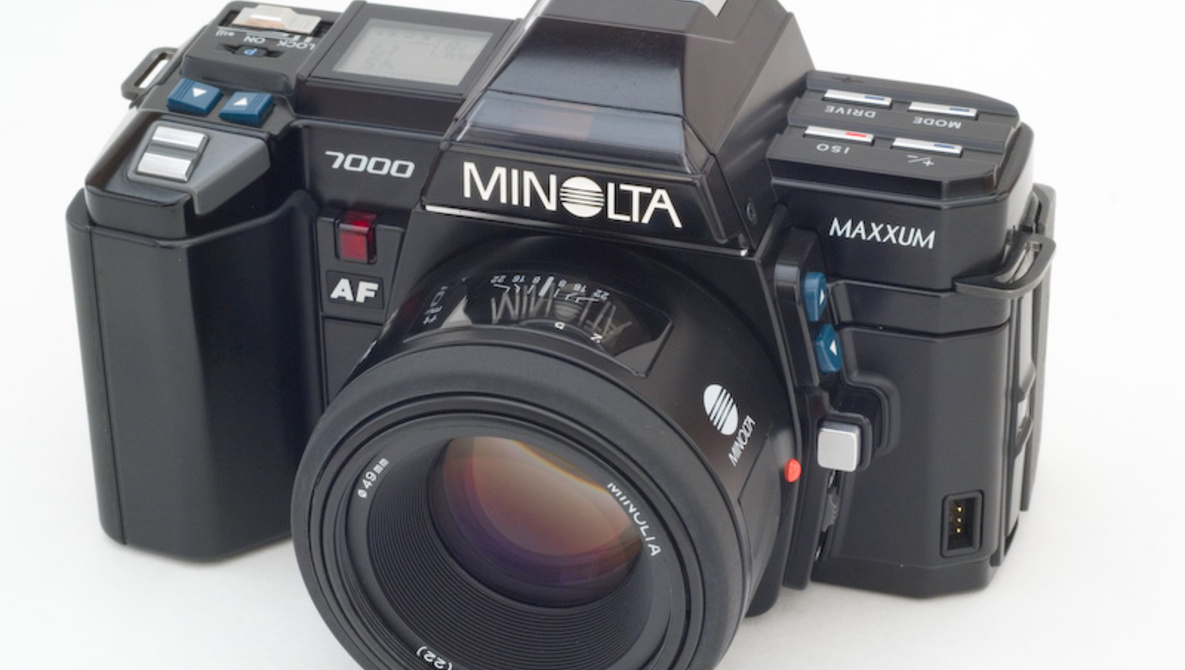
Before the “Big Two” dominated professional photography, there was a “Big Five.” Canon, Nikon, Pentax, Olympus, and Minolta all competed for market share in the film era, and among them, Minolta wasn’t just a player. They were arguably the most innovative of the entire pack.
This was the company that gave us the Minolta Maxxum 7000 in 1985, the first mass-produced 35mm SLR with fully integrated autofocus and motorized film advance that literally created the modern camera market as we know it. This was the company that introduced the world’s first sensor-based image stabilization system with the DiMAGE A1 in 2003 (what they called “Anti-Shake”), years before in-body stabilization became an industry standard. They collaborated with Leica on the legendary CL, developed advanced metering systems that pushed the entire industry forward, and consistently delivered optical quality that rivaled anyone in the business.
So what happened? How does a company that invented the modern autofocus camera and IBIS simply vanish from the face of the Earth? The common narrative you’ll hear is that Minolta was “slow to embrace digital” and got left behind in the transition from film. The reality is far more complex and far more tragic: Minolta’s death was a slow spiral that began with a catastrophic, industry-shaking lawsuit in 1992, was complicated by a desperate merger that solved nothing, and was finally ended by the company’s complete inability to compete in a technological war they could no longer afford to fight. The “slow move to digital” wasn’t the cause of Minolta’s death. It was a symptom of a mortal wound inflicted more than a decade earlier.
The Mortal Wound: The 1992 Honeywell Lawsuit
If you want to understand what really killed Minolta, you need to go back to 1992. This is the inciting incident, the catastrophic event that crippled the company long before digital photography became a serious threat. The Minolta Maxxum 7000 had revolutionized the camera industry in 1985, bringing reliable, integrated autofocus to the masses and forcing every other manufacturer to play catch-up. But there was a problem. Honeywell, a US technology conglomerate, claimed that Minolta had stolen its patented autofocus technology to create the Maxxum system. They sued, and in 1992, a jury sided with Honeywell.
The judgment was staggering: a jury awarded Honeywell $96.3 million, and the case was then settled for $127.5 million including interest. To put that in perspective, adjusted for inflation, that’s nearly a quarter-billion in 2025 money. This wasn’t a fine or a slap on the wrist. This was a corporate execution. That single payment severely constrained Minolta’s research and development capacity throughout the 1990s, the exact decade when every other camera manufacturer was pouring billions of dollars into the single most important transition in the history of photography: the move to digital. While Canon was developing the EOS D2000 and later the 1D, while Nikon was creating the D1 and building out its professional digital ecosystem, Minolta was trying to recover from a financial catastrophe that had crippled its ability to compete.
The timing couldn’t have been worse. The 1990s were when the digital revolution was incubating. Early digital cameras were clunky and expensive, but the companies that invested heavily in R&D during this period built the foundations that would dominate the 2000s. Minolta couldn’t make those investments. They were still digging out from the financial crater left by the Honeywell settlement. More specifically, they couldn’t invest in the single most expensive and critical component of the digital transition: sensor fabrication. Canon was pouring billions into developing its own CMOS sensor technology and building fabrication plants. Sony, not yet a camera manufacturer, was investing similarly massive amounts into CCD and CMOS sensor fabs, positioning itself as a key supplier. Even Nikon, which didn’t initially have its own sensor fabrication capabilities, was large enough to co-develop sensors and place massive orders with Sony and other suppliers. Minolta was left buying off-the-shelf sensors from third-party suppliers, which tended to leave their cameras a step behind in sensor performance and gave them less room on margins than fully vertically-integrated rivals.
The Death Spiral: Trying to Compete with a Broken Leg
Here’s where the mythology around Minolta’s demise really falls apart. The conventional wisdom is that Minolta was slow to embrace digital photography, that they were complacent or stuck in the film era while nimbler competitors raced ahead. But the truth is that Minolta was not slow to try. They released digital cameras relatively early, including models like the RD-175 in 1995. The problem wasn’t lack of effort or vision. The problem was that they simply couldn’t compete. By the time they launched their first mainstream A-mount DSLR, the Maxxum 7D, in late 2004, Canon and Nikon had already built out complete professional DSLR lineups and established themselves as the only serious choices for working pros. The 7D and its sibling, the 5D released in 2005, were good cameras that featured Minolta’s innovative Anti-Shake technology, but they arrived years too late to change the narrative. They were bringing a knife to a gunfight they used to own.
Canon and Nikon weren’t just making digital cameras. They were building complete ecosystems: professional-grade bodies, specialized lenses optimized for digital sensors, marketing campaigns that positioned them as the only serious choices for working professionals. They were spending the kind of money on R&D that Minolta no longer had access to. Every digital camera Minolta released was playing catch-up, always a generation behind in sensor technology, autofocus performance, or build quality. It’s not that they didn’t understand where the market was going. It’s that they couldn’t afford to get there fast enough.
By the early 2000s, both Minolta and Konica were bleeding. Both were respected camera manufacturers with proud histories and loyal followings, and both were getting crushed by the same market forces. The “solution” they arrived at was a merger, creating Konica Minolta in what was presented as a strategic combination of strengths. In reality, it was two drowning companies grabbing onto each other for support. The merger didn’t create a position of strength. It created a new entity with muddled branding, combined debt loads, and no clear market position that could differentiate it from the Canon-Nikon duopoly that was rapidly solidifying at the professional level. The prosumer and consumer compact segments were on the path to being gutted by smartphones in the following decade, and the professional market was already locked up.
Konica Minolta was trapped in the middle. Too small and under-resourced to compete with Canon and Nikon for professional photographers, too traditional and expensive to pivot to the emerging consumer electronics approach that would eventually give us companies like Panasonic and later the smartphone revolution. They were fighting on two fronts and losing on both.
The End of the Line: The 2006 Sale to Sony
By 2006, there were no more cards to play. On January 19, 2006, Konica Minolta announced they were ceasing all camera and photo operations, shocking the photography world and leaving countless loyal Minolta shooters wondering what would happen to their lens investments and camera systems. But here’s a detail that makes the story even more complex: Konica Minolta as a corporation didn’t die. The 2003 merger wasn’t just two drowning camera companies. It was a merger of two massive, diversified Japanese corporations whose business interests went far beyond photography. Both Konica and Minolta had large, highly profitable divisions in office equipment (copiers and multi-function printers), medical imaging systems, scanners, and optical components. When Konica Minolta Holdings announced it was exiting cameras, it wasn’t a bankruptcy filing. It was a cold, strategic business decision to amputate the underperforming, low-margin camera division and focus resources on their highly profitable B2B and medical imaging businesses. The camera and photo businesses together had posted losses of roughly ¥8.7 billion (around $80 million) in the prior fiscal year. Today, Konica Minolta is a multi-billion dollar multinational corporation that simply doesn’t sell consumer cameras anymore. The camera division wasn’t the whole company. It was just a diseased limb that the parent company cut off to save the rest of the body. But here’s where the story gets fascinating: Minolta didn’t just die. It was bought, and the buyer was Sony, a consumer electronics giant with deep expertise in professional video and broadcast equipment but no heritage in professional still-camera systems.
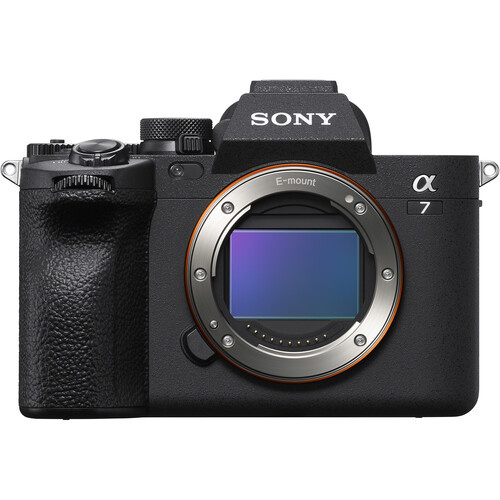 What did Sony actually purchase when they bought Minolta’s camera division? They got the A-mount, the autofocus lens mount that traced its lineage directly back to the revolutionary Maxxum system. They got all of Minolta’s “Anti-Shake” patents and the engineering expertise behind sensor-shift image stabilization. They got Minolta’s entire catalog of legendary lens designs and decades of optical engineering knowledge. And most importantly, they got a foundation to enter the camera market without having to build everything from scratch.
Sony’s Alpha line was born directly from Minolta’s corpse. The early Sony Alpha DSLRs were essentially Minolta cameras with Sony branding and electronics. The A-mount lived on. The sensor stabilization technology that Minolta pioneered became a cornerstone of Sony’s marketing. And as Sony eventually pivoted to mirrorless and created the revolutionary a7 series, that same Minolta-developed IBIS technology became one of the key features that made Sony’s full-frame mirrorless cameras so competitive against Canon and Nikon. Today, cameras like the Sony a7 IV, the company’s most popular all-around full frame mirrorless body, feature in-body image stabilization that is a direct descendant of Minolta’s Anti-Shake system, allowing photographers to shoot handheld in low light with any lens. Even Sony’s flagship a1 II, capable of shooting 50-megapixel images at 30 frames per second, is built on the foundation that started with the A-mount and IBIS technology Sony acquired from Minolta.
A Post-Mortem and a Rebirth
Minolta’s death wasn’t a simple failure to adapt or a case of corporate complacency. It was death by a thousand cuts, with the first and deepest wound being that 1992 Honeywell lawsuit. The settlement didn’t just cost them money. It cost them their future. It severely constrained their ability to invest in R&D, and particularly in sensor technology, during the exact decade when that investment mattered most. The “slow move to digital” that everyone points to as the cause of their demise was actually the inevitable result of that financial catastrophe. They were running a race with a broken leg, and eventually, they just couldn’t keep up.
The next time you pick up a Sony mirrorless camera and marvel at its class-leading sensor-shift stabilization, the next time you see a Sony shooter using an old Minolta A-mount lens via an adapter, you’re looking at the ghost of Minolta. The name is gone from camera bodies and lens barrels, but the spirit of innovation that made Minolta great, the engineering excellence that gave us the first mass-produced integrated autofocus SLR and the first sensor-based image stabilization, lives on in the company that bought its legacy. Minolta may have lost the war, but their innovations won the future.
Lead image by Shaocaholica at the English-language Wikipedia, CC BY-SA 3.0.