
Last week’s inflation data showed electricity prices have jumped by 37 per cent in the past year.
It sparked more talk of the cost of living, with Treasurer Jim Chalmers leaving the door open for a possible extension to the federal government’s electricity rebate scheme into 2026.
Why is the electricity market on Australia’s east coast so dysfunctional?
There have been two episodes in modern history where Australia has connected a domestic energy market to the global market before, and we’ve then been hit by a global energy shock, which made inflation in Australia worse.
We’re currently dealing with one of them.
Crude oil in the 1970s
One episode occurred in the 1970s.
In the early 1970s, Australia was producing much of its own oil for domestic consumption.
It meant Australian motorists were partly shielded from global fluctuations in the price of crude oil.
Is there something rotten in Australia’s fuel market?
But in late 1978, the Coalition government of Malcolm Fraser introduced a new fuel tax, with a plan announced by his young treasurer John Howard.
At the time, Australia was producing roughly 70 per cent of its domestic oil needs, and the maximum allowable retail price for premium petrol in Sydney was 21 cents per litre.
But Mr Howard said Australian motorists were getting petrol too cheaply.
He announced a plan that all Australian-produced crude oil would be required to start being sold to local refineries at the same price as it cost to import crude oil from overseas.
It meant Australians would have to start paying prices based on world oil prices; they’d no longer be able to enjoy cheap oil from their own domestic supply.
And he justified his plan partly on ecological reasons.
“Since the OPEC countries quadrupled the world price of crude oil in 1973-74, Australians have continued to enjoy artificially low prices for crude oil,” he told parliament.
“While the rest of the world was facing up to the inescapable fact that the days of cheap energy were over, Australians — even after the imposition in the 1975-76 budget of a $2 per barrel production levy — were continuing to pay less than half of the world price for Australian-produced crude oil.
“Subsidised indigenous oil prices encouraged a wasteful use of a key energy resource and inhibited the adoption of more energy-efficient processes and technologies.
“In recognition of this the government moved last year towards a more realistic pricing policy for Australian-produced crude oil,” he said.
Mr Howard said his “import parity pricing” regime would increase the production levy on oil produced in the Bass Strait from less than $3 per barrel to the “world price” of $10.26 per barrel.
He estimated it would see petrol prices rise by 3.5 cents a litre initially. Given the maximum retail price for petrol in Sydney was 21 cents a litre, it represented an increase of 16.6 per cent.
It was a historic policy shift.
From that moment, Australia would connect its petrol prices to the global price of crude oil, putting Australian motorists and consumers more at the mercy of international markets.
And it happened just before the 1979 oil crisis.
In the aftermath of that oil crisis, Australia’s domestic fuel prices would jump by nearly 50 per cent, which fed into the destructive inflation Australia experienced in the early 1980s.
Liquefied natural gas in the 2020s
The second episode occurred more recently.
Since 2015, when the Gladstone LNG terminal was opened in Queensland, gas has been a major export industry for eastern Australia.
Australia’s energy costs have tripled and manufacturers are hurting
It’s had a major impact on energy prices (and inflation) in ways most Australians still don’t understand.
As the Australian Energy Regulator (AER) explained in 2021, demand for gas on Australia’s east coast historically derived from three main domestic sources – commercial and industrial (C&I) gas users, gas-powered generators, and residential customers.
But with the launch of LNG exports in 2015, international customers became a new source of demand, competing to buy eastern Australian gas.
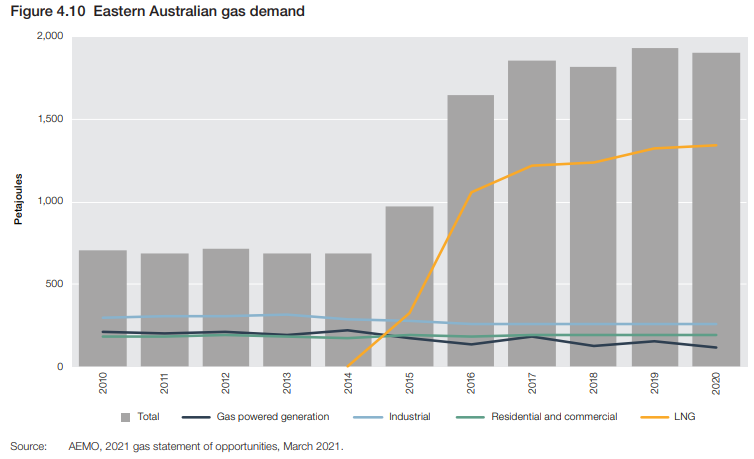
It has transformed Australia’s eastern gas market by giving producers the choice of exporting gas or selling it domestically:
“By 2018, over 60 per cent of eastern Australian gas production was being exported,” the AER said.
“With domestic users now competing with overseas customers to buy Australian gas, prices in the domestic market have shifted to align more closely with international gas prices.
“Shifting gas prices also impact electricity markets, which rely on gas powered generation to firm output from weather-dependent renewable generation and at times of peak electricity demand.”
By early 2021, the AER said so much gas was being exported from Australia’s east coast that five LNG import terminals were under consideration in NSW, Victoria, and South Australia to solve a forecast domestic gas shortfall in Australia’s southern states.
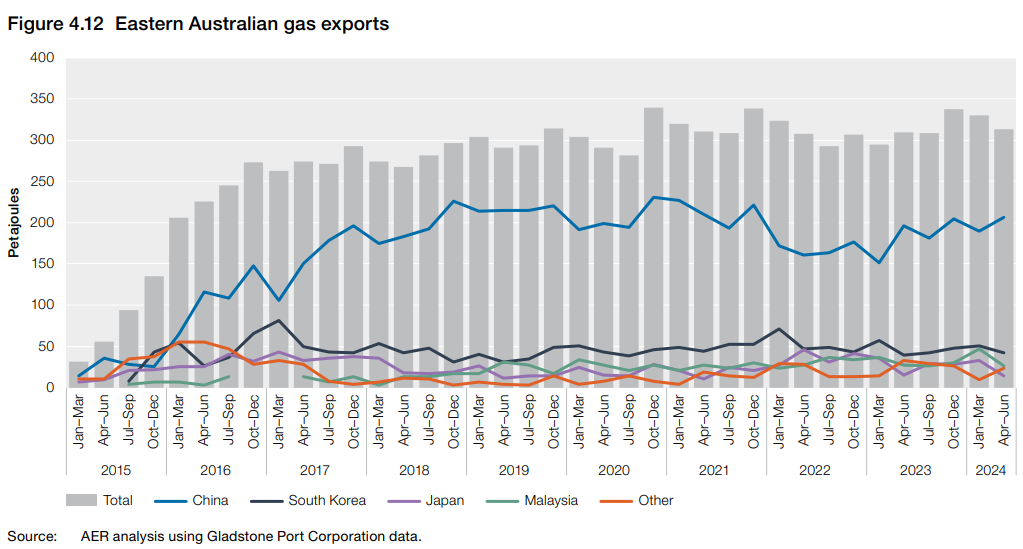
In 2023, China was the primary market for eastern Australian LNG, accounting for 59 per cent of exports (733 PJ). (Source: Australian Energy Regulator, State of the Energy Market 2024, page. 165)
Since gas prices on the east coast have become “aligned” to the world price for gas, we’ve been more at the mercy of global energy supply shocks.
And a big shock came in 2022, with Russia’s invasion of Ukraine.
It contributed to Australian domestic gas prices hitting record high levels in 2022, which fed into Australia’s surge in inflation in 2022 and 2023.
Bruce Robertson, a former stockbroker and fund manager who is now an independent energy consultant, told the ABC earlier this year that gas exporters were also responsible for high gas and electricity prices in Australia.
Gas giant Australia on cusp of importing supplies
He said the price set for gas on Australia’s east coast sets the benchmark for electricity prices in the wholesale market, which is where manufacturers buy their gas, and it was “obscenely expensive”.
“Exxon, Woodside, Origin Energy, ConocoPhillips, and the Australian company Santos — they control the market and set the price for gas,” he said.
“Prior to [gas exporting from] 2015, gas and electricity was affordable. But since the gas cartel has been operating we’ve seen prices go through the roof.”
In September this year, the Australian Competition and Consumer Commission (ACCC) said that despite recent government efforts to force those gas producers to supply more gas to Australia’s domestic market, the situation still hasn’t improved.
“Upstream markets are uncompetitive and remain dominated by the Queensland LNG producers and their associates, who influence over 90 per cent of east coast reserves,” it said.
“The lack of effective upstream competition is contributing to the imbalance in bargaining power faced by gas buyers and their difficulties securing gas on acceptable terms.”
When is the next global energy shock coming?
If Australia ever gets to the point where it can produce 100 per cent of its energy from renewable sources, will it avoid those types of global energy shocks in the future?
It’s not hard to imagine a future where the phrase “global energy shock” falls out of use and becomes redundant when enough countries can produce their own energy from domestic renewable sources.
That scenario would also help the Reserve Bank to control inflation.
Are inflation-targeting central banks ready for the ‘new inflation’?
Two economists from the International Monetary Fund (IMF) recently pointed out that the 2022 inflation surge, which was partly driven by skyrocketing energy prices, created a real-life experiment to test which countries managed inflation better during a global and synchronised supply shock.
And surprisingly, they found there was “no systematic evidence” that inflation-targeting countries, such as Australia, were any better at insulating their economies from global price pressures in recent years than countries that didn’t practice inflation targeting.
They said their finding was significant.
They said for the past 40 years, inflation has been understood as a predominantly demand-driven phenomenon, and macro-economic models have been operating on the premise that inflationary pressures can be effectively contained through aggregate demand management (shifting interest rates up and down).
But if supply-side driven inflation becomes more persistent in the future, it’s going to challenge contemporary inflation-targeting frameworks, they said.
“[And] we are entering a period marked by sustained and overlapping supply disruptions, many of which are structural and slow moving,” they warned.
So, if Australia does eventually produce 100 per cent of its energy from renewable sources (it will be a long and expensive journey to get there), you’d think it would reduce the risk of Australia being caught up in future global energy shocks.
Preventing cartels from controlling future energy supplies would also be beneficial.
Both of those things would help to reduce the cost of living.