
THEATRE
Nihilistic Optimism on Trampolines ★★
Theatre Works, until December 6
Kasey Barratt’s Nihilistic Optimism on Trampolines takes a seminal moment in the history of gothic literature – the writing of Mary Shelley’s Frankenstein – and reimagines it unfolding in the present day … at a trampoline park during a thunderstorm.
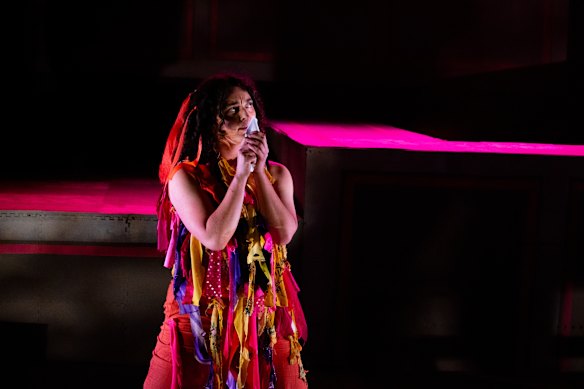
Nihilistic Optimism on Trampolines at Theatre Works is an imaginative retelling of Frankenstein.Credit: Sian Quinn Dowler
The show stitches together unlikely elements – trampolining, TikTok-length choreography, a live rock band, and an original play spliced with excerpts from Shelley’s novel and letters – and I admired the boldness, ambition and willingness to experiment that this young ensemble brings to the lab.
Is it any good? Not really. It’s a strange and misshapen creation which, unlike Mary Shelley’s classic, often feels like less than the sum of its parts.
Famously, Mary began to write Frankenstein aged 18, as part of a ghost story competition initiated by Lord Byron at Lake Geneva in the summer of 1816. (The event also birthed the first vampire fiction in English, John Polidori’s The Vampyre.)
Barratt morphs the figures present – Mary (Gabrielle Ward), her fiance Percy Shelley (Bek Schilling), her stepsister Claire Clairmont (Sophie Graham Jones), Lord Byron (Eleanor Golding) and Byron’s doctor John Polidori (Zoe Wakelin) – into bored employees at Trampoline World.
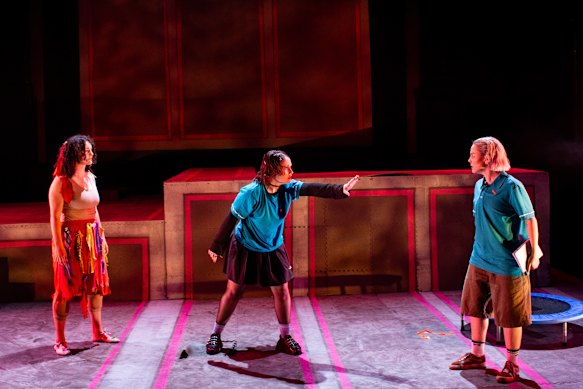
The show – set in a trampoline park – stitches together unlikely elementsCredit: Sian Quinn Dowler
A lackadaisical teen movie vibe cuts against gothic atmospherics, and Barratt’s script spends too long establishing the cheerless routines and post-industrial ennui of young drudges at a leisure park. Most of the water cooler conversation, petty power plays and furtive work flings aren’t especially funny or dramatically compelling, though occasional flashes of camp do lighten the drear.
Things pick up when Victor Frankenstein’s creature (Jett Chudleigh) boings into view. Encounters between the young author and her creation, using dialogue from the novel as well as physical theatre and dance, have an eerie lustre.
Yet somehow the act of reassertion in the face of a historical erasure (Percy Shelley was originally credited as the author of Frankenstein) doesn’t go all-in.
Loading
The climax is shadowy and under-realised, and I would have loved to have seen the monster go on a murderous rampage against the male characters (most played in drag) and for feminist fury to be unleashed with maximal force through text and stage action.
Part of the problem is an inexperienced cast. Performance elements from choreography to microphone technique could use more precision and confidence. And the script, too, needs to refine its themes and junk ineffective dialogue.
These artists may have a long way to go, but they’ve a long time to get there. And the range of talents on display – from the athleticism of the trampolining to the three musicians jamming live accompaniment – bodes well for developing a unique theatrical style.
Reviewed by Cameron Woodhead
MUSIC
Mirra – Norwegian Tradition Reimagined ★★★★
Primrose Potter Salon, Melbourne Recital Centre, November 27
Growing up in the Hardanger fjord region in Norway’s west, Benedicte Maurseth developed twin passions that have continued to propel her creative vision and career. One is the traditional nine-string Hardanger fiddle; the other is the natural beauty of the vast Hardanger mountain plateau.
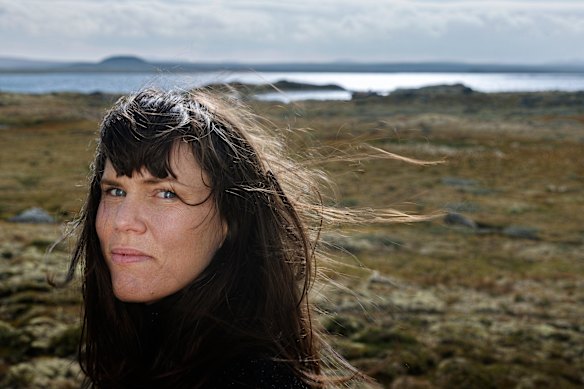
Benedicte Maurseth’s latest album, Mirra, is inspired by wild reindeer.Credit: Agnete Brun
These two passions are directly intertwined on Maurseth’s latest album, Mirra, inspired by the habitat, behaviour and migration patterns of wild reindeer.
At the Recital Centre on Thursday, Maurseth led a superb quartet through a program that – like the album – followed a seasonal cycle. We began in the depths of winter, where reindeer run in circular patterns to keep warm, or lie perfectly still in the snow as the wind whips over them. Mats Eilertsen’s bowed bass harmonics and Håkon Mørch Stene’s rolling percussion suggested the former, while Morten Qvenild’s glistening electronics and Maurseth’s graceful fiddle phrases effortlessly evoked the latter.
Spring brought new life (The Calf Rises) with a ravishing fiddle and piano duet, while Summer Pastures coaxed the music into more rhythmic territory, with electric bass, insistent vibraphone and a trance-like, minimalist drum pattern. Reindeer Call included the sampled voice of a reindeer herder, nestled within a thicket of abstract, improvised textures that gradually coalesced into a slow, shadowy Hunting March.
Loading
The reindeer nudged themselves into the foreground at various times (via field recordings of their communicative grunts), as did other native wildlife from the Hardanger region. Heilo featured the cawing of the Eurasian plover as a recurring motif, buoyed by Maurseth’s fiddle as it glided weightlessly on invisible thermals.
Often, one composition segued into the next without pause, adding to the sense that we were immersed in this mysterious and awe-inspiring landscape. Occasionally, the electronic elements dominated and overwhelmed the sound of the fiddle, smothering the resonant shimmer of its sympathetic strings. But for the most part, this was an utterly entrancing evocation of the natural world in all its fierce beauty, majesty and vulnerability.
Reviewed by Jessica Nicholas
The Booklist is a weekly newsletter for book lovers from Jason Steger. Get it delivered every Friday.