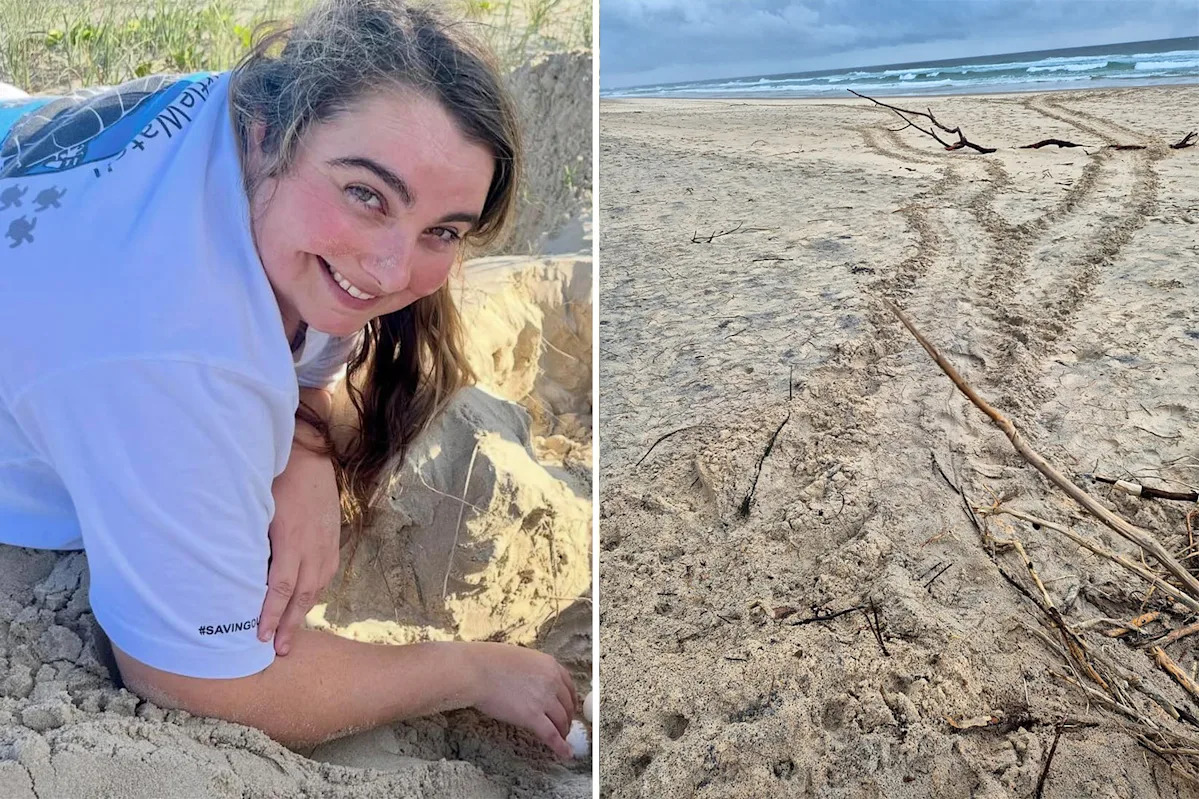
A line of tracks in the sand leading from the ocean to the dunes above has sparked a plea for everyday Aussies while they walk along our vast coastline. This year, things are looking concerningly different for our turtle population.
Merryn Dunleavy, project officer for NSW TurtleWatch, has spent the past 13 years dedicating her life to watching out for turtles as the nesting season kicks off every year from October to March.
But, the first nest of the season, discovered by a dog walker, was made by a green turtle that laid 80 eggs, in the country’s most populous state. It revealed a “really big problem”, Dunleavy told Yahoo News.
Wild weather caused by Cyclone Alfred earlier this year, combined with changing habits of the turtles, has seen the need for intervention with nests laid by the loggerhead and green turtles higher than ever before. The two NSW turtle species are both threatened.
Have you spotted a turtle nest along the coast? Contact newsroomau@yahoonews.com
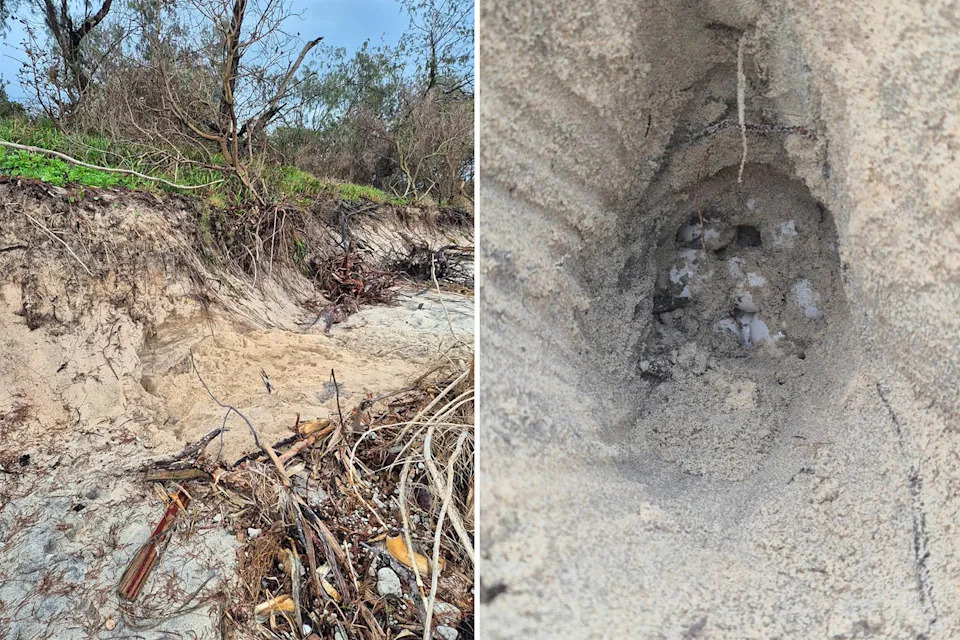
Eggs from a nest laid by a green turtle had to be moved after the animal couldn’t get to the top of the dunes. Source: Supplied
“Because of Cyclone Alfred, the dunes have been hammered quite hard,” Dunleavy explained. “They’ve not had enough time to recover, which can take many months and sometimes years.”
She said the erosion is on a scale that “has never been seen”, and it means that turtles are being forced to lay their eggs close to the water line.
Unfortunately, she explained, “seawater and turtle eggs don’t mix”. The embryos can drown if nests are inundated with water.
It means that teams of volunteers have no choice but to dig up and incubate the eggs for fear they will be wiped out in wild weather.
Only one in every 1,000 turtles will make it to adulthood, Dunleavy explained, making it important that as many eggs as possible are given the best chance of survival.
Turtle populations experiencing southern migration
As well as turtles struggling to get to dunes in their normal nesting areas, some are moving further south along the coast.
In the past few years, turtle nests have been found as far south as Wollongong and Bateman’s Bay. While there are theories as to why the turtles are moving further south, nothing has been confirmed.
“It could be because the East Australia current is being pushed further south, but we could also be seeing an increase in marine turtles nesting.”
What it means is that there is more coastline for volunteers to cover to ensure that nests have been made in appropriate spots.
Plea to Aussies to ‘report’ mysterious tracks on beach
Dunleavy has asked people to keep an eye out for tracks on the beach and report it to the TurtleWatch hotline, in case they were made by turtles appearing in unexpected locations.
The best way to tell what type of turtle came ashore is by inspecting the distinctive marks made in the sand by their flippers.
Loggerhead tracks look like “comma swirl marks”, whereas green turtle tracks look like “tyre tracks”.
“The best thing you can do is take loads of photos,” she said, and report it to the group’s 24-hour nesting hotline.
“The most important thing is early reporting. The quicker our accredited volunteers can respond and safeguard the eggs, the higher the hatching success rate. The longer they are left, the harder they are to move,” she said. “We’re putting the call out for a little bit of extra love.”
Tips for Aussies during turtle nesting season
Never touch or handle turtles or hatchlings
Be patient. Sometimes, mothers may abandon the nest and dig elsewhere
Give way to returning sea turtles. Ensure she has a clear path to return to the ocean
Don’t drive on nesting beaches, and dogs must be kept on a leash at all times
Contact NSW TurtleWatch on 0447 877 149.
Do you have a story tip? Email: newsroomau@yahoonews.com.
You can also follow us on Facebook, Instagram, TikTok, Twitter and YouTube.