
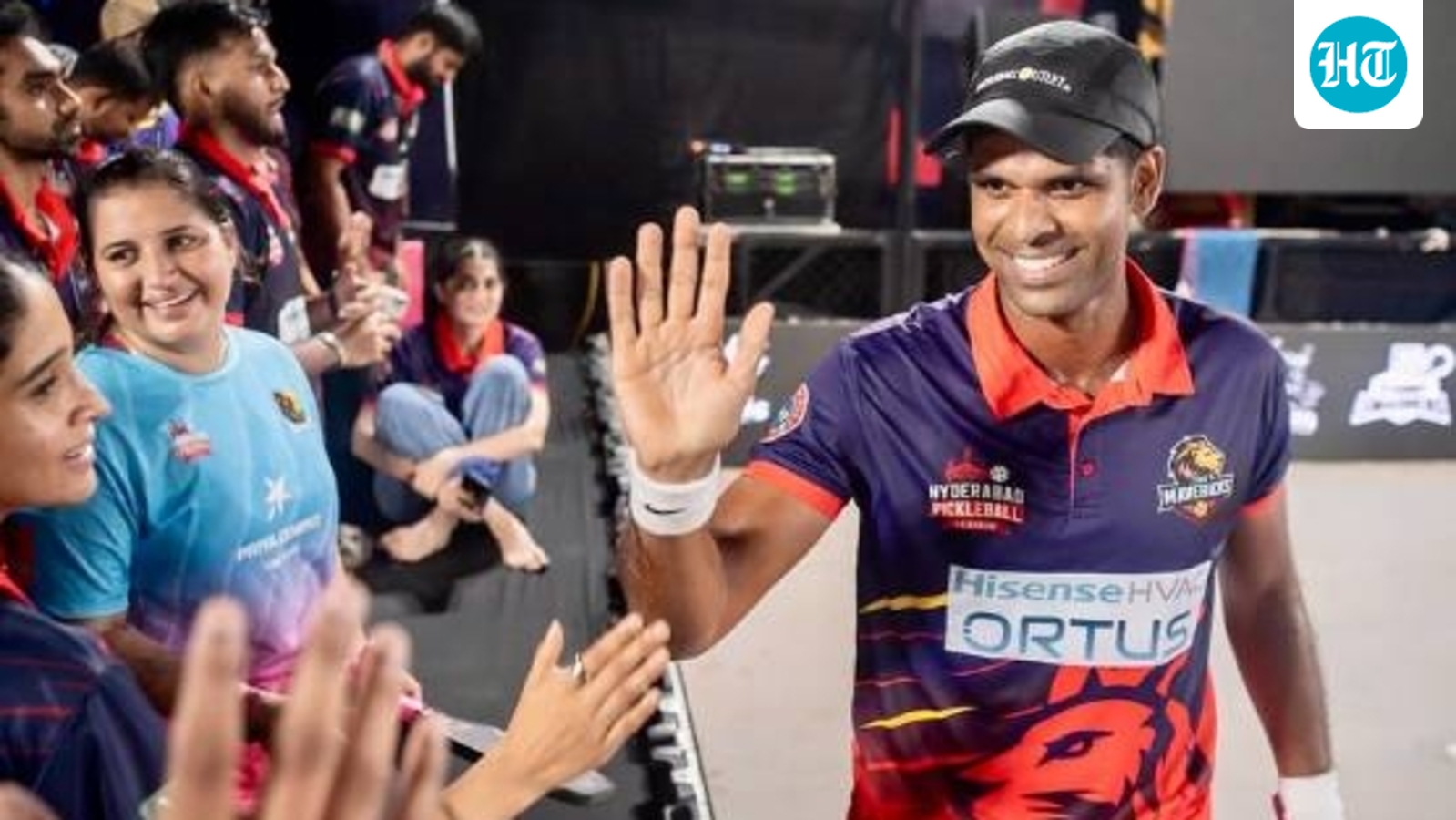
But today, the racquet sport catching the eye of his seven-year-old son isn’t tennis. It’s the one Vishnu himself has been actively promoting and playing, a sport that has turned into a nationwide fever over the past few years: Pickleball.
“Just before leaving for school, he’ll say, ‘Come down, let’s play pickleball,’ and we just go downstairs and play,” Vishnu told Hindustan Times. The point he stressed wasn’t only his child’s enthusiasm, but the accessibility of the sport — something tennis has never truly offered.
A few years ago, when the pickleball craze was beginning to take shape globally, a video went viral on social media: two men casually playing pickleball inside an airport lounge. Soon after, New York’s JFK airport launched a pop-up pickleball court within its terminal. Over the next few years, airports around the world followed suit, setting up makeshift courts to give stranded passengers a playful escape during flight delays.
This convenience, the ability to set up a court almost anywhere, is what Vishnu believes makes pickleball the cricket-equivalent of racquet sports in India. Easy to learn, inclusive by design, and playable by all age groups, it has the “gully cricket” factor that no other racquet sport can match.
“The first thing that struck me was how easy it is to get started,” the 38-year-old explained. “I’ve been playing tennis professionally for 22–23 years, and it’s always been difficult for someone like my mother, for example, to pick up tennis because the learning curve is so long. But pickleball is much easier — people can start playing almost immediately. With so much of our time now spent on screens, pickleball offers an opportunity for people to get outdoors, be active, and play a sport without much friction. That’s what drew me to it. I want to impact as many people as possible by helping them get outside and play. That will always be my main goal.”
“Even with cricket, one of the easy parts is that there’s very low friction to start playing the sport. At some point, everyone has played gully cricket. We used to play in school, even in classrooms with pads and paper balls. I feel a very similar thing is happening with pickleball.”
Vishnu has remained active in tennis throughout, and is even set to compete in the annual Tennis Premier League (TPL) in Ahmedabad next month. But alongside his ongoing tennis career, the veteran has taken on a far greater responsibility in pickleball. Since picking up the sport a few years ago, he has not only immersed himself in it but also stepped into administrative roles that have given him a deeper understanding of its landscape and potential in India.
“Tennis is something I’ve played all my life, but for the last two years I’ve been actively involved in the pickleball scene, especially within my state. I also head the Telangana Pickleball Association and have been part of the Hyderabad Pickleball League, which has created a lot of buzz in our community. We get a footfall of around a thousand people every Friday when the league takes place. We also fielded the biggest contingent at the IPA Nationals earlier this month.
“I’ve been very actively involved and stay in touch with almost the entire pickleball community, which mainly includes former tennis, badminton, or table tennis players. So the interaction has been very easy and natural. Of course, it’s a bit challenging to manage everything together, but I’m very excited about this opportunity and the value I can bring to the sport,” he said.
With such a deep involvement, Vishnu has also gained a clearer view of where pickleball is headed in India, and he feels the phenomenon is bigger than what was witnessed in the U.S.
“The potential of pickleball in the country right now is huge. I think it’s once in a generation that you see a sport explode like this. The growth trajectory we’re seeing in India is actually higher than what was observed in the U.S. or Vietnam, where the sport is already doing well. The potential is definitely enormous, and the way it’s growing, it could become a very close contender to cricket — though only time will tell if it reaches that level.
“Getting the approval of the government for the All India Pickleball Association (AIPA) as the official Pickleball association, and heading the Telangana chapter, is a proud moment for me. I want to use all my experience as a professional tennis player to strengthen administration, support players in the state, and help them turn professional. Alongside that, we have very ambitious grassroots goals — for example, introducing pickleball to 10,000 students in 2026. It’s ambitious, but we have a strong team working on it,” he added.
Few in India dare to compare any sport’s potential with cricket and its unmatched fanfare. But having served both as a player and in an administrative role, Vishnu does so confidently, arguing that pickleball’s “entertainment quotient” gives it a cricket-like appeal — and, with time, the potential to reach unprecedented popularity.
“Another similarity with cricket is the entertainment quotient. When people watch a cricket match or a league, they’re fully entertained, not just by the sport but by everything happening around it. The audience doesn’t have to sit quietly or be stoic — they can enjoy the action and the atmosphere together. I think these similarities are helping pickleball see a spike in both viewership and participation.”
What does pickleball need now?
Any trend — even one growing as explosively as pickleball, can lose momentum if its rise isn’t supported by structure. India has witnessed the launch of countless sports leagues over the past few years, with several more in the pipeline. But long-term growth requires organisation, consistency and a clear pathway for players. In pickleball’s case, that responsibility lies with the All India Pickleball Association (AIPA), the national governing body founded in 2008, which now works closely with state units to streamline the sport.
Vishnu believes that while participation has skyrocketed, the next phase of growth depends on building a solid, unified system.
“See, right now, as I mentioned, a proper structure needs to be brought into the sport. We’re yet to see that fully manifest in pickleball. Currently, there are a lot of haphazard events, sometimes multiple events in a week, with organisers pressuring players to participate in their own tournaments. It’s very important that the federation and associations put a proper structure in place, not just for events but across other aspects as well, like standardising surfaces and balls, training officials and referees, and ensuring tournaments are conducted fairly and uniformly. IPA is focusing very strongly on these areas.”
Over the next week, at Delhi’s KD Jadhav Indoor Stadium, Vishnu will take on a new role, head coach of the Lucknow Leopards in the inaugural Indian Pickleball League. It is the country’s first official pickleball league, and marks a landmark moment for the sport, backed by the Ministry of Youth Affairs & Sports and the Sports Authority of India.
“I’m super excited to be part of a sport that’s growing so rapidly in India. The Indian Pickleball League is the country’s first official league, and it’s being organised on a very grand scale. I’m truly honoured to be part of this historic event. Having the support of the Sports Ministry and the Sports Authority of India gives the sport clear direction. Along with taking pickleball to a professional level through the league and major tournaments, there are also several grassroots initiatives planned. So it’s a very exciting time for pickleball right now.”
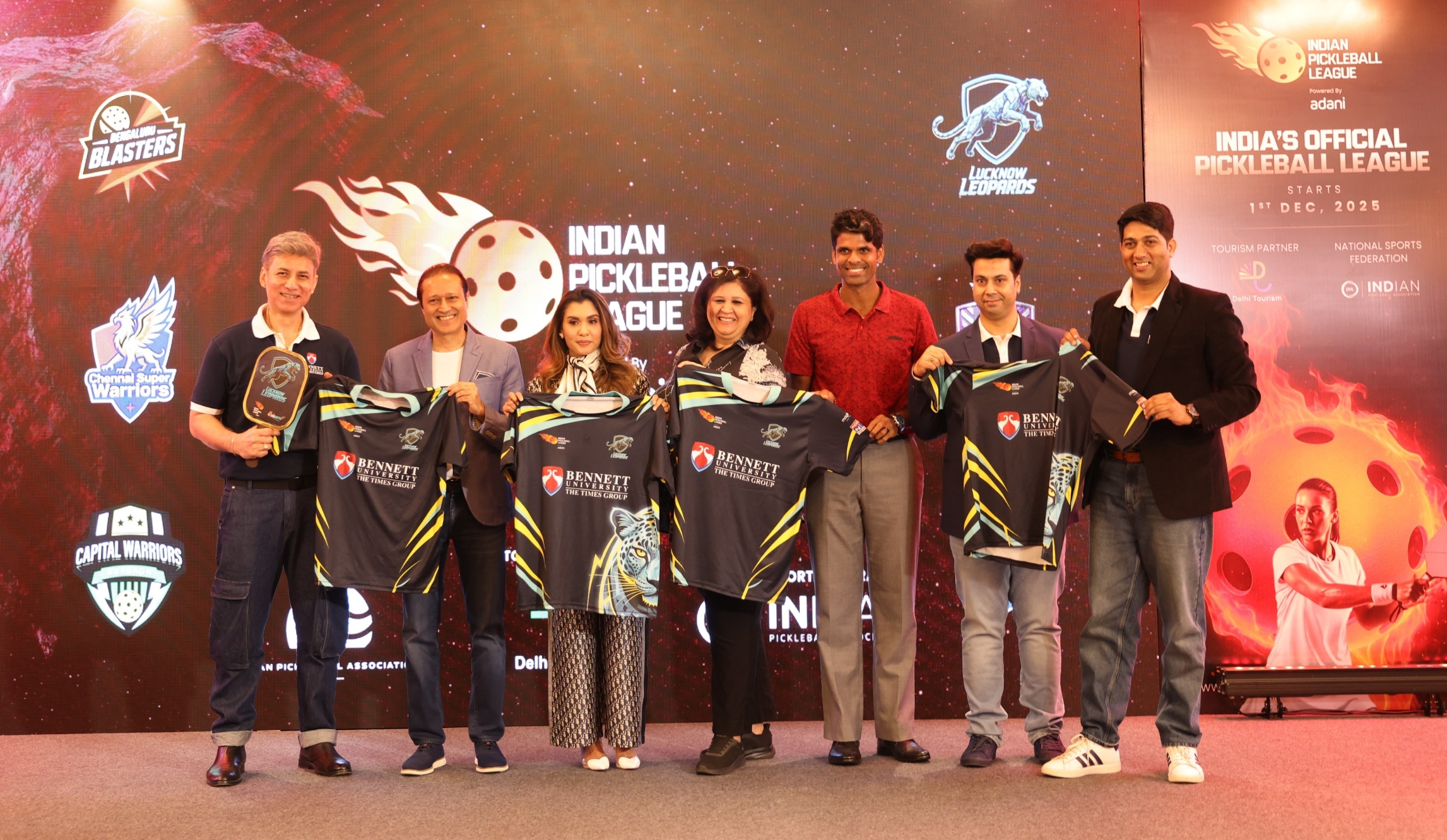 Lucknow Leopards coach Vishnu Vardhan (third from right), ace Indian tennis player, at the IPBL 2025 player draft
According to Vishnu, once India, and the rest of the pickleball-playing world, embraces a structured approach, the sport will be ready for its next big leap: inclusion in major multi-nation events.
“Once this structure is in place, the next step would be inclusion in the Asian Games. We are already seeing pickleball grow rapidly in countries like India, Malaysia, Vietnam, and Thailand. Even in China, known for its excellent table tennis and badminton players, pickleball is catching on. Some of their players have incredibly fast hands — even quicker than what I’ve seen in India. Once these countries adopt the sport on a larger scale, inclusion in the Asian Games becomes a natural progression. And once it’s in the Asian Games, it’s only a matter of time before it becomes an Olympic sport.”
Is pickleball going head to head with other racquet sports in India?
A few months ago, The New York Times published an in-depth investigation into how pickleball had overtaken thousands of tennis courts in the US. By analysing nearly 100,000 aerial photographs, the study identified around 26,000 outdoor pickleball courts were built in the past seven years, many at the expense of former tennis facilities. The report noted that more than 8,000 tennis courts had been converted for pickleball use.
From his unique vantage point — active in both sports as a player and administrator — Vishnu didn’t deny that a similar trend is visible in India.
“There’s no two ways about it — pickleball is taking some traction from tennis and badminton, mainly because the entry barrier is very low. On a single tennis court, you can set up four pickleball courts. I’ve seen many tennis courts being converted, and a lot of pickleball events are held on tennis courts with temporary lines. Even our own national championship happened at a tennis facility that was converted for pickleball,” he said.
But Vishnu was quick to clarify that this shift doesn’t necessarily come at tennis’ expense.
He explained that pickleball has largely created its own wave of participation, pulling in people who once drifted away from sport — and offering them a fresh re-entry point rather than redirecting existing tennis or badminton players.
“Having said that, I don’t see a dip in participation or progress in tennis or badminton. Instead, a new set of players is entering pickleball. Many former tennis players now compete in the 30-plus or 40-plus categories, especially in South India. Friends who quit tennis years ago due to finances or education have come back through pickleball. And former junior tennis players — like Armand Bhatia and Sameer Verma from Hyderabad — are now among the best pickleball players in the country.”
To Vishnu, this influx strengthens but doesn’t threaten India’s racquet-sport ecosystem.
“Rather than taking away from tennis, badminton, or table tennis, pickleball is creating a new entry point. For a young sporting nation like ours, this is very positive. With India set to host the 2030 Commonwealth Games and bidding for the Olympics, I feel we are going to mature into a strong global sporting nation.”
When asked whether young racquet-sport athletes are actively switching to pickleball, Vishnu agreed, and said the transition is logical.
“This transition is happening because tennis, badminton, and table tennis players already have an advantage when they come into pickleball. They see a good opportunity here.”
That opportunity, he added, is amplified by the structure of the new Indian Pickleball League.
“Unlike some tennis leagues like the Tennis Premier League, which involve many foreign players, the Indian Pickleball League focuses heavily on Indian talent. Each team has only two foreigners and four Indian players. I think this is a great concept — it gives our players a platform to showcase their skills, test themselves on a big stage, and grow. This will definitely help them going forward.”