
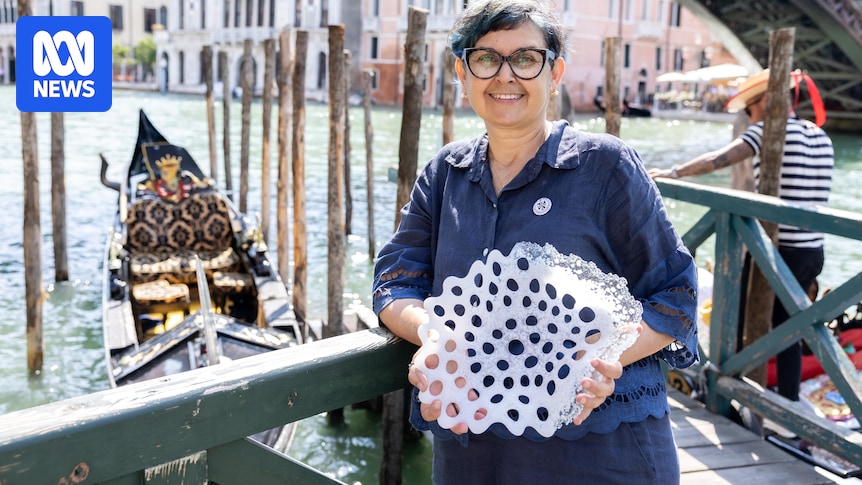
When Sabrina Dowling Giudici was a teenager who loved art, her Italian father sat her down and said it was not something she could do for a living.
“He explained it was because Michelangelo died with ticks on his body,” she said.
“So he said, ‘it’s all well and good to make beautiful art but you need to be able to make a living as well’.”
So Dowling Giudici dutifully went to the University of Western Australia and studied accounting, but it was far from her passion.
“I thought my soul was going to be ripped out of my body,” she said.
Home filled with light
Dowling Giudici moved back to Carnarvon, where she grew up, to work in regional development.
However, she eventually found her way back to art.
Dowling Giudici, works in cold glass, draping panes of solid glass over moulds and shapes, then placing them in a kiln to produce works that speak very much to her home.
“I’m a bit of a specialist with fire blankets, so I get very organic shapes as a result of that,” she said.
“I will hand shape a fire blanket and then I’ll put my very flat piece of glass over that and it will soften down and take the shape that I have underneath it.”
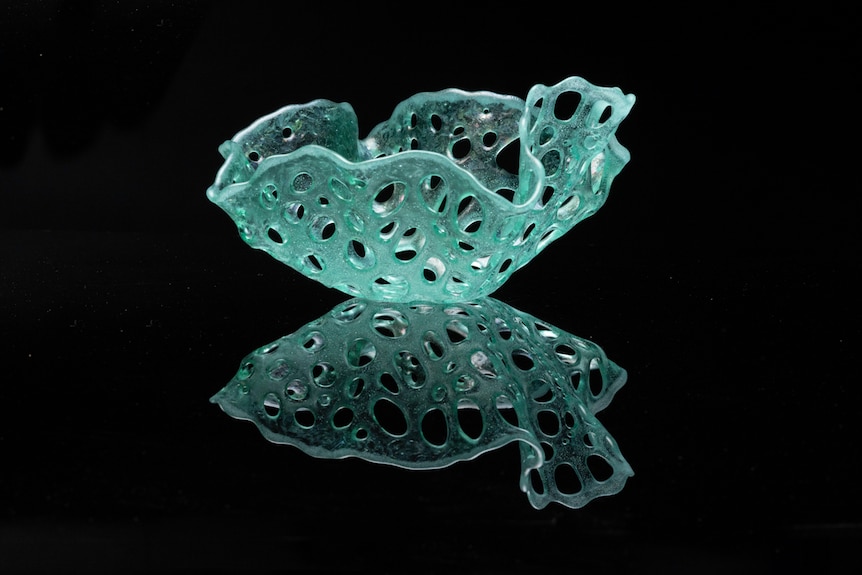
Sea Nymph has an organic, lacy appearance that features heavily in Sabrina Dowling Giuduci’s work.
(Supplied: Anton Blume/Aartworks)
She said she chose glass because of her Gascoyne upbringing. The medium allows her to capture the light and colour of the place she was raised.
“Carnarvon is one of the world’s highest light-intensity places on the planet,” she said.
From 1963 until 1975, NASA operated a tracking station in Carnarvon, during which it supported the Gemini, Apollo and Skylab space programs, including the moon landing in 1969.
At the time it was the largest tracking station outside mainland USA and had the most accurate radar system in the southern hemisphere, proving vital for staying in touch with Neil Armstrong and his crew.
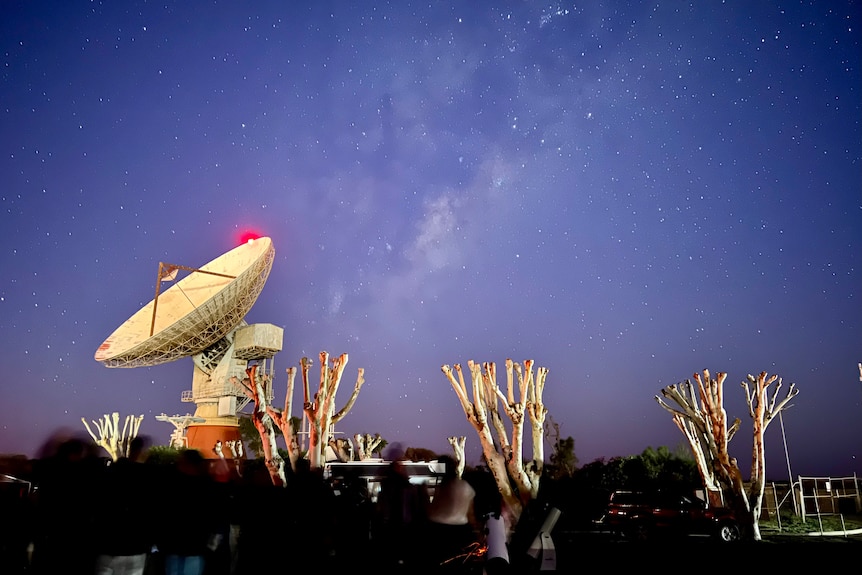
Carnarvon was chosen by NASA for a space tracking station due to its remarkably clear skies. (ABC News: Alistair Bates)
“I was in Carnarvon during all the moon landings. When I was a child, I thought everybody worked in the space industry because we had the NASA tracking station there,” Dowling Giudici said.
“We have those projects there because we have very few cloudy days.”
Learning on Malgana country
Dowling Giudici said her leap from regional development into art came five years ago, after the death of local elder Uncle Jimmy Poland, from Shark Bay, with whom who she had been working.
“I’m here today, I believe, because of him,” she said.
“Because I had the privilege of working with him for a few years.
“On the day of his funeral I’m sitting down and we’re watching sunset approaching. We’re looking over the bay.
“This is a Malgana country, Shark Bay. And the sky became moody. It was out of the blue and we got the most amazing white rainbow.
“And it hit me all of a sudden that he actually had been teaching me for the last few years and I hadn’t realised, it’s that really beautiful, profound elder style way of teaching.
“And so I thought that’s it, I’m going to do it myself.”
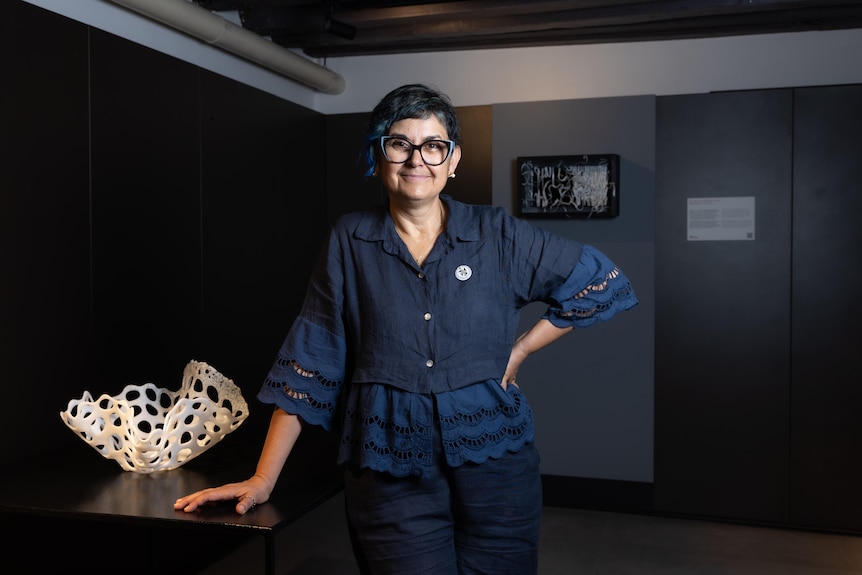
Sabrina Dowling Giudici with Phyto at the 2025 Venice Glass Week Hub. (Supplied: Svaldo Di Pietrantonio)
From Carnarvon to Venice
Recently, her glasswork has taken her even further back to her roots, to Rome where she was born to Italian parents, her mother a seamstress and her father a civil engineer.
Her father’s brothers migrated from Italy to Carnarvon to start a construction business, and when she was a toddler, her parents decided to join them.
“When we arrived in Carnarvon, [my mother] was fully resplendent in her Roman fashion gear,” she recalled.
“I had shiny patent black shoes with lace white socks and my father was in his beautiful long elegant pants and shirt and we arrived in the middle of this very, very Aussie outback town.
“As a child I never had toys. I played with what was available. So there was bits of wood and my mother she sewed all day and all night, and so I would have pieces of lace.
“For me they were the toys.”
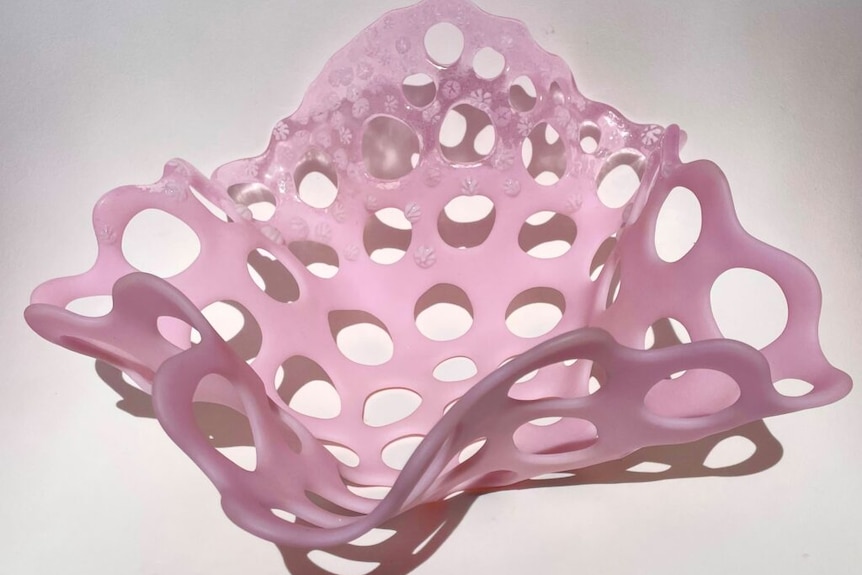
Onda Series: Coral Spawning by Sabrina Dowling Giudici (Supplied: Linton and Kay Galleries)
Glass meets lace
This year, for the second time, Dowling Giudici has been invited to exhibit in Venice, one of the world’s greatest glass-making centres, for Glass Week.
“Venetians love their glass, and they know their glass,” she said.
“When I arrived there, I arrived with a very different style of glass. They were very curious.
“My glass has been described as quite lacy. It’s Murano meets Burano. Murano is where glass is made, and Burano is where lace is made.”
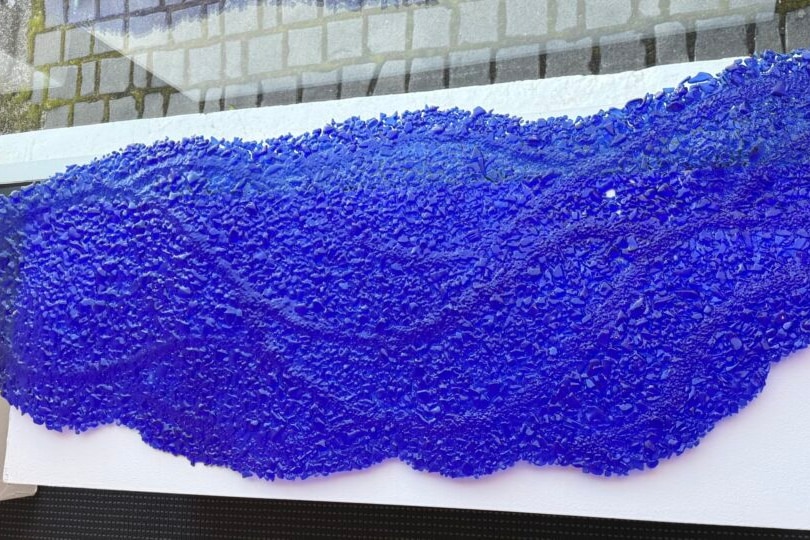
Acqua Alta/High Tide is a large-scale work made from recycled glass. (Supplied: Linton and Kay Galleries)
Now she is back, and making more glass, inspired by her trip Venice and making pieces on a larger scale.
“I’ve got a fun piece and it’s called Acqua Alta, which means high tide,” she said.
“In Venice, at certain times of the year, you’ve got to put your wellies on because [the water] comes up to your kneecaps.
“It’s really a weird way of living. Even the shop doors have barricades.
“So within my practice, I’m starting to go into to large-scale works.
“Acqua Alta is 1.3 metres in length, and it’s made with crushed Italian mineral water bottles.
“It’s actually displayed at about knee level, just for fun.”