
Loading
The acidic area close to the seeps was a window into the future. Each metre away from the seeps suggested the impact of a few extra years of greenhouse gas pollution. Metre by metre, the study she led revealed what our reefs might look like should the world fail to reduce carbon dioxide emissions.
It was not good news.
Typically, a scientific breakthrough is attended by the joy of understanding. Fabricius’ discovery was not. The reefs closer to the seeps – those most like the world we will soon live in – were desolate places.
What we call coral reefs are the exoskeletons of living structures made up mostly of calcium carbonate, or more simply put, limestone. Acid eats lime and weakens these structures. Fabricius’ natural laboratory quantified the acid’s impact.
The reefs will not immediately disappear, but they will become dominated by softer, fast-growing corals as the ocean acidifies.
The abundant species of fish that depend on the rich variance of healthy reefs will shrink. Lichens and plant life will dominate and the ecosystems that have existed for thousands of years, but which most of us only came to know a generation ago with the proliferation of rubber face masks, will wither.
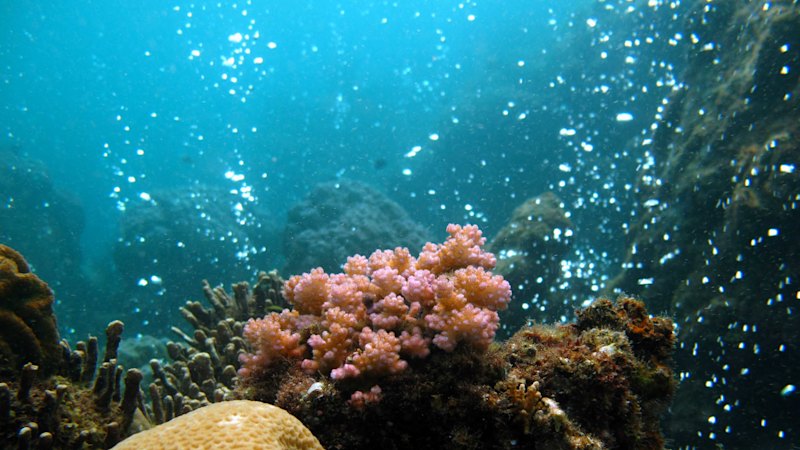
Volcanic gas escapes from the reef in Milne Bay.Credit: © AIMS | Katharina Fabricius
Fabricius says it would be like losing a rainforest teeming with life only to see it replaced with a few fecund weed species. The region might be covered in life, but it would still not be anything like a forest.
Worse, this process is separate from the coral bleaching caused by global warming that is already slowly cooking our coral. It is, to use a phrase that comes up depressingly often in climate science, a “concurrent and compounding” threat.
Oceans are slightly alkaline with a pH of 8.0, but their acidity has already increased by 30 per cent since the industrial era began, says Fabricius, whose study on the reef around carbon dioxide seeps was published last week in the leading journal Communications Biology.
As carbon dioxide emissions rise, the ocean pH is predicted to decline further to 7.8 by the year 2100.
“By studying organisms at 37 sites along a 500-metre gradient of CO2 exposure, we were able to see what happens as CO2 increases. There was no sudden collapse or tipping point; instead, as the CO2 increased, we saw fleshy algae become dominant, replacing and smothering coral and calciferous algae.”
The significance of her work gives her little comfort.
“A lot of my colleagues are dealing with climate grief,” says Fabricius. “The problem with ocean acidification is that there is no longitudinal escape.
“For warming, organisms can migrate towards the poles if they’re really lucky, but ocean acidification is everywhere. It’s absolutely pervasive and totally underreported. The sea is already 30 per cent more acidic than it was in pre-industrial times.”
If there is any upside to her work, it is the evidence Fabricius found that, like global warming, ocean acidification works in lockstep with greenhouse emissions. It will stop when the pollution does.
Get to the heart of what’s happening with climate change and the environment. Sign up for our fortnightly Environment newsletter.