
When Leah Wray and her family moved into a new suburb on the outskirts of Darwin in 2023, she was sold on the promise of it being a “smart community” with top-of-the-line underground technology.
But two years later and Ms Wray says “ultimately it was the opposite of that”, with reports of regular internet outages and recently, the loss of free-to-air television.
And she’s not alone, with tens of thousands of residents across Australia — typically living in greenfield suburbs — experiencing similar issues.
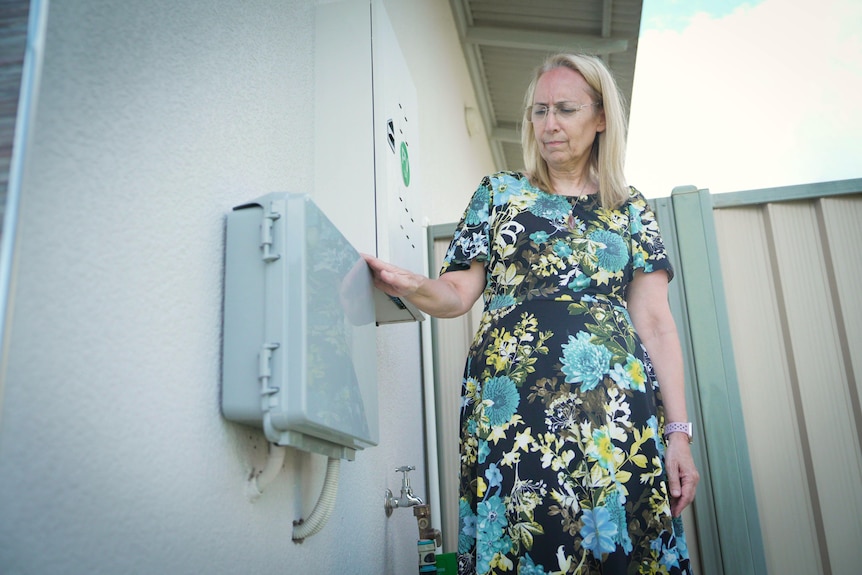
Leah Wray lives in Bellamack, where private company Opticomm owns the fibre-optic network. (ABC News: Marcus Kennedy)
Decommissioning free-to-air TV technology
In Ms Wray’s suburb of Bellamack and in more than 500,000 other properties across Australia, the fibre-optic network is owned by a private company called Opticomm, as opposed to the publicly owned network most Australians are familiar with — the National Broadband Network (NBN).
Unlike the NBN, Opticomm not only provides the infrastructure for internet connectivity, but also the technology for each home to receive free-to-air (FTA) television over the fibre-optic network.
Leah Wray says the loss of free-to-air television is “unbelievable”. (ABC News: Marcus Kennedy)
However, in September, Opticomm sent a letter to a subset of their customers — about 10 per cent according to Opticomm — telling them that free-to-air television would “no longer operate over our network”.
The letter advised residents to either transition to streaming services using free-to-air apps or investigate whether they could install an antenna — both at their own cost.
“We shouldn’t have been required to have any other additional costs to get our free-to-air on,” Ms Wray said.
“We bought into this suburb knowing we would have access to free-to-air television and then suddenly its gone.”
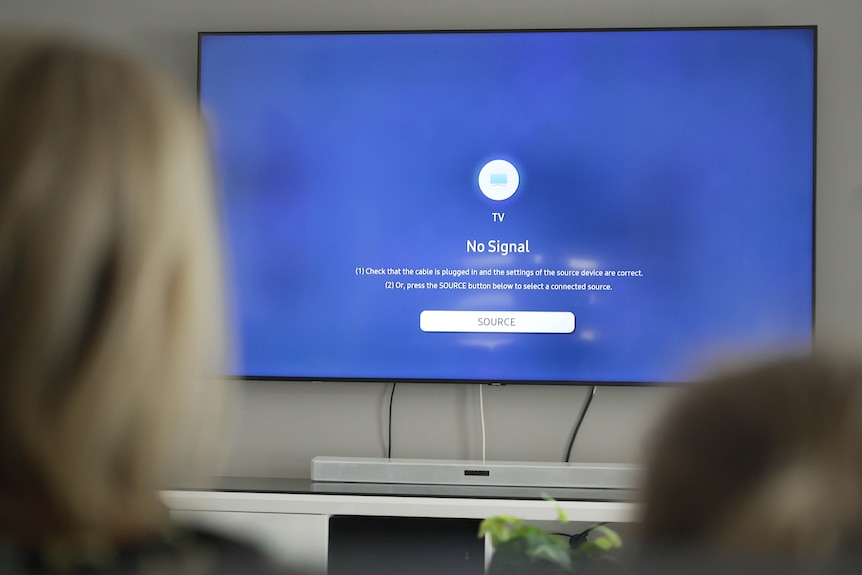
Leah Wray says not long after receiving Opticomm’s letter she came to find her television could no longer access free-to-air channels. (ABC News: Marcus Kennedy)
While Ms Wray was eventually able to install an antenna on her home’s roof for about $600, the process is not that simple for everyone.
Apartment residents ‘left in the lurch’
Mike Thomas who lives with his wife in a multi-storey retirement village in Yeronga, Brisbane also received the letter from Opticomm.
“The situation that they have presented us with is very poor, and it’s just not good enough,” Mr Thomas said.
“There’s a lot of people who were really left in the lurch.”

Mike Thomas says Opticomm’s removal of free-to-air television has been a huge blow to residents, particularly at such short notice. (ABC News: Mark Leonardi)
Village Retirement Group general manager Ryan Knowles explained that as a multi-storey apartment building with senior residents, the options provided by Opticomm were not ideal.
Mr Knowles said installing an antenna would require the re-cabling of the entire apartment building at a huge cost.
“From people we’ve spoken to, it would be running into the couple hundred thousand dollars to re-cable it,” Mr Knowles said.
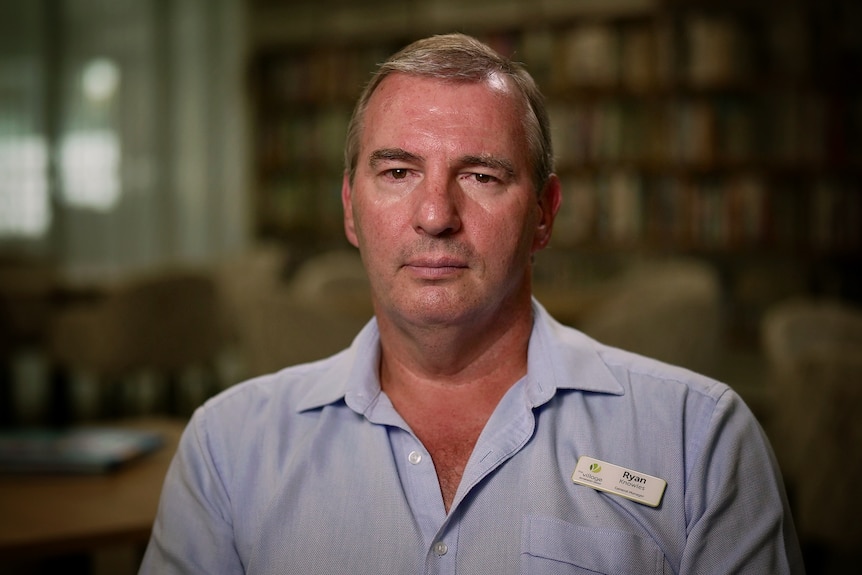
Ryan Knowles says residents at two of his villages have lost access to free-to-air television over Opticomm’s fibre-optic network. (ABC News: Mark Leonardi)
As for streaming apps, Mr Knowles noted that “not everyone in our villages has the digital acumen to handle digital tv”.
To make matters worse, despite Opticomm’s letter stating the decommissioning of free-to-air would begin on October 1 with a full-shut down on February 1 2026, most residents in Yeronga and another village lost access on September 27— the day of the AFL grand final.
“To lose that at the AFL grand final afternoon was very devastating and very upsetting for the majority of residents,” Mr Thomas said.

Mike Thomas describes himself as an “avid” watcher of sport. (ABC News: Mark Leonardi)
In a statement, an Opticomm spokesperson told the ABC the “equipment used to receive free-to-air television” in these communities was “reaching end-of-life” and “interfering” with other upgrades to the network.
The spokesperson said Opticomm would “extend the availability of FTA television services” in the NT until July 1 2027, but did not respond to the ABC’s questions about what would happen to customers who had already lost access and those outside the NT.
In a statement, the Australian Communications Media Authority (ACMA) confirmed that rules around statutory infrastructure providers (SIP) such as Opticomm did “not apply” to the supply of FTA television, which it said was “ultimately a commercial matter”.
Regular internet issues and limited regulations
Both Mr Thomas and Ms Wray said they had issues with Opticomm’s internet services, from dealing with regular “glitches” and loading delays to waiting four months to be connected.
Dozens of customers have told the ABC they too have had issues with Opticomm, including regular and lengthy outages sometimes lasting from two days to two weeks.
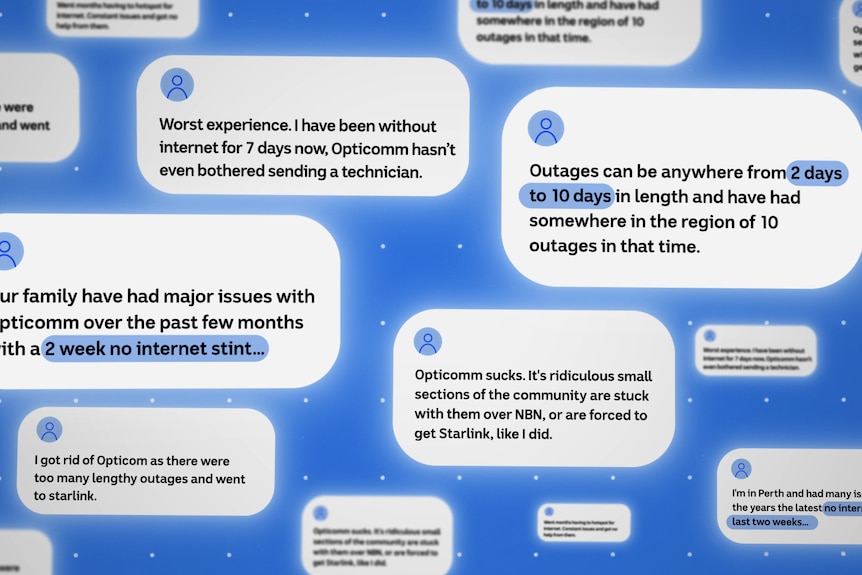
Dozens of Opticomm customers told the ABC they have experienced significant issues with their internet. (ABC News: Randi Dahnial)
An Opticomm spokesperson said in the NT the company was “actively investing in infrastructure to improve the resilience of the network”, but did not respond to the ABC’s questions about whether it was doing the same in other parts of Australia.
Many customers said they have complained to their internet service provider and the Telecommunications ombudsman, but with limited success.
RMIT University associate professor in engineering Mark Gregory said because the current legislation did not include “performance standards” for infrastructure providers, including Opticomm, ultimately regulators had “very limited powers” when there were “large numbers of outages”.
Dr Gregory said he believed that needed to change, and a September 2025 report from the Telecommunications Industry Ombudsman (TIO) showed he was not the only one.

Cynthia Gebert says Statutory Infrastructure Providers (ISP) should be held to service quality standards, just like internet service providers are. (Supplied: TIO)
In its report, the TIO called on the federal government to develop “service quality standards” for statutory infrastructure providers (SIP) “as a matter of priority”.
In a statement to the ABC, Telecommunications Ombudsman Cynthia Gebert added: “It’s not enough for a statutory infrastructure provider to have obligations to a retailer – we need clear service quality standards consumers can rely on.”
The ABC sent questions to Federal Minister for Communications Anika Wells, who did not respond by deadline.