
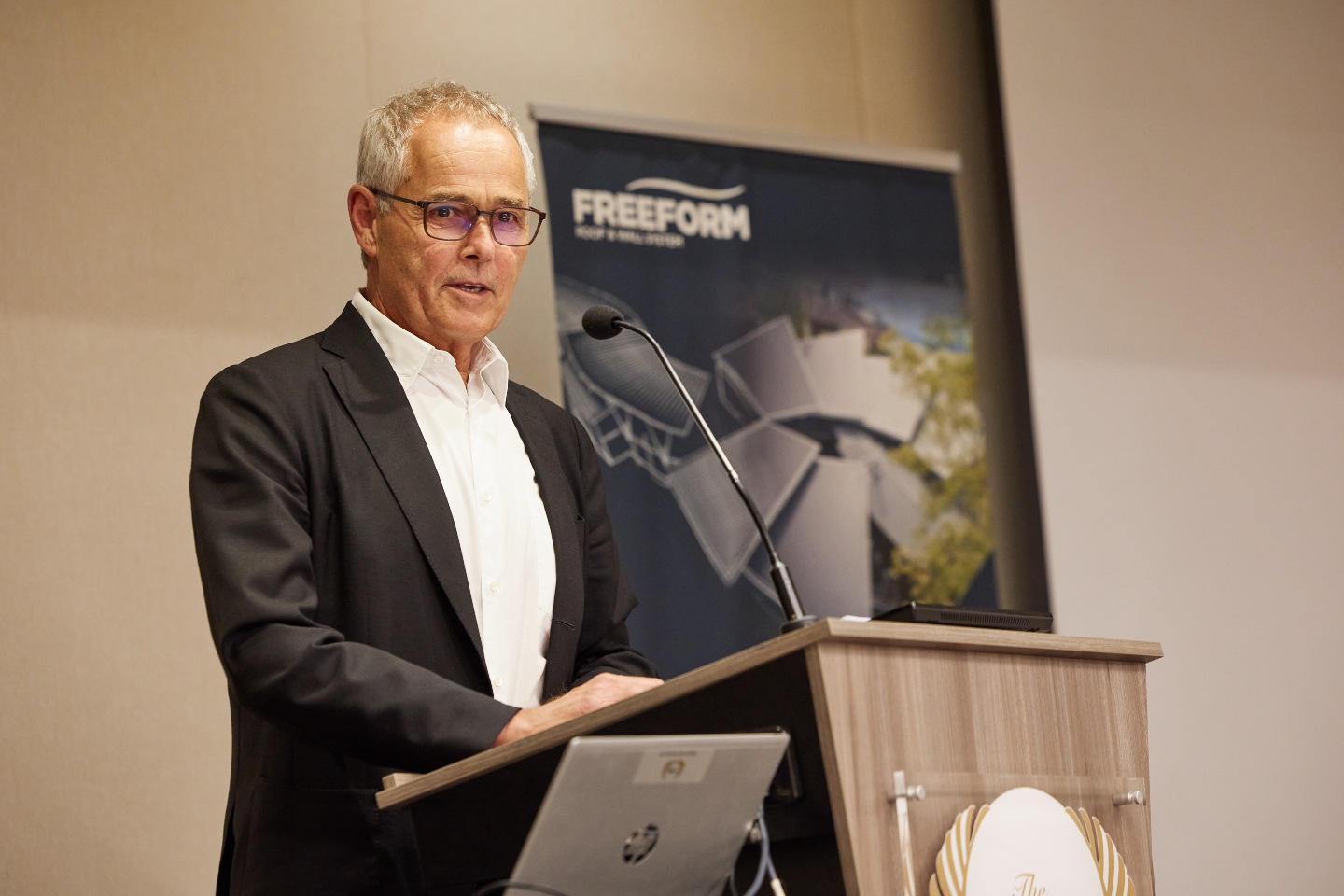
Adrian Fini has encouraged architects to continue to challenge the status quo despite resistance from planning authorities.
The H-U director last night became an honorary fellow of the Australian Institute of Architects WA Chapter, for his contribution to the field of design.
The 2016 Western Australian of the Year and Order of Australia recipient is behind several significant projects, including the restoration of the Old Treasury Buildings and the Malaga Film Studios.
In a rare speech, Mr Fini outlined his deep connection to architecture during the course of his more than 40-year career.
He joked that it was unusual for a developer to be recognised in this way.
“It’s not lost on me that I’ve been invited into the architects tent, even if this is some kind of scam that you’re trying to trick me,” he said.
“Most of my career, I’ve just been standing outside holding the budget and asking why you’re making everything cost too much, but to the institute, to the jury and the colleagues and the communities who have walked alongside me, thank you.
“I don’t see this as a culmination of what I do, but an encouragement to keep going.
“In a sense, development is the same as what your profession is. We’ve never really finished anything and we haven’t done it properly.
“There’s always one more building, one more street corner, and one more community waiting to be connected to its place.”
He pointed to the challenges associated with property development in WA, given its harsh environment, which often led to exemplary design.
“In Western Australia, I think we’re lucky and tested at the same time in the context we build in,” Mr Fini said.
“We’ve got this endless horizon line, this intense, fierce light, this crazy wind that hits us all the time, this … climate that doesn’t really forgive lazy design.
“They’re not really inconveniences, but these raw materials make our architecture a little bit more distinctive.
“I think, you know, as developers and architects, we should lean more into these conditions, use them, celebrate them, rather than trying to engineer them the way away.
“The best buildings in WA in my view, aren’t flashy; they’re confident, climate wise and generous.”
Challenging the norm
Mr Fini added that economic viability and the incorporation of quality design were not mutually exclusive aspects of projects.
“In my life as a developer, obviously I’ve got to worry about feasibilities and returns, but I’ve also learned that the projects that perform commercially are often the ones that also perform architecturally,” he said.
“People are drawn to places that feel right, they want comfort, they want beauty, they want practicality.
“And they’re not opposites; they’re just good business partners that we all have to work with and learn to work with.”
He encouraged the architectural professionals in the audience to keep pushing the boundaries of design, even when it was difficult.
“We found as a developer that doing something that is different, that challenges the norm, is difficult to get approved,” he said.
“The authorities that we all have to deal with are practiced and well-practiced at approving the ordinary and the really quite simple.
“Therefore, a project that is complex difficult and wants to deliver new outcomes is often too complex for the authorities to understand, and that’s actually our biggest battle.”
He added that it took courage to go against the grain.
“It means having the courage to commission good design, even when the spreadsheets to us say, just do what you did last time,” he siad.
“It means trusting architects to surprise us, and being brave enough to say yes when the right idea appears.
“It also means keeping the process open, ethical and sustainable.”
Mr Fini advised the architects in the room to challenge developers.
“I think it’s just really about challenging us, saying we’re wrong, [saying] ‘what about this?’,” he said.
“I don’t know how many schemes we go through until we get to an answer, but sometimes it’s … very frustrating for some of the architects, but that’s frustrating for us.
“If you’re not doing cookie cutter stuff, it’s a process.
“It’s a learning process, and hopefully we’re all collectively learning in that process to do even a better job the next time; so it’s just a big, long conversation.”
When asked about what planning authorities could do to improve, he said “the list could go on forever”.
“Obviously, there’s a process that’s complex … it’s got to be fair and equitable and transparent,” he said.
“But you all live in the R code environment … these things are archaic, so we’re in a process that’s wrong.”
Key issues
Mr Fini also stressed the importance of mentoring and noted that he received some valuable guidance from key high-profile WA architects.
“You’ve taught me, in a sense, that design is a form of leadership, and that good architecture isn’t about shouting the loudest, but it’s about listening the hardest,” he said.
He added that the challenges the development industry faced into the future were serious, including housing affordability and environmental sustainability.
“[There is] an urgent need to decarbonise our built environment, and an extremely serious issue about greening our cities, which we’re obviously not good at solving at the moment,” he said.
“But I’m an optimist; I believe that architects and developers together have the tools to meet these challenges head on.”
Mr Fini called on the audience to continue to fight for sustainable projects.
“Hopefully we have the energy and many of you and the passion and the will to battle towards the next approval, and the conviction to convince our political leaders, and it’s a hard battle,” he said.
“We’ve got many people on the front line at many times, arguing these cases, and obviously the architectural profession is an important part of that war.
“If I’ve learned anything, it’s that buildings matter less than the life they enable.
“And in the end, that’s what we’re all chasing, the chance to make life better, a little richer and a lot more connected.
“And if we can do that, even occasionally, it’s a legacy worth building on.”
Recognition
In handing the honorary fellowship to Mr Fini, Australian Institute of Architects WA president Ross Donaldson commended the developer on the material impact he has had.
“His love of architecture has seen him champion many architectural practices, and he has created buildings that have transformed and revitalised whole precincts of Perth and Fremantle, melding successful commerciality with design,” he said.
Mr Donaldson handed out the President’s Prize to Officer Woods Architects.
The Fremantle practice has received more than 30 awards for its projects, which include Spinifex Hill in the Pilbara and Boola Katitjin at Murdoch Univeristy.
Officer Woods was also selected from an international competition to include its designs in the recently launched NSW Pattern Book.