
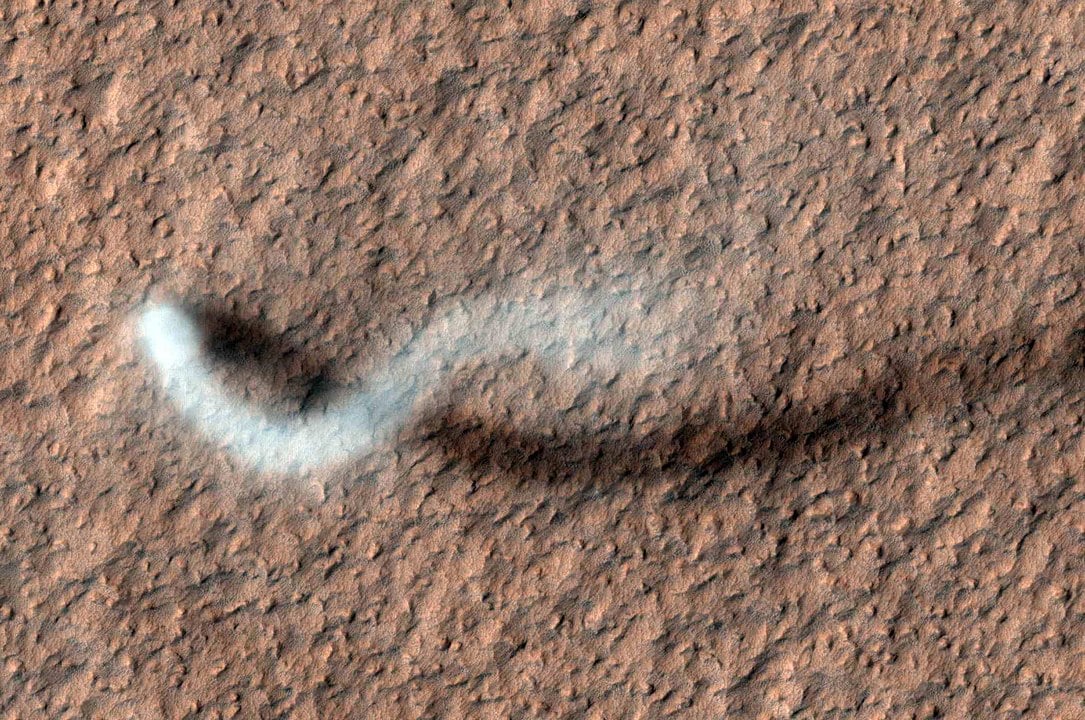
Touch a metal door handle on a dry day and you might get a small static shock, an annoying but harmless release of built up electrical charge. Now imagine that same phenomenon happening constantly in the swirling dust devils that race across the Martian surface. A team of scientists have just detected these electric discharges on Mars for the first time.
The discovery, rather surprisingly came from a microphone. When NASA’s Perseverance rover landed on Mars in 2021, its SuperCam instrument carried the first microphone ever to operate on another planet. Over the past several years, it has recorded more than 30 hours of Martian sounds, everything from wind whistling across the landscape to the rhythmic whir of the Ingenuity helicopter’s blades cutting through the thin atmosphere.
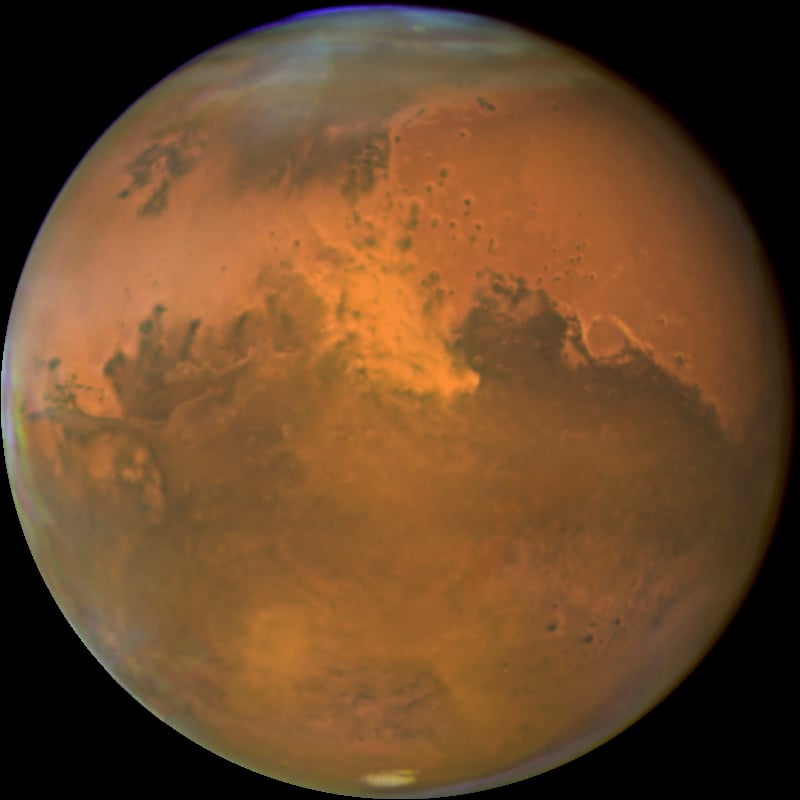 *Dust devils are often seen dancing across the surface of Mars*
But in two recordings captured inside dust devils, scientists noticed something unusual. Particularly strong signals appeared that didn’t match typical wind noise. Researchers at French institutions analysed these recordings and identified them as the electromagnetic and acoustic signatures of electric discharges, sparks jumping between charged dust particles.
The physics behind these Martian sparks mirrors what happens on Earth, but the thin Martian atmosphere makes them far more common. When fine dust particles rub against each other in wind driven whirlwinds, friction strips electrons from some particles and deposits them on others. Eventually, the electrical potential becomes strong enough to overcome the surrounding air’s resistance, and charge jumps between particles in tiny electric arcs a few centimetres long, accompanied by audible shock waves.
On Earth, atmospheric conditions rarely allow such discharges despite dust becoming charged regularly in desert regions. Mars’s atmosphere, however, is mostly carbon dioxide and roughly one hundred times thinner than Earth’s, meaning far less electrical charge is needed to create sparks. What would be insufficient to generate a discharge on Earth easily produces visible arcs on Mars.
 A dust devil captured by the Curiosity rover in 2020 (Credit : NASA/JPL-Caltech)
These electrical discharges can accelerate the formation of highly oxidising compounds, aggressive chemicals that destroy organic molecules on the surface and break down atmospheric gases. This could finally explain how the methane detected in Mars’s atmosphere disappears far more rapidly than photochemistry alone can account for.
The electrical activity also affects dust transport patterns, playing a role in Martian climate dynamics that scientists are only beginning to understand. More immediately concerning, these discharges could pose risks to robotic missions’ electronic equipment and represent a genuine hazard for future astronauts exploring the red planet. What began as an accidental observation has opened an entirely new window into how Mars works, confirming that acoustics represents a powerful tool for planetary exploration.
Source : Electric discharges detected on Mars for the first time