
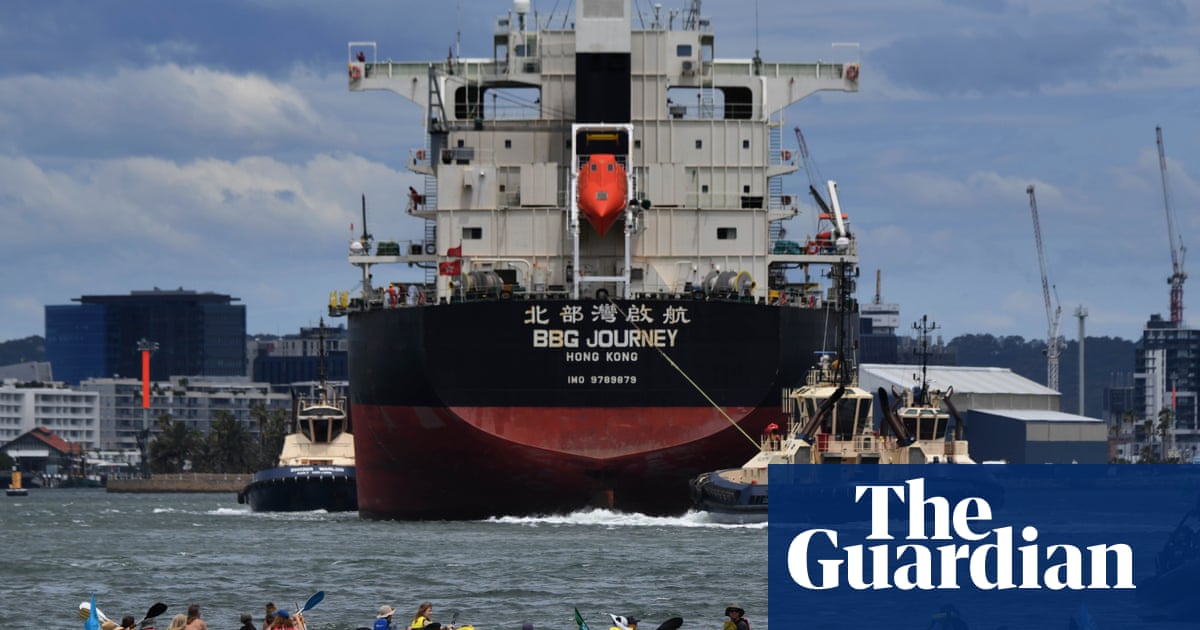
Annabelle* knew before she paddled into the world’s largest coal port that she might be arrested. The 71-year-old arrived in Newcastle on Sunday with thousands of others to join Rising Tide, one of Australia’s largest annual climate protests.
After a signal was given that a coal ship was coming, she entered the port in a kayak with hundreds of others. She managed to paddle beyond yellow buoys that marked the start of a zone the Minns government created for the duration of the protest – which gave police additional powers to arrest people. The police floated on boats just inside the zone, ready to pluck anyone out of the water who might defy their direction to turn back.
“I just paddled and paddled, madly paddled,” she tells Guardian Australia. “I was determined to get into that channel, it’s the first time I’ve done something like this, and I wanted to stop that ship.”
By Monday morning, more than 130 people had been arrested and charged under the Marine Safety Act or Crimes Act for blocking the shipping lane. Photograph: Dean Sewell/The Guardian
Cheers erupted when the ship turned around, the third to be blocked on the fourth day of the six-day protest.
Annabelle is among the estimated 8,000 who’ve travelled from across Australia to take part in the protest, which is now in its third year and continues to grow, despite warnings from the NSW government that anyone who blocks the major artery for the world’s coal trade could be arrested.
‘We need to be prepared’
At times, the event feels more like a family friendly festival than a protest – there’s an air of frivolity, despite it centring around a distressing issue. Foreshore Park is a hum of activity, with a community kitchen, a stage where bands play and tents to provide legal information and take statements for those that have been charged. Sessions are run to teach people about non-violent direct action.
Horseshoe beach is jam-packed. People are waving flags calling for climate action, some are dancing around in costumes. The water is dotted with colourful kayaks. A police officer stands among the crowd, holding a megaphone, warning that anyone who goes beyond the yellow buoys risks being arrested under section 18B of the Marine Safety Act.
 Rising Tide climate activists stop ships from entering world’s largest coal port – video
This is the exclusion zone the NSW government, with approval of the transport minister, John Graham, placed around most of Newcastle Port in an attempt to dissuade the protesters from blocking the shipping lane. By Monday morning, more than 130 people had been arrested and charged under the Marine Safety Act or Crimes Act for doing so.
Among the crowd on the beach is 22-year-old Zac Tritton, who works in the coal industry in Newcastle. He’s worried about the climate collapsing, and with it, regions like the Hunter that rely on fossil fuel extraction. He found out about Rising Tide through his housemate, and after attending a meeting recently, realised one of their main pushes is more support for workers like himself.
Rising Tide’s demands are the immediate cancellation of all new fossil fuel projects; taxing fossil fuel profits at 78% to fund community and industrial transition and pay for climate loss and damage; and the end of coal exports from Newcastle by 2030. Photograph: Dean Sewell/The Guardian
“I think this rhetoric coming from within the coal corporations – that coal’s not going anywhere, and that protesters like this are here to threaten the communities and threaten jobs with people in the [Hunter] Valley and across the coal regions – is misleading,” he tells Guardian Australia.
He points to recent Treasury modelling which found the value of Australia’s coal and gas exports will plunge by 50% in the next five years.
“We need to be prepared for it,” he says. “At the heart of the fears of these people in the industry, that I spend almost every day with, is that their communities will be uprooted, that their livelihoods will be lost.”
Council ‘very concerned’
Rising Tide’s demands are the immediate cancellation of all new fossil fuel projects; taxing fossil fuel profits at 78% to fund community and industrial transition and pay for climate loss and damage; and the end of coal exports from Newcastle by 2030.
skip past newsletter promotion
Sign up to Breaking News Australia
Get the most important news as it breaks
Privacy Notice: Newsletters may contain information about charities, online ads, and content funded by outside parties. If you do not have an account, we will create a guest account for you on theguardian.com to send you this newsletter. You can complete full registration at any time. For more information about how we use your data see our Privacy Policy. We use Google reCaptcha to protect our website and the Google Privacy Policy and Terms of Service apply.
after newsletter promotion
The deputy lord mayor of Newcastle, Charlotte McCabe, who attended the event, told Guardian Australia: “Council is very concerned about support for our workers in declining industries.”
“We have been calling for transitional support from both the state and federal governments for some time,” she said.
This year, the council approved the land-based activities for the event. It found through consultation that 86% of respondents supported using a section of the park for live music, and 76.6% backed another section as a temporary campground.
Last year, the group went to the supreme court after the police knocked back their form 1 permit to do the same activities on land, as well as plans to shut down the shipping lane for 50 hours.
The previous year – the event’s first – the police had authorised the group to shut down the port for 30 hours. However, 109 people were arrested and charged after they stayed on the water beyond the agreed period.
Speaking on ABC Radio Newcastle last Monday about the protest, the minister for police and the Hunter region, Yasmin Catley, said: “This is not an event. This is a protest. And we are absolutely committed to keeping that shipping lane safe.”
The police floated on boats just inside the exclusion zone, ready to pluck anyone out of the water who might defy their directions. Photograph: Dean Sewell/The Guardian
“If I had the confidence, if we all had the confidence, our whole community had the confidence that they would do the right thing, then we could go about that. But that is not the case.
“The behaviour that they have exhibited in the past has been reckless and it is dangerous.”
Zack Schofield, one of the organisers of the event, sees it differently.
“I grew up in Newcastle,” the 26-year-old says. “I learned to count by counting the coal ships on the horizon with my mum.
“Because Newcastle is the world’s largest coal port, we have in Newcastle a responsibility at a global scale to do everything in our power not just to protect the livelihoods of Hunter workers, but to protect the future generations of the entire planet,” he says.
Arrests and applause
After Annabelle paddled into the shipping channel, she was pulled into a boat by police and arrested for the first time in her life. She was later charged with blocking a major facility under section 214A of the Crimes Act – which carries a maximum penalty of two years in prison or a $22,000 fine.
“We could understand why [the police] had to do their job,” she tells Guardian Australia after she was released. “I’m not young, and they were very mindful of our physical issues.”
Protesters at Rising Tide. Photograph: Dean Sewell/Oculi
Annabelle returned to the park with the dozens of others who were arrested, waving the yellow slips that police had given them with their charge triumphantly in the air. The crowd erupted in applause.
She had driven up from Melbourne with a carload of others, including her daughter, who had been part of the movement to end native logging in Victoria. That movement achieved its aims last year, after the state government officially banned commercial native forest logging.
“I have been protesting, writing emails, doing vigils for a long, long, long, long time now – it seems to fall on deaf ears,” she says. “I’m inspired by what my daughter did. She can’t get arrested any more, but I can.”
* Not her real name