
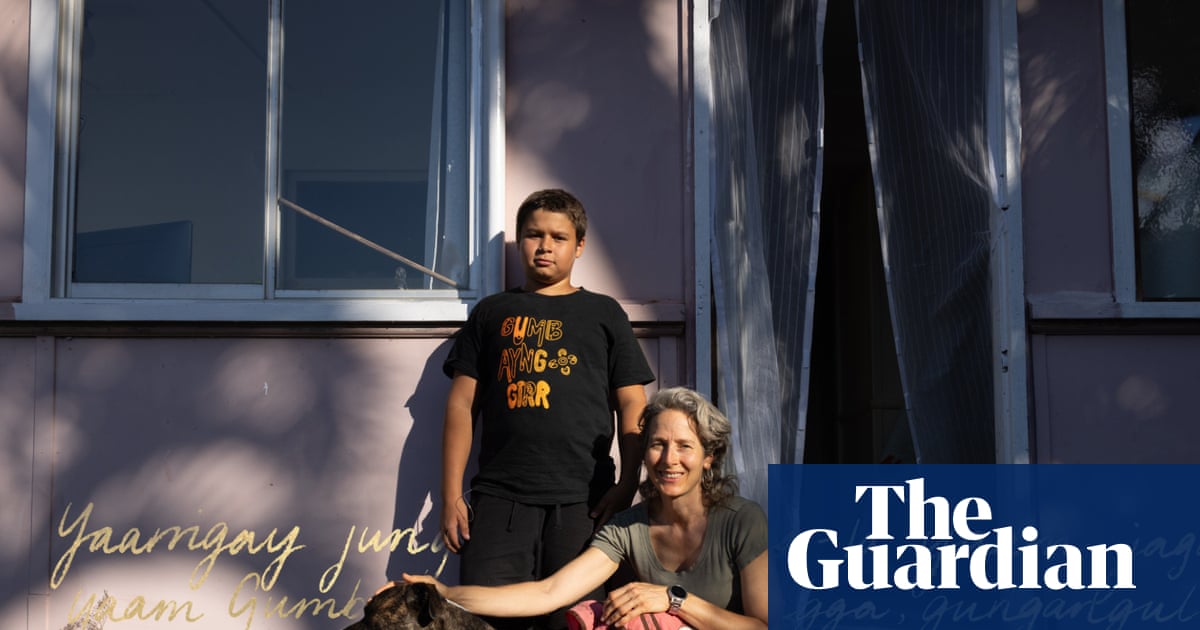
There are several words for “morning” in the Gumbaynggirr language but bambuuda is Anne-Marie Briggs’ favourite. Drawn from bamburr, meaning soft and gentle, it speaks to the quiet moments before sunrise, literally translating as “in the softness”.
“Doesn’t it just melt your heart?” says Anne-Marie, sitting at the kitchen table of the Coffs Harbour home she shares with her 12-year-old son, Darruy.
The pair have found an easy morning routine since moving to Coffs three years ago. On a bright spring day Darruy wolfs down his Weet-Bix before strolling across the road to the small independent school that has been making headlines for its unique approach to education on the New South Wales mid-north coast.
When the bell rings, the students converge on a shady sandpit. They stomp bare feet to the click of clapsticks, singing and dancing as the sun gathers warmth. By 9.30am, barely a word of English has been spoken.
This is how each day begins at the Gumbaynggirr Giingana Freedom school, the state’s first Aboriginal bilingual school. GGFS opened three years ago amid a broader push to breathe new life into the critically endangered Gumbaynggirr language.
Sign up: AU Breaking News email
As Indigenous languages decline, Gumbaynggirr is experiencing a resurgence. What began with a handful of elders pooling their pensions to record a few words in the 1980s has led to its revival, to the point where it is once again being spoken in homes and learned by babies.
I know how important language is for connecting with culture and knowing who you are Anne-Marie Briggs
On a busy Monday morning, Clark Webb, a Gumbaynggirr and Bundjalung man, is treading the school verandas barefoot, his wavy dark hair pushed back by a thick headband. His relaxed demeanour belies the fierce ambition that saw him spearhead the school’s formation as the chief executive of the Bularri Muurlay Nyanggan Aboriginal Corporation.
The corporation wanted to start a bilingual school partly because its members were seeing the education system “fail miserably”, Webb says. Aboriginal families were being blamed for gaps in attendance and academic achievement, he says, rather than schools looking inward at their own deficiencies.
“It insinuates that our children are a problem and we know that’s not the case,” he says.
Dozens of NSW schools teach Aboriginal languages but this is the state’s only bilingual school. GGFS is open only to Indigenous students from kindergarten to year 8. They attend at least one language class every day and have weekly lessons on country. Some advanced classes are taught almost exclusively in Gumbaynggirr.
When Darruy Briggs’ parents heard about the school, they decided to move a nine-hour drive north from their home in Queanbeyan. At the time, Darruy was unenthusiastic about education. His father, a Thunghutti and Gumbaynggirr man, and mother Anne-Marie, a German Australian, hoped a school built on Aboriginal culture might be a better fit.
“He’s not like a Naplan sort of a kid but he is very smart,” Anne-Marie says.
“I know how important language is for connecting with culture and knowing who you are as a person. I really wanted that for Darruy.”
Three years on she says the change in her son has been “unbelievable”. He looks forward to school and is already a confident language speaker – even legally adopting the Gumbaynggirr word for “good” as his first name (he was previously called Albert).
Darruy switches between Gumbaynggirr and English as he explains the difference between his current and former schools.
“The difference is like light and day,” he says. “The other school … they didn’t really understand the components of Aboriginal culture. I do prefer this school a lot more, because they understand how culture is to us.”
We just wanted her to go to a school where she was going to feel safeCourtney Elliott
A short drive from the school, on a balmy Tuesday evening, Courtney Elliott arrives at the Kulai Aboriginal preschool, fresh from her paediatric nursing shift, for her weekly Gumbaynggirr lesson. Parents and carers at GGFS are required to learn the language but it’s no chore for Elliott.
“It’s kind of a break, to be honest with you,” she says. “It’s a giant family there.”
Like Darruy’s parents, Courtney has noticed a transformation in her eight-year-old, Marlarrah, since she enrolled. At her former preschool another child once told her she was “too dirty to play with”.
“We were at a Naidoc event and she was saying things like, ‘I don’t want to get ochre on me because then people know I’m Aboriginal,’” Courtney says. “She wouldn’t dance any more. She was becoming completely disconnected from her culture … we just wanted her to go to a school where she was going to feel safe.”
Now Marlarrah’s confidence has “skyrocketed”. Her younger sister Bea also attends GGFS. The use of Gumbaynggirr has become so normalised in the home that Courtney will accidentally slip into it at work. Even their one-year-old, Raven, knows a few words.
GGFS opened with 15 students in 2022. Next year there are 95 students enrolled and more on a waitlist. Its goal is to become fully immersive, following the Māori schools model in New Zealand.
But the venture has not been without challenges. The first was finding qualified teachers who can speak Gumbaynggirr, which the school solved by finding experts in one field then training them in the other.
Webb says detractors tell him there’s no economic benefit to learning a “dead” language – the kids are better off studying Mandarin or French. They also ask if the children have a sufficient grasp of English.
But results speak for themselves. Attendance levels are 88.5%, just above the average rate for all students nationally and far exceeding the national Indigenous attendance rate of 76.9%.
And Naplan results are “just above average” for Indigenous students – but Webb says he has a different metric for measuring success.
“Happiness,” he says. “When we bring our children up to feel really good about who they are through their language and through their culture, then all other learning is sorted.”
The principal, Glen Cook, has been teaching for 30 years. He concedes that the school is still finding the right balance between Gumbaynggirr and western teaching methods. But the Dunghutti and Bundjalung man, who was forbidden from speaking his language as a child in the 1960s, says the importance of instilling pride in the students should not be underestimated.
He recalls his year 3 teacher giving a lesson on “Aborigines”, whom she described as “savages” and “natives”.
“You were never made to feel proud of who you are,” he says.
A freedom rider looks back
At Nambucca Heads, elders at the Muurrbay Aboriginal Language and Culture Co-operative are still pinching themselves that such a school exists. Its chief executive, the civil rights activist and freedom rider Gary Williams, remembers when a handful of the last remaining fluent Gumbaynggirr speakers gathered at an old church in Kempsey in 1986 for a meeting that would kick off a movement.
Enlisting the help of a linguist, they made recordings and scoured archives to create the first Gumbaynggirr dictionary. The group morphed into Muurrbay, which develops language courses for schools, Tafes and the broader community, creating a blueprint that other NSW communities have begun to follow.
Gumbaynggirr is now ranked among the top 10 Indigenous languages being renewed nationally, according to a 2019 survey by the Australian Institute of Aboriginal and Torres Strait Islander Studies.
One of Muurrbay’s first graduates, Michael “Micklo” Jarrett, is training the next crop of Gumbaynggirr teachers as an Aboriginal language and culture officer at the NSW education department.
“When we first started, one of the biggest problems was not enough educators to go into all the schools,” he says. “Now our problem is we haven’t got enough schools for all the educators.”
Jarrett says the quest to save Gumbaynggirr is unending. There are always new words to add to the dictionary: mobile phone (muya-banggi – breath fly); computer (marlawgay-bangarr – lightning brain) and floor (jali-julu – down side), to name a few.
Eager to share the joy of language more widely, he started the Girrwaa Duguula (People Together) choir last year with a local musician, Ruth Kennedy. On Wednesday nights people from all walks of life, and aged from 12 to 75, meet at a country hall in the hinterland to learn songs in Gumbaynggirr.
Some hope to gain a deeper understanding of the place they call home. Others are looking to reconnect with their culture. Most say they drive home elated.
Jarrett is not simply teaching people words, he says. He is showing them the hidden stories in the stars; singing the creation stories of sacred waterholes.
“It’s giving the Gumbyanggirr people back an identity,” Jarrett says. “This is who we are.”