
A sweeping genetic investigation is reshaping what researchers know about the first journeys of modern humans into Australia and its neighboring lands. Analysis of nearly 2,500 mitochondrial genomes from Indigenous communities across Australia, New Guinea, and the wider Pacific has produced one of the clearest timelines yet for the settlement of Sahul, an ancient continent that once connected these regions during the Pleistocene.
 New genetic study reveals how modern humans first arrived in Australia 60,000 years ago. Credit: Steve Evans / CC BY 2.0
For a long time, scientists have debated whether people reached Sahul around 60,000 to 65,000 years ago or several thousand years later. The earlier date, referred to as the “long chronology,” has been supported by archaeological discoveries and oral histories from Aboriginal communities. However, some genetic models have favored a shorter timeline. The new study, published in Science Advances, details what the authors say is the strongest genetic case to date for a 60,000-year-old settlement, closely matching the long chronology.
This research focused on extensive mitochondrial, Y-chromosome, and genome-wide data that provide a broad view of early population movements. With the use of refined molecular clock models—methods that estimate when DNA lineages diverged—researchers were able to more precisely determine when the ancestors of Aboriginal Australians and New Guineans first crossed from Sunda, the prehistoric landmass that included much of Southeast Asia, into Sahul. Their results point to two distinct migration routes: one moving southward from the Indonesian islands into present-day Australia and another traveling through the northern corridor, most likely through the Philippines, toward New Guinea.
These two groups were part of a larger population that migrated out of Africa some 70,000 to 80,000 years ago. Genetic evidence suggests that these groups separated somewhere in South or Southeast Asia several thousand years before they moved further east. The findings indicate strong population continuity in the region and add evidence that Aboriginal Australians and New Guineans retain some of the oldest unbroken lineages found outside Africa.
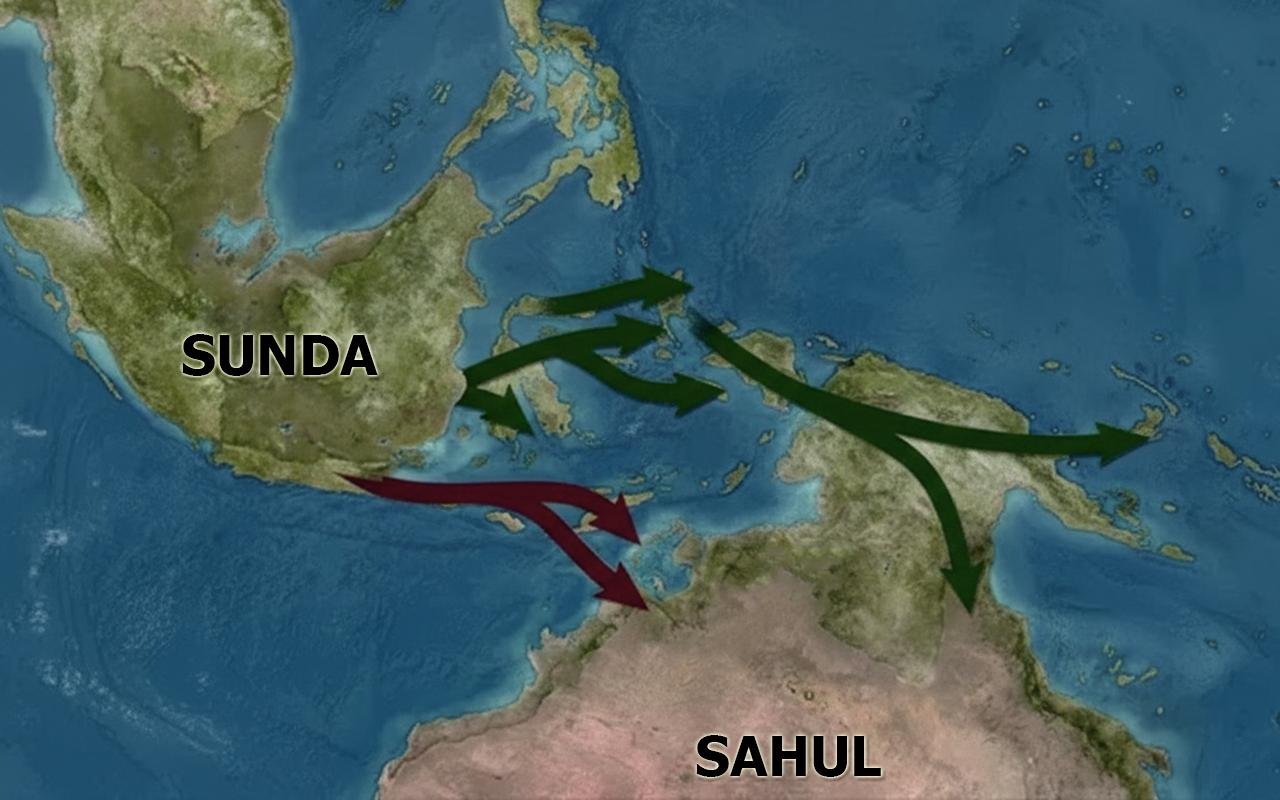 Map of Sunda and Sahul, illustrating possible north and south migration routes revealed by genetic analysis, based on a map by Helen Farr and Erich Fisher.
The research also sheds light on connections beyond Sahul. Near Oceania—the islands of the Bismarck Archipelago and the Solomons—appears to have been settled during the same broad time frame, with constant movement and contact continuing afterward. These genetic links challenge the long-standing tendency to treat Oceania as separate from early Sahul history.
The analysis carries broader implications for understanding humanity’s migration out of Africa: while recent models have suggested more recent dispersal dates or proposed earlier waves of migration that left minimal trace, the new dataset supports a single major movement between 50,000 and 70,000 years ago. The authors argue that earlier proposed dispersals did not substantially shape the ancestry of present-day non-African populations.
Although the researchers remain constrained by the scarcity of ancient DNA from Southeast Asia and Sahul, the large-scale genetic approach deployed here enhances the precision of current timelines. Paired with archaeological and paleoclimate evidence, these findings form a more complete picture: early modern humans entered Sahul no earlier than 60,000 years ago, using watercraft to cross portions of the ocean, and they did so along more than one path.
More information: Gandini, F., Almeida, M., Foody, M. G. B., Nagle, N., Bergström, A., Olivieri, A., … Richards, M. B. (2025). Genomic evidence supports the ‘long chronology’ for the peopling of Sahul. Science Advances, 11(48), eady9493. doi:10.1126/sciadv.ady9493