
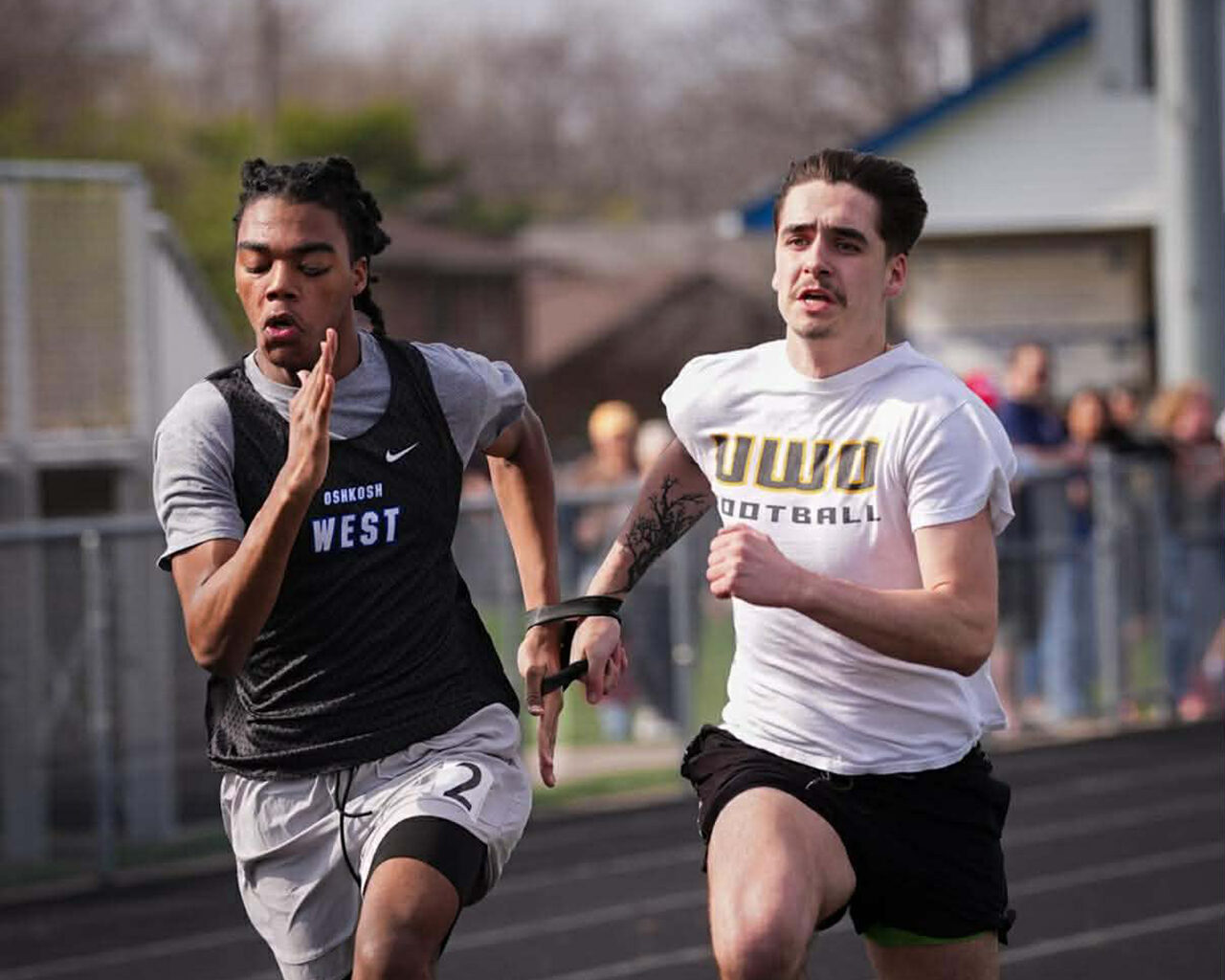
Blind Oshkosh West sprinter Kymani Stephen, left, powers down the track with UW-Oshkosh football player Austin Eklund guiding him during a 100-meter race in April. Kathy Bechard Photography
Inside the echoing walls of a racquetball court in UW-Oshkosh’s Albee Hall, a rubber ball, filled with three metal bells, slams repeatedly against the far wall. The sharp rattle reverberates across the floor as Kymani Stephen, a 17-year-old Oshkosh West High School senior who is blind, tilts his head and listens, pinpointing the exact moment the ball comes within reach before launching it again with precision.
Standing against the left wall in the court, Austin Eklund, a UW-Oshkosh junior majoring in special education and defensive back on the Titan football team, watches with quiet awe.
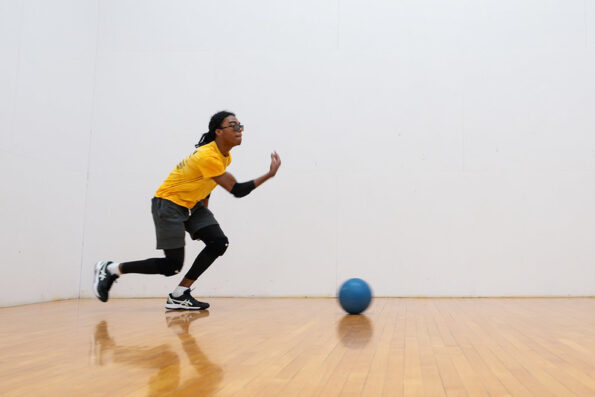
Blind Oshkosh West senior Kymani Stephen practices throwing drills for goalball inside a UWO racquetball court. Stephen will compete later this week at the National High School Goalball Championships in Austin, Texas.
“I mean… he’s just incredible,” said Eklund, who has known Stephen since spring 2024 when he became the younger athlete’s running guide. Stephen runs 100m and 200m races for Oshkosh West High.
Watching Stephen train for the National High School Goalball Championships Dec. 4-6 in Austin, Texas, is different for Eklund. As Stephen’s track guide runner, he’s used to being tethered to him, matching stride for stride, guiding him around curves, helping him navigate high-speed races.
But here, on the racquetball court, Eklund isn’t guiding. He’s witnessing a different kind of athletic skill at work.
Goalball, which originated in 1946 as a way to keep blinded WWII veterans physically active, is considered the premier team sport for blind athletes, according to Texas School for the Blind and Visually Impaired—host site for the national competition. In goalball, the ball contains bells that sound when in motion and thrown at a goal at the opposing team’s end of the court.
Stephen wasn’t born blind. A childhood accident triggered the loss of his vision, which deteriorated between ages 7 and 9 until he was considered blind by sixth grade. Multiple surgeries followed, along with glaucoma in both eyes. Today, he describes his vision as a shifting field of gray static, like what you’d see on an analog TV when it’s not receiving a broadcast signal.
How Their Paths Crossed
Oshkosh West’s coaching staff knew Stephen needed a guide runner they could count on—someone who would show up every day, train consistently, and stay with him for more than a few weeks. He had already worked with two or three well-meaning student runners, but none had been able to commit long-term. 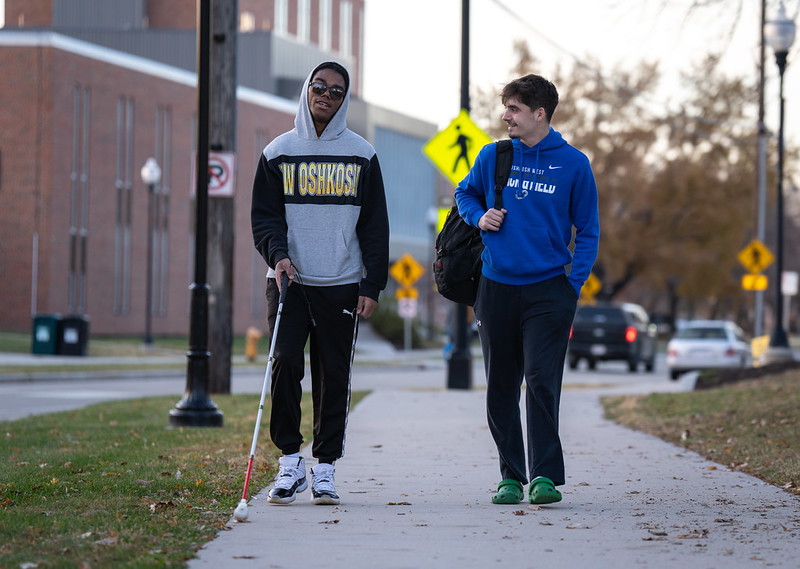
Kymani Stephen, left, walks across the UW-Oshkosh campus with guide runner Austin Eklund, a defensive back with the UWO football team. The pair train together throughout the track season, competing in the 100- and 200-meter races.
That’s when Joey Ray—Eklund’s former defensive coordinator from Sussex High School, now head football coach at West—stepped in. Ray recognized that the team needed reliability. And he knew Eklund.
“He told me he had something different for me, an opportunity out of the ordinary,” Eklund said. “They had a blind student-athlete who needed a guide runner.”
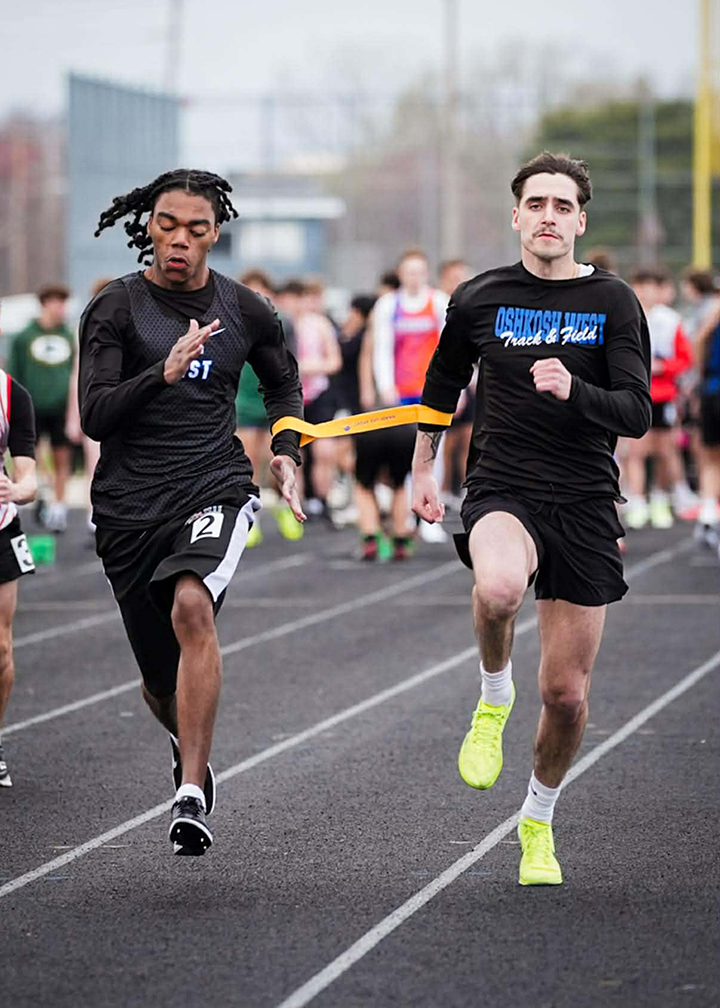
Stephen and Eklund using a longer tether at an April 2025 race. Kathy Bechard Photography
Eklund said yes, even though he wasn’t a runner. In high school, he competed mainly in long jump and only occasionally raced the 100-meter dash. Becoming a guide runner meant transforming himself into an athlete who could run at 75% or more every day, just to stay even with Stephen.
And it meant showing up. Every. Single. Day. For two track seasons.
“My days during spring were wake up, football practice, class, then West High School to run with Kymani,” Eklund said. “Every practice he was at, I was at. Every meet he was in, I was in.”
Running as One
Their first practice together was messy. The tether was bulky, the rhythm off, the communication still forming. But they kept going.
At meets, Eklund noticed the way people sized Stephen up, the quiet judgmental assumption that a blind sprinter was there for a feel-good moment, not to compete.
“Everybody just assumes he’s gonna show up and get a participation trophy,” Eklund said. “It’s the furthest thing from the truth.”
Their first race silenced the doubters. In a JV 100-meter heat, they exploded off the line and left the entire field behind and “dusted everyone,” as Eklund put it.
“I was yelling, ‘You’re freaking amazing!’ because I couldn’t believe it,” he said. “And he just smiled. He’s Mr. Cool. That’s what he does.”
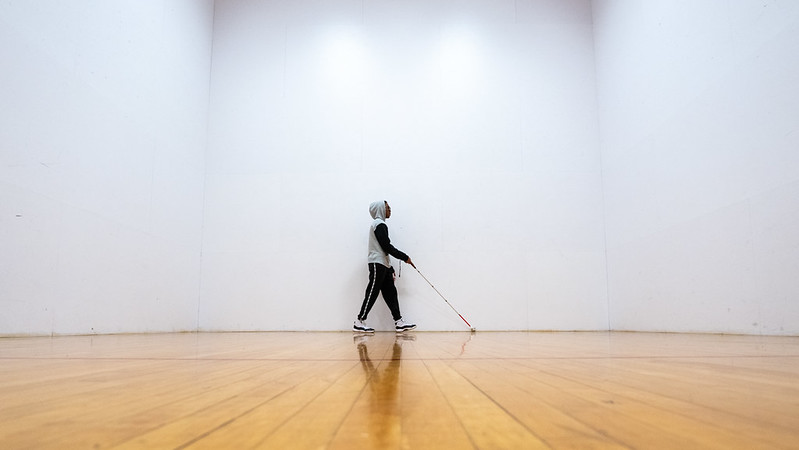
Kymani Stephen measures steps in the UWO racquetball court before his goalball practice.
Before Eklund began guiding him, Stephen estimates he ran the 100-meter dash in about 13.9 seconds. With Eklund at his side, he dropped that time to around 12.5 seconds by the end of last season.
They laugh now about early missteps, like the time Stephen accelerated so quickly in a 200-meter race that the pair got out of sync and both face-planted across the track. “As soon as I fell, he fell,” Stephen said. “We just went flipping. Somehow it was only a couple scrapes.”
What They Teach Each Other
Stephen says that trust is the foundation of everything they do.
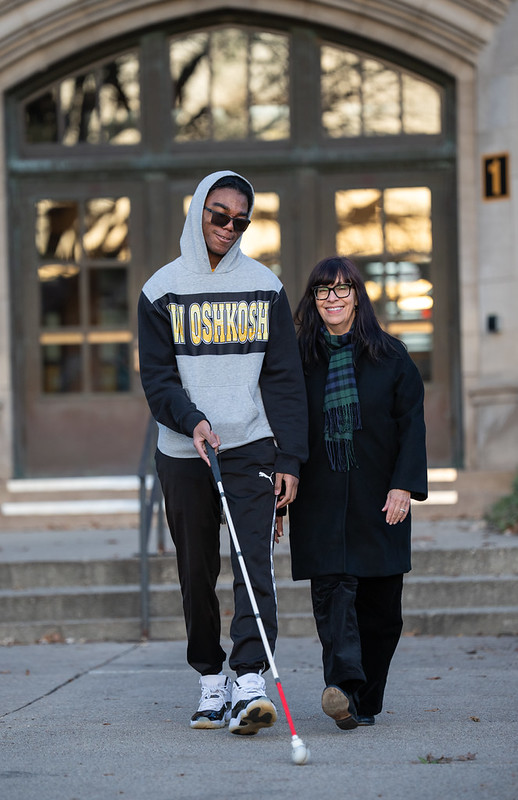
Kymani Stephen, a blind high school student-athlete, walks across the UW-Oshkosh campus with Trina Woldt, director of Leadership Oshkosh. Woldt helped coordinate practice space for Stephen’s goalball training.
“We’re running full speed, so essentially I’m putting my life in his hands,” he said. “I don’t think there’s another way to measure the amount of trust in a person.”
Hearing that level of trust from Stephen was deeply moving for Eklund.
“What hasn’t he taught me?” Eklund said, choking up a bit. “He’s taught me how to be a better person, a better future teacher. He breathes life into the people around him.”
Stephen’s goalball training only deepened that admiration.
“I wish more people would really stop and look at how talented these athletes are,” Eklund said. “Kymani gets doubted before every race. If people paid attention, they’d see incredible athletes who compete at the highest level.”
Stephen now competes on a youth team supported by the Michigan Blind Athletics Association, the organization that first discovered him at a sports camp in Kalamazoo. He played alongside the Michigan Omega team in Chicago to gain experience.
There are no goalball programs in the Fox Valley, so he typically trains alone. That’s why having practice time in Albee Hall at UWO has meant so much.
In Albee, he focuses mostly on offense, experimenting with different throwing techniques from camps and tournaments. Director of Leadership Oshkosh Trina Woldt, who taught him in Youth Leadership Oshkosh, has even stepped onto the court to throw balls at him so he can work on blocking.
“It’s definitely a boost of encouragement,” Stephen said. “A lot of athletes drop goalball because they can’t find places to practice. Now I’m excited I have this space, and I’m going to use it to the fullest.”
“What stands out isn’t his blindness, it’s his character,” said Woldt, who helped facilitate the use of the racquetball court for Stephen. “He chooses resilience every day. He pushes himself in ways most people never will.”
Woldt sees something special in the partnership between Eklund and Stephen.
“They model what inclusion looks like at its best,” she said. “Two people learning from each other, matching pace, pushing past boundaries.”
Considering a Future in Special Education
Stephen, who grew up in Chicago, has been accepted to UW-Oshkosh and is strongly considering majoring in special education. His mom works as a physical therapist assistant in nursing homes, and his dad is a construction worker; both have supported his academic and athletic ambitions as his vision changed.
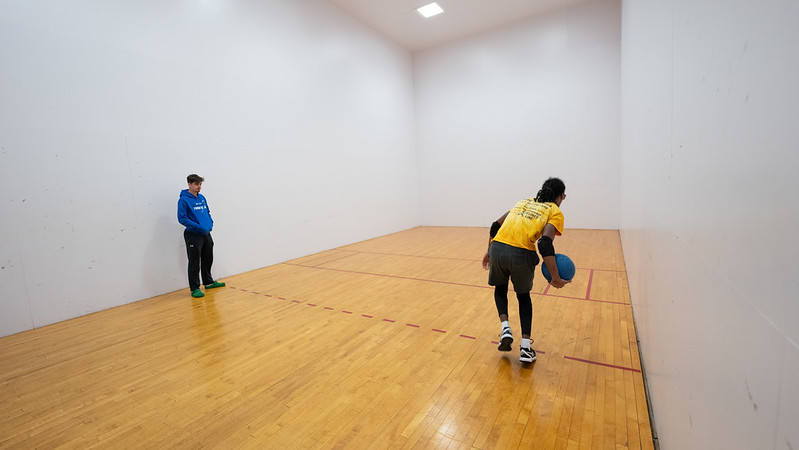
During a goalball training session in a UW-Oshkosh racquetball court, Kymani Stephen works on offensive throws as UW-Oshkosh student-athlete Austin Eklund observes his technique.
He said the idea of special education first surfaced in middle school, inspired by the adults who supported him—his paraprofessional, vision teacher, and orientation and mobility instructor.
“They did a lot to influence my life, especially with sports,” Stephen said. “They supported my aspirations both academically and outside of school. I really feel like I want to give back and invest my time into students the way they invested in me.”
UW-Oshkosh is at the top of his list, even if he hasn’t officially committed yet.
“I’ve met a few people here and it’s definitely growing on me,” Stephen said. “I just want to make sure that wherever I go, I can give my all and keep doing the things I love.”
Their partnership has shaped both athletes, but Eklund says Stephen changed him in lasting ways.
“He solidified that I’m on the right path with my special education major,” Eklund said. “Working with him made me realize this is what I want to do for the rest of my life.”
Learn more:
Study special and early childhood education at UWO
School of Education and Human Services