
Former Royal Australian Air Force instructor Chris Holt uses skills learnt in the military in a classroom full of year 6 students.
But even for someone with his life experience, the demands of being an early-career teacher are taking their toll.
“The stressors and pressures of the profession feel like they’re growing at a rate, and I’m experiencing that even after only being in it for a couple of years,” Mr Holt said.
He is not alone. Australian researchers estimate up to 50 per cent of graduate teachers leave the profession within their first five years on the job, further affecting an education sector already struggling with workforce shortages.
One of the major factors causing teachers to walk away is burnout caused by increased workload and administration.
Diverting resources for teacher support
Mr Holt teaches at All Saints Anglican School (All Saints) on the Gold Coast, an independent school that is regulated but not operated by Queensland Education.
All Saints principal Matt Corbett this year launched an additional teacher program, aimed at reducing staff workload, especially for early-career teachers like Mr Holt.
“We are nearing a crisis, and we need to make the profession particularly attractive to young people,” Mr Corbett said.
“If they hear or read the statistics — that we know all too well — about the volume of hours that teachers work outside the workplace … it’s not a profession they’re going to be attracted to or want to enter.”
By redirecting resources, but without employing extra staff, the program assigns experienced teachers to several classrooms across a year level.
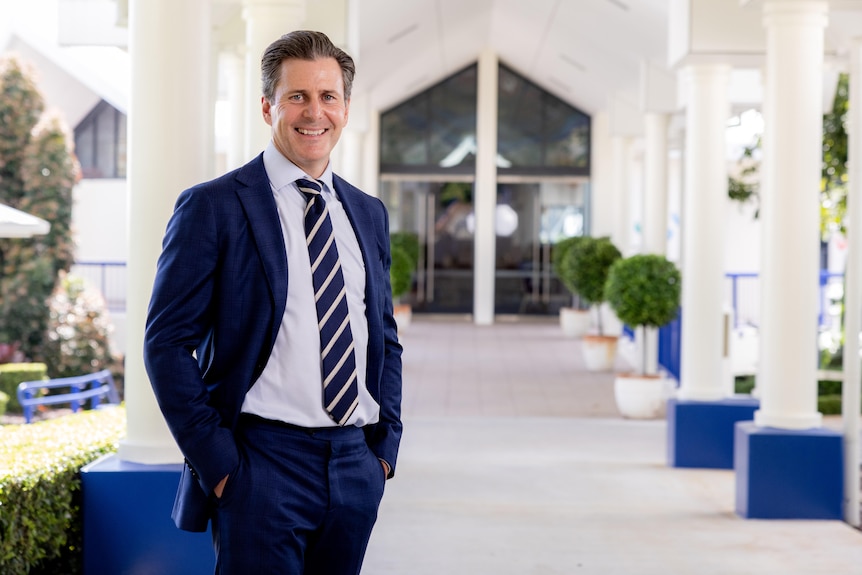
Matt Corbett concedes the additional teacher program is not feasible at all schools. (Supplied: All Saints Anglican School)
They then work in tandem with less experienced teachers throughout the week.
“We want our teachers diverting their energy to our young people, rather than administration,” Mr Corbett said.
Helping guide Mr Holt and his year 6 teaching colleagues is Joanna Smith, who has been teaching for more than 15 years.
Ms Smith leads the science modules for year 6 classes at All Saints and works as an additional qualified teacher in the classroom for other subjects.
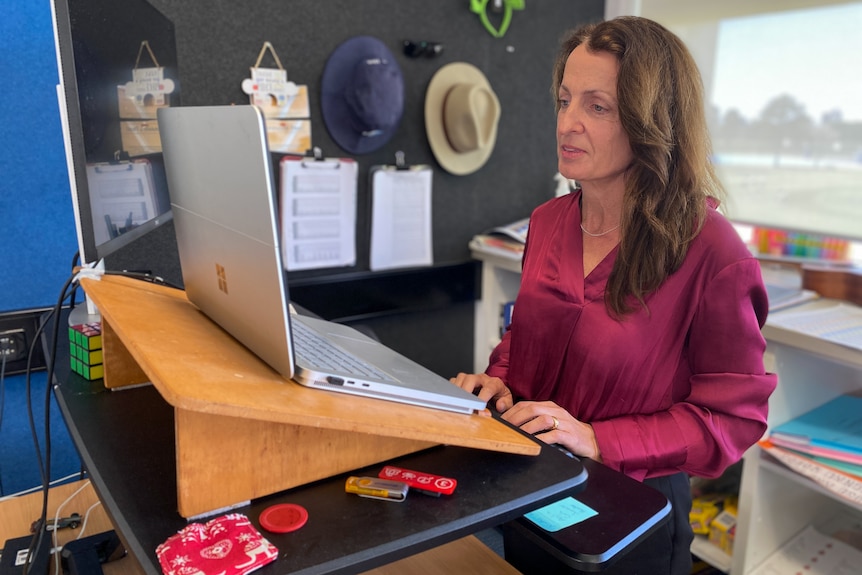
Joanna Smith says student focus has improved through the team-teaching model. (ABC Gold Coast: Mark Rigby)
“It’s not someone just helping you,” she said.
“I lead some lessons, the year 6 teachers lead some lessons and then we support each other — so it’s like a team-teaching model.
“Another benefit is that your lesson has always got to be the best it can be because you’ve always got someone watching … if someone’s in there watching you do your job, your level lifts, and that’s a good thing.”
Increasing focus for teachers and students
The support of an experienced teacher to help plan, deliver, and record data on lessons benefits students as well as educators, according to Mr Holt.
“It’s allowed me a little bit of breathing room to really look at my practice and how I can do it well from really early on in my career,” he said.
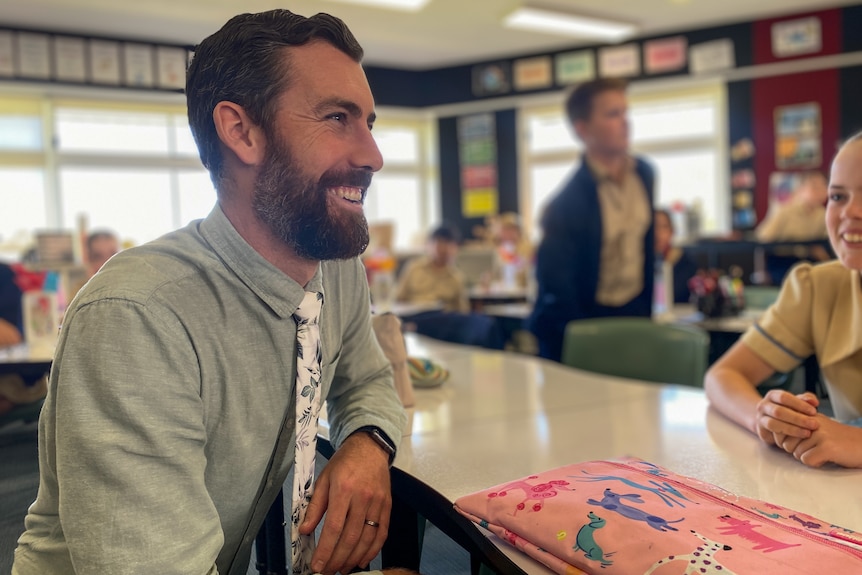
Chris Holt says the additional teacher program at All Saints is helping relieve a growing teacher workload. (ABC Gold Coast: Mark Rigby)
“With one teacher able to focus on supporting students who need extra support or extending students who need extension, in the moment and all lesson long, it’s a golden thing for the students.”
Mr Corbett conceded that All Saints was in a privileged position and having an additional teacher per year level was not feasible for all schools.
But he said the early results of the program were promising.
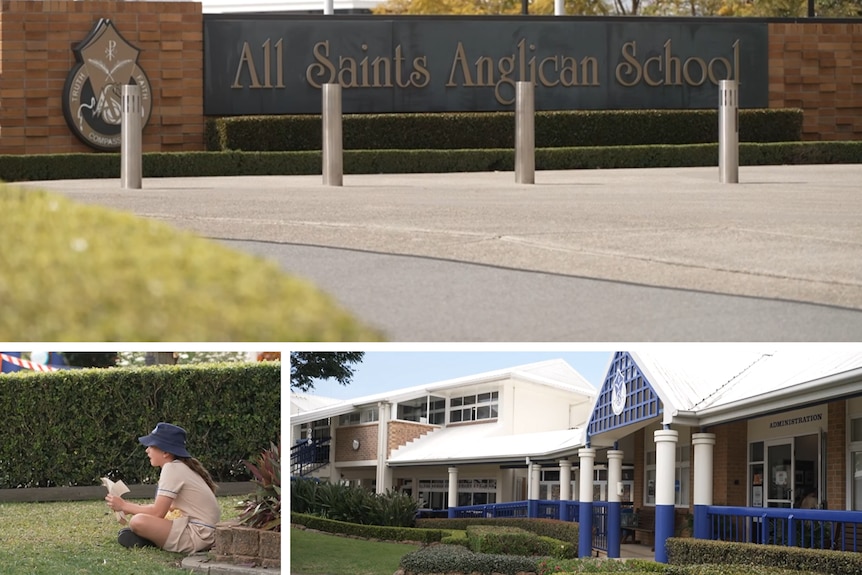
All Saints Anglican School is a privately operated independent school for prep to year 12 students. (ABC Gold Coast: Mark Rigby)
“If there’s a shared responsibility for the planning, for the teaching and reflecting on the learning in the class, naturally that’s going to enhance the energy and focus of our teachers,” he said.
“The wellbeing of our teachers, reportedly, has gone up.”
Cycle of attrition
Glenys Oberg is a former state school teacher-turned education researcher at the University of Queensland.
Ms Oberg studies the impacts of increased workload on teachers and how it contributes to burnout and teacher attrition.
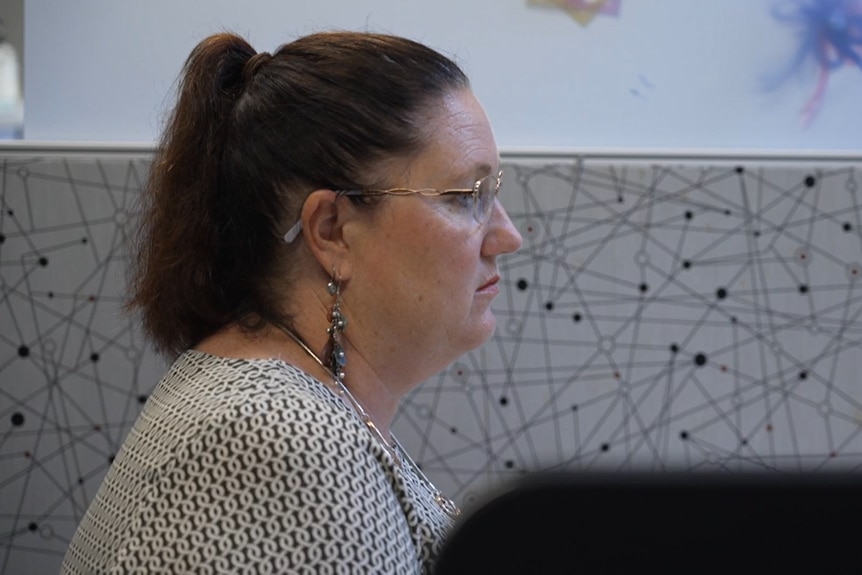
Glenys Oberg says teachers feel undervalued and untrusted as professionals. (ABC News)
“We’ve got huge numbers of teachers, Australia-wide, who are leaving the profession,” she said.
“Attrition leads to more workload, which leads to more attrition, so it’s this cycle at the moment and it doesn’t seem to be stopping.”
The Queensland College of Teachers (QCT) is the state’s regulatory body for teachers and approves teacher registrations and permission to teach in Queensland.
Its latest annual report shows teacher registration numbers are increasing in the Sunshine State; from 117,167 in 2023 to 119,646 in 2024 — a rise of 2.3 per cent.
But also going up is the number of teachers who cancelled or let their registration lapse — from 3,641 in 2023 to 4,221 in 2024 — a 15.9 per cent year-on-year increase.
Scholarship support
The federal government and each state and territory has plans in place to boost teacher workforces, but the Catholic Education Diocese of Cairns (CEDC) has taken measures into its own hands.
In 2022, it struck a deal with James Cook University and Central Queensland University and started paying tuition for aspiring teachers and people looking for a career change.
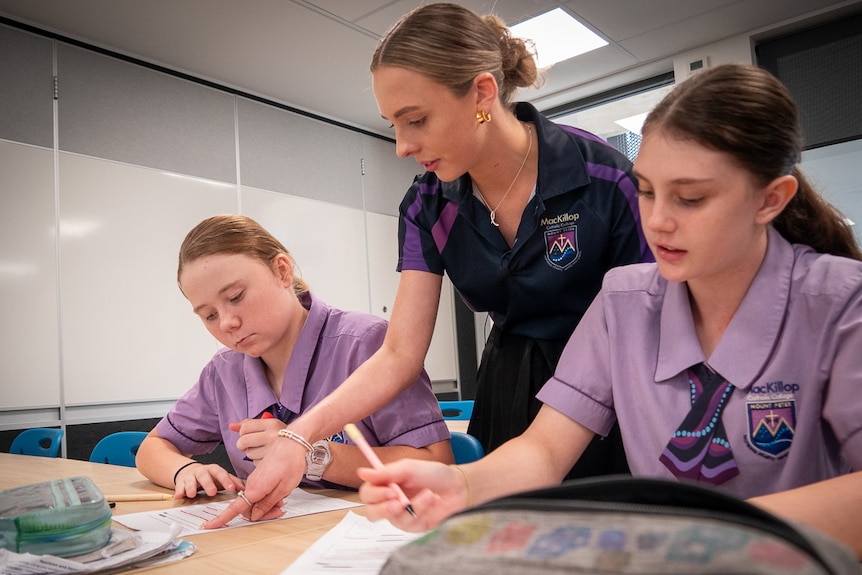
Olivia Parise takes responsibility for her own class of high school students in 2026. (ABC Far North: Brendan Mounter)
Recipients awarded a full scholarship for a bachelor’s or master’s degree commit to at least two years’ full-time work with CEDC after they graduate.
“We’ve got more people retiring than we’ve got coming into the profession, so we just have to be more proactive in attracting people,” CEDC executive director Diarmuid O’Riordan said.
Olivia Parise, 21, is among the first group of bachelor’s scholarship recipients and will graduate this year before taking the reins of her own high school class in 2026.
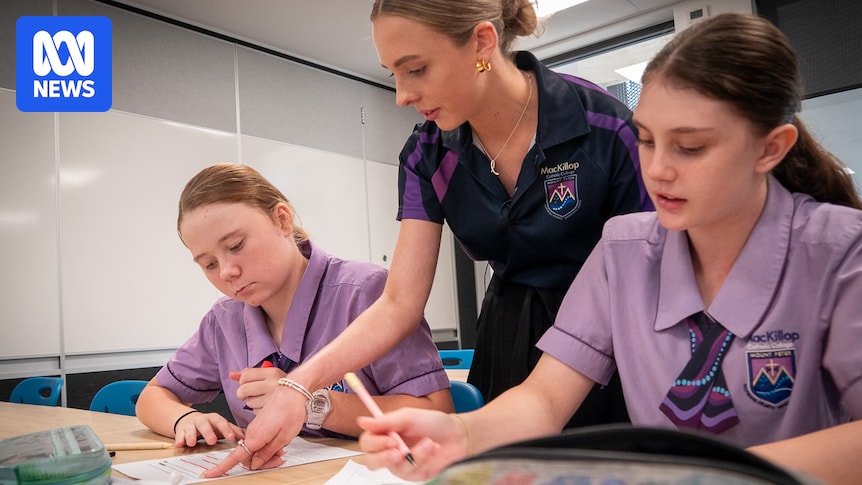
For the final two years of her studies, Ms Parise has also worked as a teacher’s assistant at Mackillop Catholic College, south of Cairns.

Olivia Parise has worked as a teacher’s assistant while studying. (ABC Far North: Brendan Mounter)
She said the on-the-job experience, in addition to her university placements, had prepared her for the reality of being a teacher, but she admitted to already doing a lot of work outside school hours.
“It’s about learning the content before you’re able to teach it and I think, in the early years, we [graduate teachers] spend a lot more time learning the content and planning lessons,” she said.
“But I’ve been fortunate enough to have a network of people that I can go to with all my endless questions and doubts.
“Gradually, it will just become a part of us, and we’ll be able to teach it without having to think about it and learn about it.”
Investing in teachers
Mr O’Riordan said more than 30 scholarships had been awarded through the CEDC program since 2022, costing more than $200,000.
But he said the investment was making a difference to teacher shortages with six master’s scholarship recipients placed in schools and the first group of bachelor’s scholarship recipients coming online in 2026.
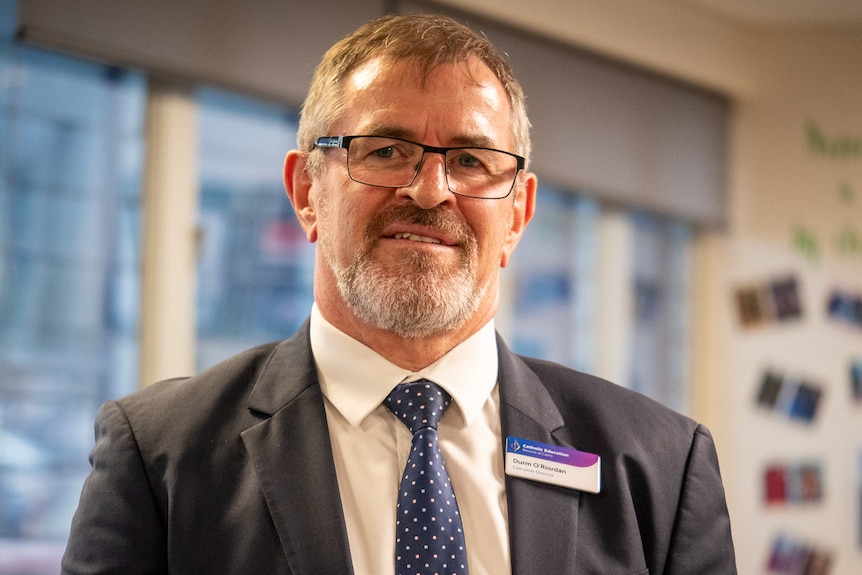
Diarmuid O’Riordan says school leaders need to be more proactive in attracting people into teaching. (ABC Far North: Brendan Mounter)
“Because they feel they’re being supported, they’re mentored and they’ve already got some connections and relationships in the schools … that adds to them coming in and being that quality teacher that we’re seeking,” Mr O’Riordan said.
“[They are] those teachers that really want to be there, that have a commitment to the profession and see it as something more than just a job, more like a vocation.”
Queensland’s Department of Education runs similar internship and scholarship programs designed to attract “career changers” into teaching positions and offers one-off grant payments of up to $5,000 for “exceptional Queensland Year 12 graduates” starting a teaching degree at a Queensland university.
Benefits of mentoring
Ms Oberg said support programs like those in place at CEDC and All Saints would not solve teacher workforce shortages alone, but they could go some way towards relieving pressure on schools and educators.
“Teaching can be a really isolating position to be in, especially with all of the extra admin and data collection that teachers are asked to do,” she said.

Glenys Oberg says burnout is rife among teachers. (ABC News: Mark Rigby)
“We know from research that mentoring is a huge benefit both for the mentors and the mentees.
“Anything that you can do in a school to really build systemic support will be hugely beneficial, so mentoring is a great start.”
Queensland’s state school teachers last month rejected the government’s “best and final” enterprise bargaining offer after months of negotiations.
The Queensland Teachers’ Union said the offer lacked enough “respect, fairness and real investment” to address the state’s teacher-shortage crisis.
In response to questions about its approach to teacher shortages, the Department of Education provided data on its teacher workforce and vacancy rates.
That data shows the average teacher-vacancy rate across Queensland is about 1.8 per cent, but that figure is much higher in north, far north and central Queensland.
The data also shows the department’s teacher workforce has grown by 1,182 staff in the five years to March 2025, but only by 109 in the past 12 months.
“To attract and retain teachers, particularly in rural and remote areas, the department offers a range of initiatives,” the spokesperson said.
“These include specific incentive programs such as 12 months of subsidised accommodation, generous relocation packages, and retention payments for both new and experienced teachers.
“The Queensland government remains committed to supporting current programs in addition to introducing additional programs to boost Queensland’s teacher workforce.”
Ms Oberg said Queensland school teachers she had spoken to in her research felt the state education system put more focus on attracting new teachers than retaining experienced ones.
“While it’s a really positive step to attract some of our great young thinkers into education, we need to remember that we need some of those experienced teachers as well,” Ms Oberg said.
“Teachers get told a lot from the department and from government initiatives that ‘we care about teachers and we care about students’.
“But there’s not very much being seen on the ground that makes them feel that people care.”