
Earlier this year, I found myself in a private room at the University of Melbourne’s Baillieu Library, huddled around a very old book with my friend Kirsten.
It’s a small atlas printed in 1776 in France, with delicate, hand-coloured illustrations.
But this is no regular map of the world. It’s a star atlas.
And my friend Kirsten — she’s an astrophysicist.
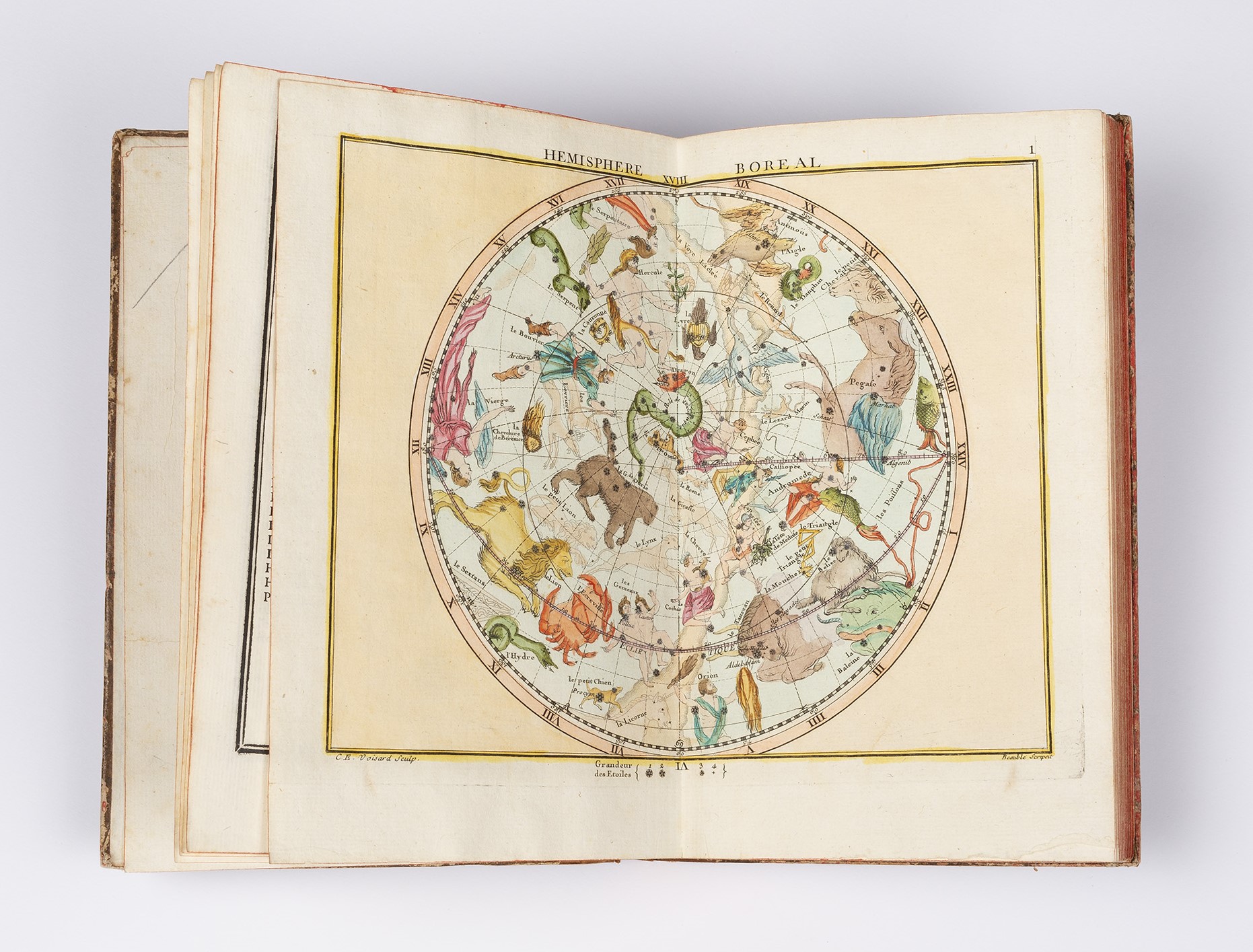
The Atlas Céleste de Flamstéed printed in 1776. (Supplied: Archives and Special Collections, University of Melbourne)
“You’ve got Leo, you’ve got the crab — cancer — gemini there, the serpent…” says Kirsten Banks, Wiradjuri woman and astrophysicist from Swinburne University, as she points out the constellations in this centuries-old chart.
Of course, Dr Banks can do more than just identify constellations. Her PhD research involved some very sciency-sounding things like “stellar spectroscopy”, “asteroseismology” and “galactic archaeology” (wow).
But today, I’ve asked her to share some knowledge that is far, far more ancient than the 18th century book resting on a white pillow in front of us.
A short history of constellations
There are 88 constellations recognised by the International Astronomical Union — all of which have European origins.
Deep Time: A story more than 65,000 years in the making
Most come from the ancient Greeks, including the twelve zodiac signs that we know and love (the lion “Leo”, the bullish “Taurus” etc). There are dozens more, such as the greater and lesser bears of Ursa Major and Minor, the winged horse Pegasus, the Lyre (harp) and the less-creative “Triangulum”. Three guesses what shape that last one is.
The rest were decided upon by a series of 17th and 18th century Enlightenment astronomers.
Gripped by the spirit of the age of scientific discovery (or perhaps just having run out of animals to name constellations after) they christened them with such esoteric titles as “the Pendulum clock”, “the Air Pump”, and “the Chemical Furnace”.

In Flamsteed’s atlas the Southern Cross is found under the back hoof of the centaur, but in Wiradjuri this group of stars is given greater importance. (Supplied: Archives and Special Collections, University of Melbourne)
The emu chase of Baiame
One of the first constellations most children are taught to recognise in the night’s sky is Orion. Visible in the southern hemisphere over summer, the three stars that make up Orion’s belt are more colloquially known as “the saucepan”.
To the Greeks, Orion was the giant huntsman placed in the stars by Zeus. But, as Dr Banks explains, a parallel story can be found in Indigenous astronomy.

Kirsten Banks is a Wiradjuri astrophysicist and science communicator. (Supplied: Kirsten Banks)
“In Wiradjuri we actually see the stars of Orion as the same sort of pattern representing a human — or a man in this case. For us though, we see it as the creator spirit Baiame,” Dr Banks says.
“But from the southern hemisphere we see him from upside down, and in some stories that is relevant. There’s a story about Baiame running around trying to chase Dinawan — which is an emu — and he trips on a log and falls flat on his face.”
This story, Dr Banks tells me, is animated in the way the stars move across the sky: when Baiame sets on the western horizon, he sets face-first.
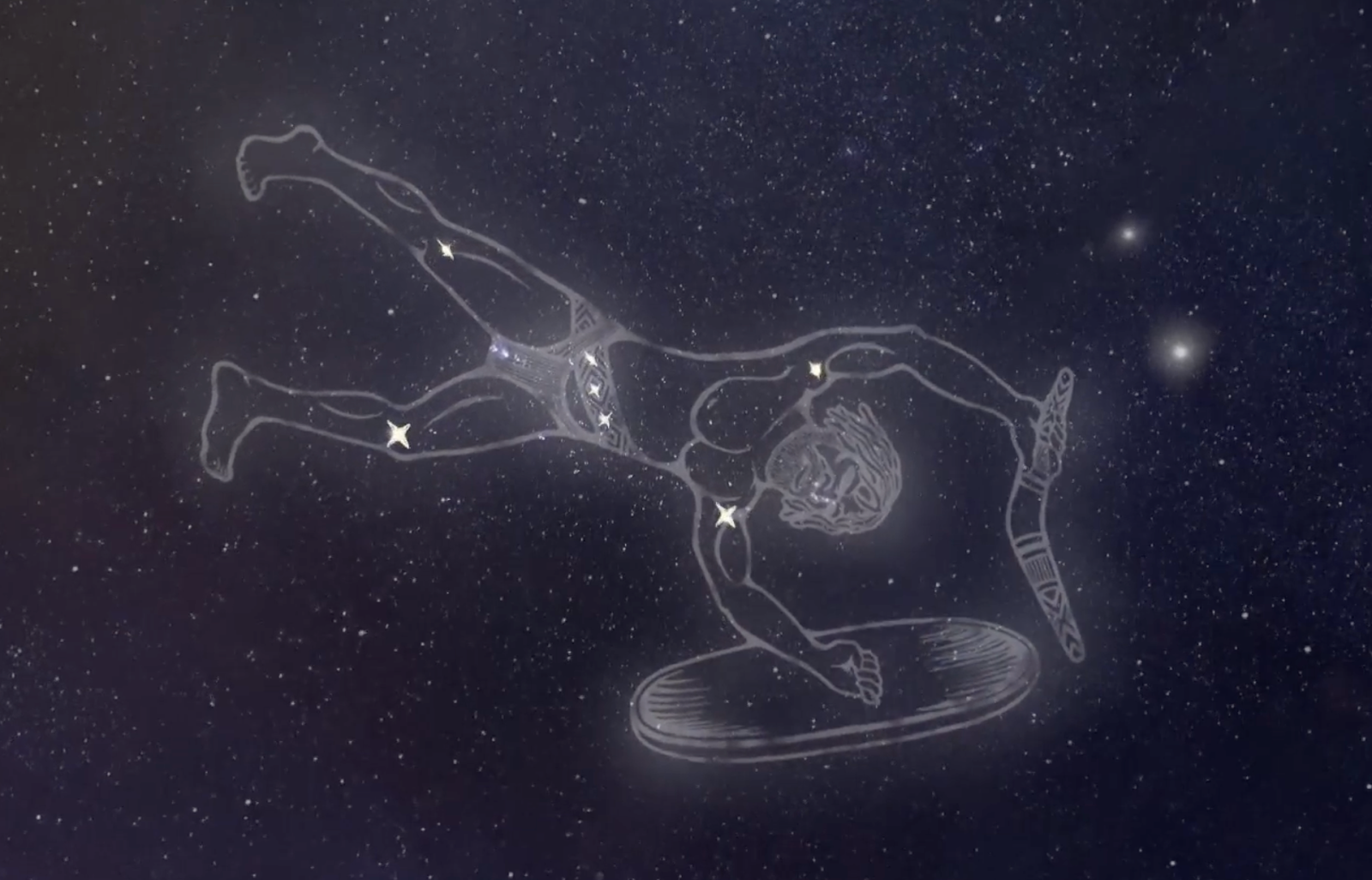
Baiame is the creator god and sky father in the Wiradjuri Dreaming. (Supplied: Scott “Sauce” Towney)
The Southern Cross, too, is the site of an important Wiradjuri story.
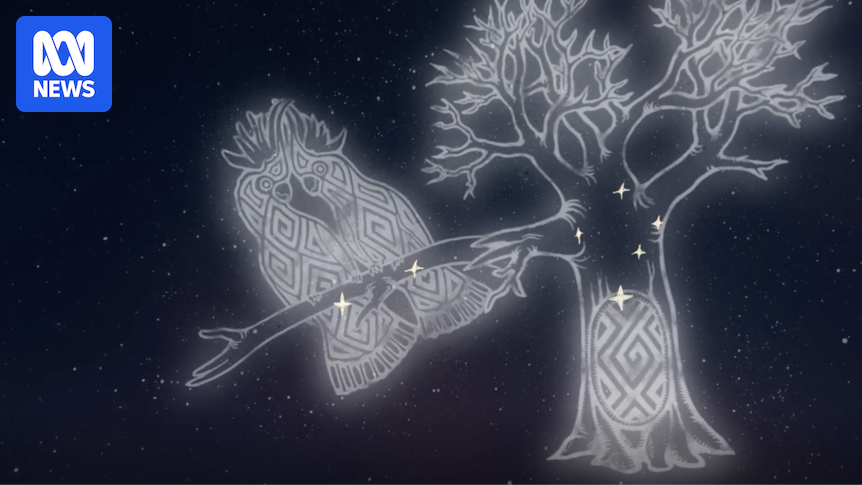
“The story behind this is so beautiful. The cross we call Yarran, it actually is a tree, and the pointer stars are muraany muraany, which are two cockatoos,” Dr Banks says.
“The tree Yarran is their home that got uprooted and put into the sky as part of a different story. Muraany muraany want to follow their home in the sky, and because of how the earth rotates and how the stars move in the sky, the pointers are always following behind the tree. Always flying home.”
Great emu in the sky
The most famous Aboriginal constellation is not made up of stars, but rather the space between them.
The great emu in the sky — known as Gugurmin in Wiradjuri — is a truly massive form that stretches from the Yarran (the Southern Cross) all the way past Scorpius.
Stream The Art Of… on ABC iview
Usually the image of a constellation is created by connecting the dots between bright stars. But in the case of Gugurmin, as Dr Banks explains, the form of this giant celestial bird is made up of the patches of gas and dust of the Milky Way that block light from more distant stars.
What’s more, this object of wonder and beauty holds ancient practical knowledge for Wiradjuri, too.
“Its position in the night sky indicates when is the right time to go looking for emu eggs,” Dr Banks says.
“If it’s on the horizon after sunset it looks like it’s running along the ground, so that shows Dinawan running around looking for a mate and trying to make their nests.”
Later in the year, when the emu is high in the sky, the time is right for collecting.
“We change our perspective from an emu, to an emu egg in a nest. We are the egg.”

The Great Celestial Emu — known as Gugurmin in Wiradjuri — is a dark constellation, which means its shape comes from the space between stars. (Supplied: Scott “Sauce” Towney)
The constellations passed down to us by the ancient Greeks promote a largely passive observation of the stars — the movements of the zodiacs may have some fortuitous or malicious effect on our destinies, but they are up there, and we, down here.
But the story of Gugurmin invites us into the annual cycle of the emu to play each part for ourselves.
At its centre, Wiradjuri astronomy teaches us about our interconnectedness with the world around us, both terrestrial and beyond.
Watch the new season of The Art of… free on ABC TV and ABC iview.