
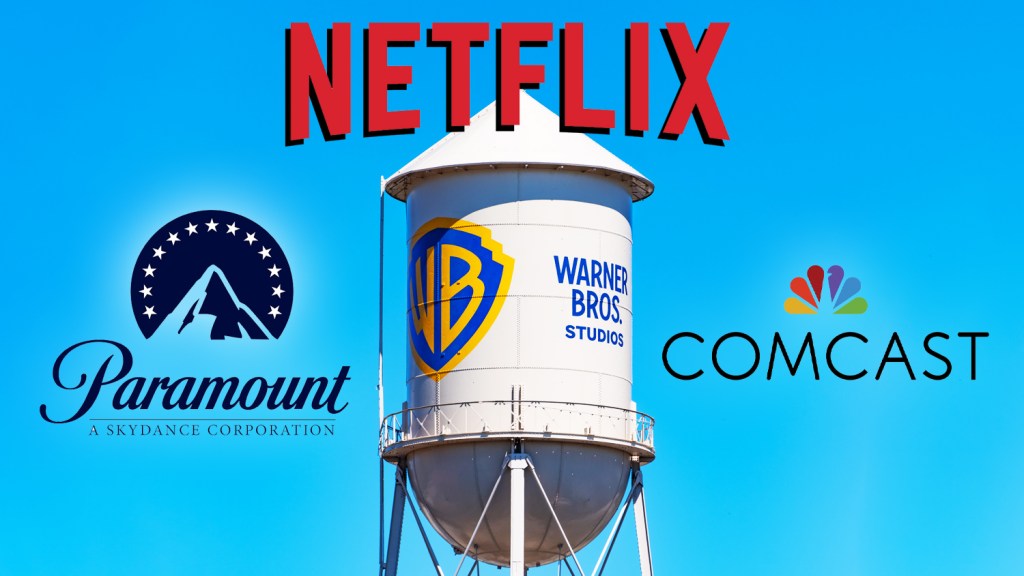
Word of revised bids by the three companies looking to acquire all or part of Warner Bros. Discovery surfaced Monday, the day designated by the media giant as the deadline for the next round of offers.
Paramount, which has already had three proposals rejected by the WBD board, is staying in the hunt, as are Netflix and Comcast, multiple sources familiar with deal deliberations have told Deadline. For the bulk of WBD’s empire, the change in ownership would be the fourth in a decade but likely the most consequential. With many pieces yet to fall into place, and a lengthy period of regulatory review will follow, the future ownership of the Warner Bros. movie and TV studios; HBO; streaming flagship HBO Max; DC; CNN and other storied assets is up in the air as a turbulent year for the industry winds to a close.
The financial and structural details of the offers and the shape of the resulting company remain fluid. Bloomberg reported earlier Monday that Netflix submitted an all-cash offer for the studios-and-streamers division of WBD. Comcast and Netflix are interested in only the studios-and-streamers part, while Paramount’s bid is for the entire company.
Wall Street analysts, citing recent press reports, estimate that Warner Bros., HBO and the deep vault of franchises and library titles could be worth at least $70 billion. The market value of WBD, which currently includes linear TV networks like CNN, TNT and Discovery, was $59 billion at the end of Monday’s trading day.
The new bids are considered binding, although parties can still tweak their offers, sources said. One participant said the private process being managed by WBD could, as is sometimes the case in M&A, involve to an exclusive negotiating window with one of the suitors, though that wouldn’t necessarily preclude the other parties from re-entering the fray. WBD CEO David Zaslav has reportedly expressed confidence that the M&A process could be wrapped up by the end of December. The companies pursuing WBD made full use of the Thanksgiving holiday, putting in long hours to fine-tune their latest offers, insiders said.
Reps from WBD, Paramount, Comcast and Netflix declined to comment when contacted by Deadline.
WBD, which was formed in April 2022 from the merger of Discovery Communications and WarnerMedia, has been planning to formally separate into two companies if it doesn’t receive terms it likes from any of the bidders. The split would close by mid-2026, the company has said. The move is designed to enable a smoother acquisition path for potential buyers down the road. It is also a way to relieve WBD’s balance sheet of the burden of a declining linear TV portfolio. Comcast is close to finalizing the spinoff of most of its cable networks into a new company, Versant, with similar motivations.
With reports swirling over the past two months, WBD has sought to keep the deal process out of public view. During the company’s quarterly earnings call with Wall Street analysts in early November, Zaslav declined to address specifics about the inbound interest, but did observe, “It’s fair to say that we have an active process underway.”
Zaslav, one of the highest-paid media executives over his two decades as CEO of Discovery and WBD, agreed with the company on an adjustment to his compensation package last month in light of the potential merger. In the case of a split, he was set to become CEO of the skinnier Warner Bros., with current WBD CFO Gunnar Wiedenfels leading the linear television company to be called Discovery Global.
Wall Street has largely cheered the prospects of an M&A transaction, though the share prices of all of companies involved were relatively flat in after-hours trading Monday. WBD’s formerly moribund stock skyrocketed in recent months after Paramount’s aggressive pursuit of a deal became public and led to a formal auction.
Several veteran analysts have been weighing in, with most finding reason for optimism (or at least pragmatism) in the anticipated transaction. “The global media industry stands at the precipice of historic transformation,” BofA Securities analyst Jessica Reif Ehrlich wrote in a client note. WBD, she continued, is “positioned at the epicenter of a significant shift in asset valuation and competitive strategy.”
The company has been contending with a linear TV downturn “beyond initial worst-case scenarios,” Ehrlich added, but it will reap the rewards of a “scarcity premium” and set the pace for more dealmaking down the road. WBD changing hands “should lead to much awaited and needed industry consolidation,” she wrote. “The market is witnessing the endgame of the cable TV era, and WBD is another domino in a likely cascading series of transactions that redefine the competitive fabric of the media & entertainment industry.”
Although he may wind up in the minority, especially in the financial community engineered to profit from M&A, Doug Creutz of TD Cowen called the WBD acquisition “a deal that probably should not happen” in a note last Wednesday. Regardless of who ends up buying the company (and each, Creutz argues, faces high hurdles with regulators), the transaction “would have significant implications for the supply of film and television content to consumers and the continued employment of people involved in making said content,” the analyst wrote.
Dominic Patten contributed to this report.