
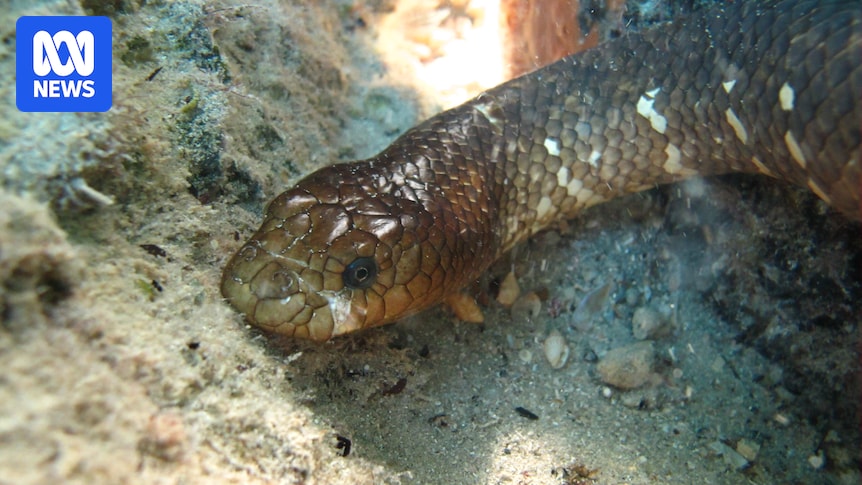
Carnarvon residents and scientists have raised concerns about the number of dead sea snakes washing up on shores.
The snakes have primarily been found in Nanga Bay, which is located inside the Shark Bay World Heritage site, 700 kilometres north of Perth.
The Department of Biodiversity, Conservation and Attractions (DBCA) said 15 dead sea snakes were collected this October from the area.
DBCA said the snakes were a variety of species.
Numbers still slithering out of recovery
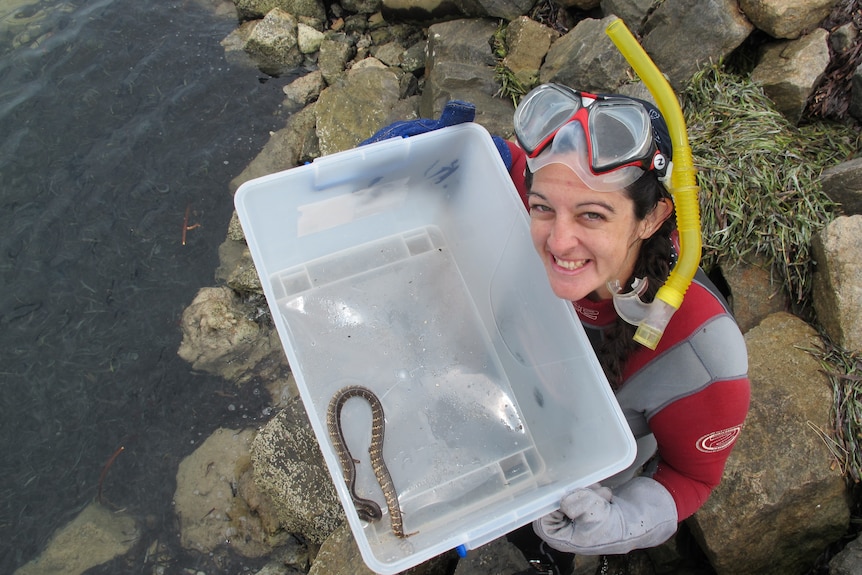
Blanche d’Anatasi holds up a sea snake at Shark Bay. (Supplied: Tara Fullston)
Sea snake researcher Blanche d’Anastasi said she was concerned about the unusual numbers being reported to authorities and her research team.
She urged the public to help record any sightings on the Australian Sea Snakes Facebook page of both healthy and distressed sea snakes.
However, she said sea snakes should not be handled as they were highly venomous and had a very delicate spine, which was made for water.
“If you see a sea snake on the beach it means they’ve either been afraid of drowning because they are unwell and stranded themselves, or they’ve been so tired that the waves, currents or wind have washed them into shore,” Ms d’Anastasi said.
“Sea snakes on the beach should not be pushed back into the sea. The best thing to do is to keep people, dogs and children safe — and the sea snake safe — and call an expert.”
Ms d’Anastasi said her team would use the data collected to understand what was driving the big stranding events.
“We know sea snakes really don’t cope well with really big weather events, they get caught up in all of the amphibolis sea grass that washes up after cyclones,” she said.
“And they don’t do well after heatwaves.”
In 2010, a deadly heatwave hit Shark Bay, which Ms d’Anastasi said caused a 76 per cent decline in the local population of snakes.
“Sea snakes are something that used to be really quite abundant, and then following that heatwave they’ve really declined savagely,” she said.
Snakes not the only wildlife found dead
Meanwhile, nearly 20 turtles have been found on the same shores, but wildlife authorities said those numbers were not out of the ordinary.
Increased sightings have been recorded in Nanga Bay, but Carnarvon resident Shauna Kershaw said it was happening further north in Carnarvon as well.
“Sometimes they’re still alive and they just look like they are resting, but sometimes they look like they’re a little bit messed up,” Ms Kershaw said.
Ms Kershaw said she found about 20 dead snakes on Pelican Point Beach in just two months.
But she was also alarmed by a similar pattern she was seeing with sea turtles.
“It’s mostly the smaller ones we’re finding,” she said.
“Some have barnacle growths on them, and then some have been floating in the sea that long that there’s not much left of them.”
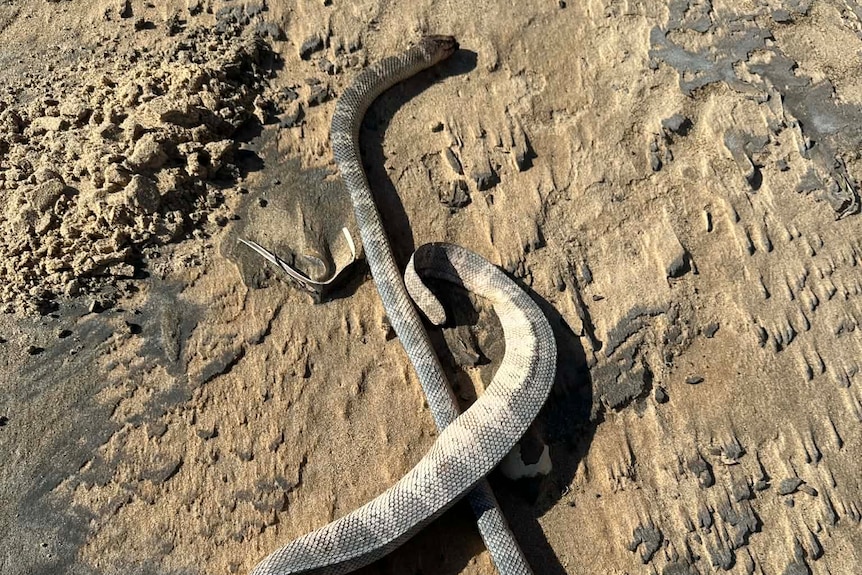
One of the 20 snakes Shauna Kershaw found on Pelican Point Beach. (Supplied: Shauna Kershaw)
A DBCA spokesperson said 17 dead turtles had been reported in Carnarvon and Shark Bay since June.
“Two juvenile green turtles showed visible tumours, likely linked to fibropapillomatosis [FP virus], and samples have been sent to experts for analysis,” the spokesperson said.
“While FP virus is not common in WA, several cases have presented in recent years, primarily affecting juvenile green turtles.
“The cause of death for the remaining turtles is undetermined.”
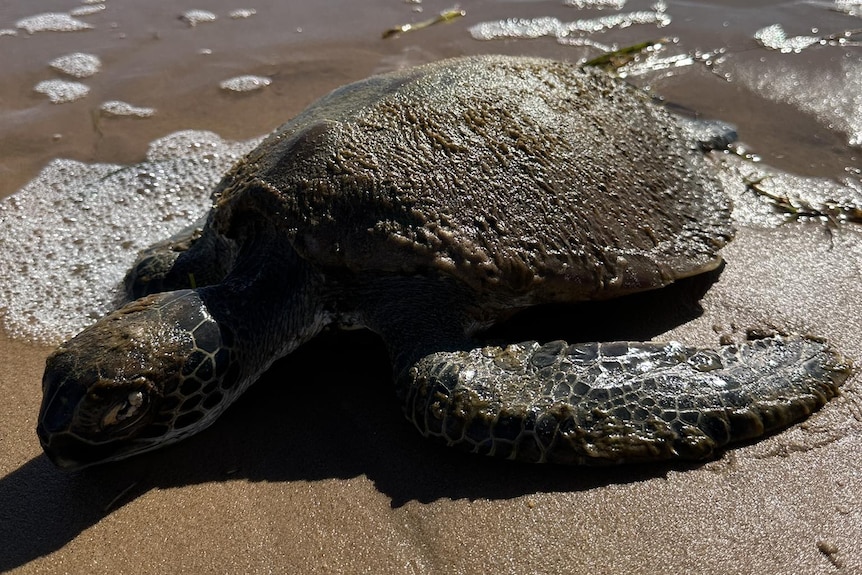
A small turtle was found by Ms Kershaw at the Old Prawn Jetty heritage site. (Supplied: Shauna Kershaw)
Snakes still alive
Carnarvon resident Barrie Mckinney has also noticed a number of dead snakes near the historic One Mile Jetty precinct.
Over two days in November, Mr Mckinney said he spotted two stranded sea snakes on his early morning walks.
“I’ve seen the odd turtle washed up and the odd fish but that’s it, no sea snakes [previously],” Mr Mckinney said.
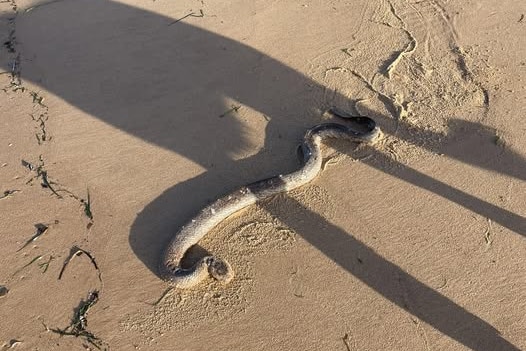
Barrie Mckinney thought this snake was dead, but when he returned he found it had moved. (Supplied: Barrie Mckinney)
On his initial sighting of the snakes, he believed both to be dead. However when he returned, one of them had changed positions.
“It looked 100 per cent dead, but you could see it had been moving,” he said.
“I thought [there had been] a lot of fast movements and then it was dead.
“But when I came back I could see it had moved its head into a different position, so it wasn’t dead.”