
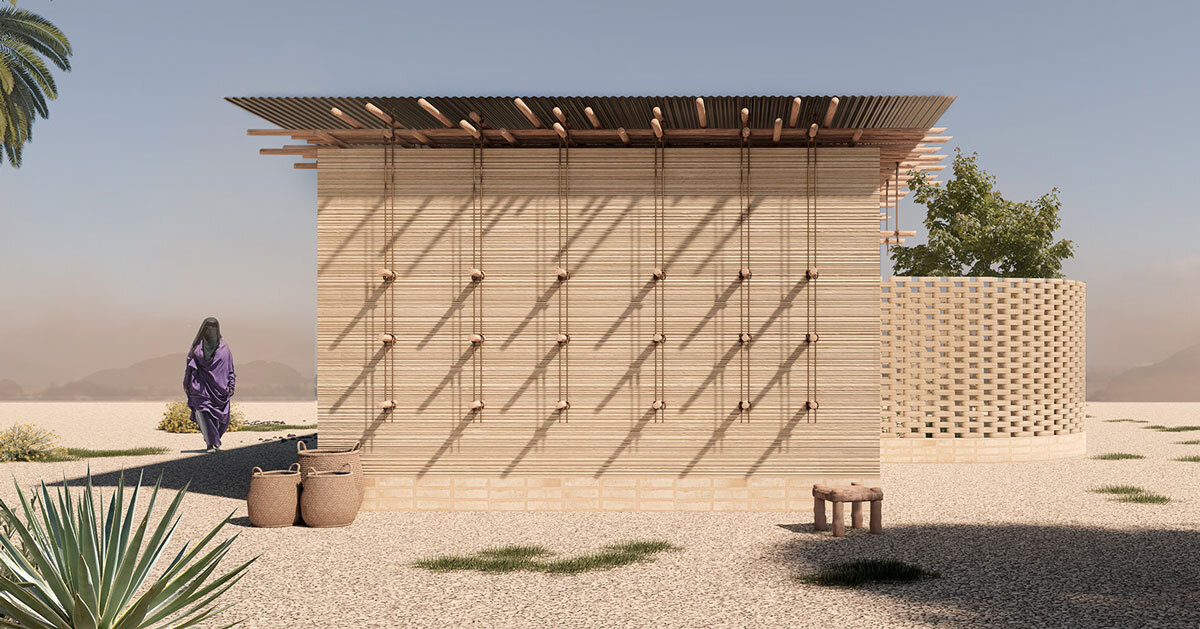
Flexible Modules Shape Low-Cost Shelter Framework in Somalia
Shelters of the Future is a modular housing proposal developed by Rabie Al Ashi for an international competition focused on low-cost shelter solutions for Internally Displaced Persons (IDPs) in Somalia. The competition was part of a program launched by the Ministry of Public Works, Reconstruction and Housing (MoPWRH) and the International Organization for Migration (IOM – UN Migration) with Young Architects Competition (YAC), to rethink the future of a dignified, contextual, and resilient shelter design for the displaced communities in Somalia. Created in collaboration with Kengo Kuma & Associates, under the guidance of Anteo Taro Boschi Sanada, the project was awarded 1st Prize.
Rooted deeply in Somali vernacular architecture, the concept reinterprets traditional building knowledge through a contemporary, community-driven framework. The design is anchored by a flexible 4×4 m spatial module, a simple, human-scaled unit that can be organized into diverse configurations. Each module pairs two enclosed rooms with a semi-open central space and a private garden, allowing households to maintain dignity, privacy, and cultural spatial norms.
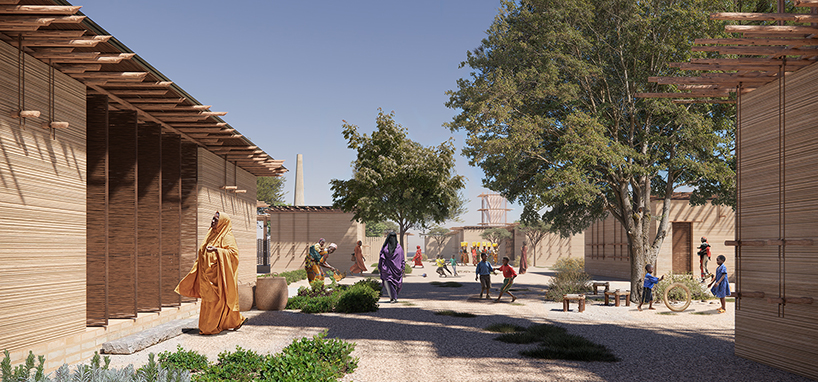
reinterpreting Somali vernacular architecture through a contemporary system | all images courtesy of Rabie Al Ashi
Adaptive Modular Clusters Support Community-Oriented Living
The system grows organically, where modules cluster into radial, linear, or courtyard arrangements, forming vibrant neighborhood structures capable of supporting evolving community needs. This adaptability enables shelters to transition from emergency response to long-term, livable environments. Materiality is central to the project’s identity. Construction relies on locally sourced, renewable, and low-embodied-energy materials such as acacia logs, mud bricks, palm leaves, and earth-based finishes. The shelter is designed for low-tech, self-build assembly, empowering residents, strengthening local craftsmanship, and reducing dependency on imported systems.
The project also integrates passive strategies, cross-ventilation, thermal mass, shading, and breathable enclosures, to enhance comfort in Somalia’s hot, arid climate. Gender-sensitive layouts, space for small-scale farming and livestock, and shaded communal areas further support social cohesion and livelihood recovery. Shelters of the Future, conceived by designer Rabie Al Ashi, reframes humanitarian shelter as more than a temporary fix: it proposes a scalable, culturally grounded, and resilient architectural framework that grows with its users, restoring stability, dignity, and a sense of belonging in displacement contexts.
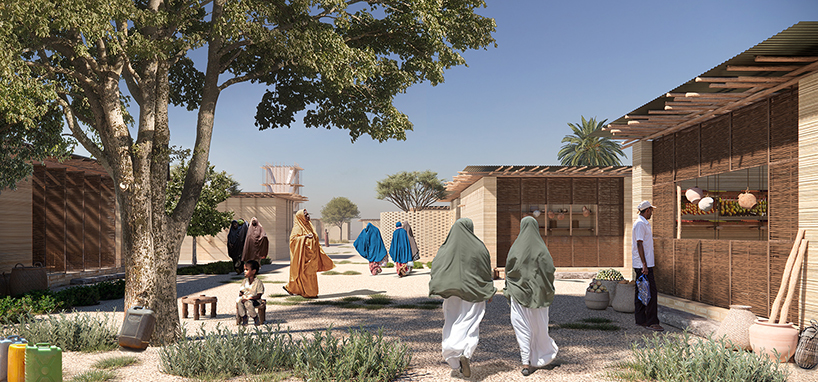
modular neighborhood formation designed for scalable community growth
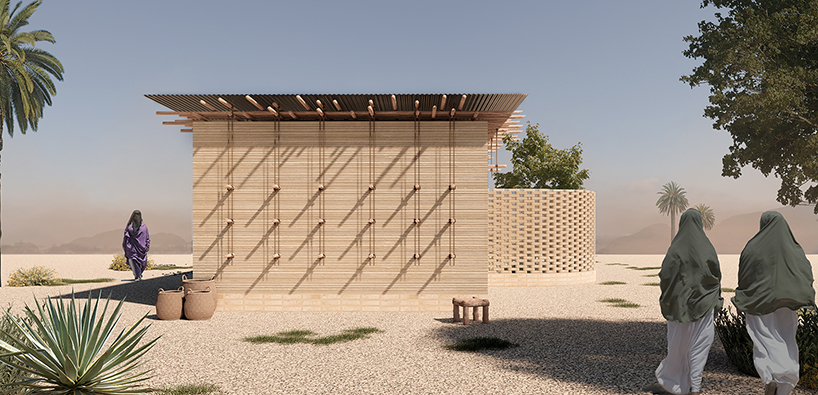
the shelter celebrates the use of local materials and the local construction techniques