

The Autumn Nations ended with a whimper, if you are a Welsh fan, or an emphatic exclamation mark if you’re South African. The other games had finished a week early which meant South Africa’s record demolition of Wales took centre stage. In this article we will look at how each of the top 12 ranked nations fared this Autumn and what the stats say about their progress.
1st: South Africa – Grade: A++
They played five games with wins against Japan, France, Italy, Ireland, and Wales. That represented two of the top four test sides in the world at the end of October – France have now dropped to 5th. At times it felt like the Springboks were toying with the rest of the rugby world. They won when down to 14, they won with backs in the forwards, they beat Italy with a red card and four first half subs, and they beat Wales with a 39-year-old coach on standby to play. Whatever was thrown at them, they just bulldozed past it and in doing so significantly lengthened the gap they have on the rest of the teams in the world.
South Africa led for 81 minutes of their match against Ireland
2nd: New Zealand – Grade: C
C may seem harsh for a team that beat Ireland, Scotland, and Wales. However, there seems to be a clear dimming of the All Blacks’ star this year. It’s important not to overstate that though, they aren’t as scary as they once were but that still means they are very very scary. Their victory over Ireland in Chicago was a limp occasion to start the Autumn Nations but it showed that you can’t afford to take any time off when you play New Zealand. The following week they travelled to Edinburgh with a genuine feeling of optimism among the Scots, then again periods of inattentiveness saw a Damian McKenzie-inspired New Zealand pull clear. England’s dismantling of them in London felt like a seismic moment. There England got better and better as New Zealand faded, ultimately out of sight. There were brief moments of worry against Wales but in the end the 52pts they scored was the highest total since Japan last October.
New Zealand won the last 20 minutes of their games against Ireland, Scotland, and Wales by a combined 38-8.
 The All Blacks only lost one game but the manner of the defeat against England and previously South Africa, has left a lot of questions back home (Photo JUSTIN TALLIS/Getty Images)3rd: England – Grade: A+
What a difference a year makes. Narrow losses against New Zealand,Australia, and South Africa left Steve Borthwick’s days numbered in the eyes of many English fans in 2024. A comfortable victory against Japan did little to turn the tide especially when the next match was a loss against Ireland in the Six Nations. But since then it’s been 11 wins on the trot. This Autumn they brushed aside Australia and Fiji before the big test against the All Blacks. The first half looked to be setting up a New Zealand victory but then England turned on the afterburners. A final weekend victory against Argentina lacked that same zip. Overall though, not only are England successful but they are also enjoyable to watch after accusations of pragmatism dogged the early days of the Borthwick reign.
Ben Earl led England’s carry stats in all four of the Autumn matches, topping out with 20 against New Zealand.
4th: Ireland – Grade: C-
The best teams in the world have something of a first world problem. It’s hard to judge their performance based on anything other than how they go against the other top teams in the world. For Ireland that meant that their confident victories over both Japan and Australia don’t sway the overall grade. That is dictated by opening night losses to New Zealand and an end of term defeat to South Africa. The loss to the Boks in particular felt existential. Ireland’s scrum was systematically dismantled, they hit just 73% on their own lineout, and conceded 18 penalties. At minute 42 they had just 12 players on the pitch and were shown five cards (four yellows and a red). Even so, the second half might have been even worse as they struggled to get any foothold in a game where the Boks looked like they were a cat playing with their food. Before the series, the biggest question was whether Sam Prendergast or Jack Crowley should be given the keys to the attack. That is no longer the biggest question. Not because it’s been answered, but because there are issues now right the way across the squad.
Ireland scored just 1.1pts per entry from their six entries against South Africa.
5th: France – Grade: B-
The overall story of this Autumn has been that of the top ten only South Africa, England, and Argentina have enhanced their reputation. Everyone else has either stayed where they are or slunk backwards. France have stayed put. Their loss against South Africa came with a side shorn of some of their biggest talents. But it also came after they’d led for an hour and were playing a 14-man Springbok side. They finished off their tournament with victories over both Fiji and Australia, though the Wallabies made them work harder than they would have expected. France will probably benefit from a series where they had to play up and coming talents, but they do also seem to be a lesser version of the team that looked like it was the best in the world a few years back. Antoine Dupont’s return can’t come soon enough.
France made just six line breaks from their 101 carries against South Africa.
 Damian Penaud broke the Springbok defensive wall but they struggled against to penetrate the defensive line in a sobering loss (Photo FRANCK FIFE/Getty Images)6th: Argentina – Grade: A
It’s been a very good year for Argentina which has seen them take the scalps of the Lions, New Zealand, Australia, Scotland, and Wales. They remain infuriatingly inconsistent, they played 13 matches this season and Wales and Scotland were the only two matches where they won back-to-back. The inconsistency even extends to their play within the same game as shown against Scotland where they were 21-0 down and won the last 30 minutes 33-3. They were 17-3 down at half-time against England and lost by four points. They’ve been knocking on the door of the top four for a while now, will 2026 be the year the break in?
Argentina had more than ten 22-entries in each of their three Autumn matches – their best return was 3.7pts per entry against Wales.
7th: Australia – Grade: D
The Wallabies have been coming back to relevancy in global rugby this year, but that comeback might have hit the buffers. Their trip to the north featured four losses against England, Italy, Ireland, and France. In two of those games they conceded more than 40pts and in only one did they score more than 20pts. They are still a team who are hugely dependent on just a handful of players, as became apparent when they were without key players for their opening match against England. They had three different fly-halves starting; Tane Edmed, Carter Gordon, and James O’Connor. There were promising performances from the likes of Fraser McReight and Harry Wilson, but it’s a long way back to their former level.
Australia conceded more than ten penalties in every game bar their loss to Ireland.
8th: Fiji – Grade: C
Fiji faced England, France, and Spain and came away with one victory over Spain. They pushed England and France – they were 1pt behind England at half-time and drew level with France at 43 minutes. But, they lost the second halves of those games by a combined 37-12. Their teamsheets appear terrifying, especially the backline, but they still struggle to break down organised defences. It’s still been a successful year though, they played nine times and won six of those games; taking a tier one scalp in Scotland along the way.
Fiji played with 48% of their possession in their own half against England, their opponents had just 21% of their possession in their own half.
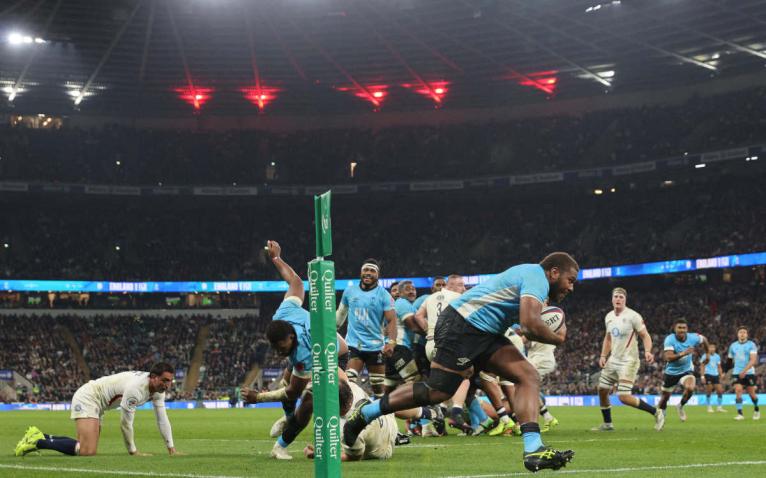 Fiji gave in-form England a fright before Steve Borthwick’s men pulled away in the final quarter (Photo Adrian DENNIS/Getty Images)9th: Scotland – Grade: C+
It is worth remembering how far Scotland have come in recent years. It is a sign of their growth that losing to New Zealand caused such consternation among Scottish fans. That was followed up by a much worse loss to Argentina when they conspired to snatch loss not just from the jaws of victory but the stomach of victory instead. Those two losses were sandwiched between very straightforward victories of the USA and Tonga. Scotland are to be commended for their desire to play tier two opponents, but it does put more pressure on them to come up with the goods when they face the likes of the All Blacks and the Pumas – they couldn’t do that this year.
Scotland won their two best halves of rugby against New Zealand and Argentina 31-8 and lost the two worst halves 50-10.
10th: Italy – Grade: B
Victories over both Italy and Chile mean Italy have a winning record this Autumn. Added to that was a feeling that this is a team with fewer and fewer weaknesses. Tommaso Menoncello and Juan Ignacio Brex are both top-drawer centres, Paolo Garbisi leads the backline superbly, Ross Vintcent, Manuel Zuliani, Michele Lamaro, and Lorenzo Cannone are a brilliant group of back rowers. They had a poor Six Nations campaign in 2025 and how they perform next year will be the real marker. To show progress they need to move on to winning twice and pushing the likes of England and France closer.
Based on the underlying stats, Australia had a 72% win probability against Italy in their loss.
11th: Wales – Grade: D-
This was a chastening month for Wales. The two key games were Argentina and Japan and the reason their grade isn’t worse is because they snatched a win over Japan with the last kick of the game. They had hoped to catch Argentina cold but had no such luck, the Pumas led by 17pts at half-time. That game followed a similar pattern to the other three; the Welsh attack was markedly improved but their defence was hopeless. They crossed 20pts in just one of their Six Nations’ matches and did it in three of their four Autumn matches – they conceded 50pts or more in three of the four as well. The wheels really came off in the final, and pointless in both meanings of the word, game against South Africa. That was Wales’ record loss and proof that no matter how far you’ve fallen, you can always fall further.
Wales had a points per 22 entry greater than 3pts in all of their first three Autumn matches.
 Wales beat Japan with the last kick of the game in what was a mixed Autumn campaign, which included a 73-0 to the Springboks (Photo David Rogers/Getty Images)12th: Japan – C+
Japan were well beaten by South Africa and Ireland before the serious business of matches against Wales and Georgia. They narrowly lost to Wales after a confident and assured performance and then narrowly beat Georgia in their final match. All that means that they’ve probably neither improved or regressed on where they were before the Autumn began. However, they have improved in the rankings to jump ahead of Georgia and get into the all important top 12 before the World Cup draw. We know how good Japan can be come the World Cups, but they remain some way short of where they reached in 2015 and 2019.
Japan averaged just 1pt per entry in their victory over Georgia, instead relying on fly-half Seungsin Lee to provide 20 of their 25pts, including the last minute match winning penalty.