
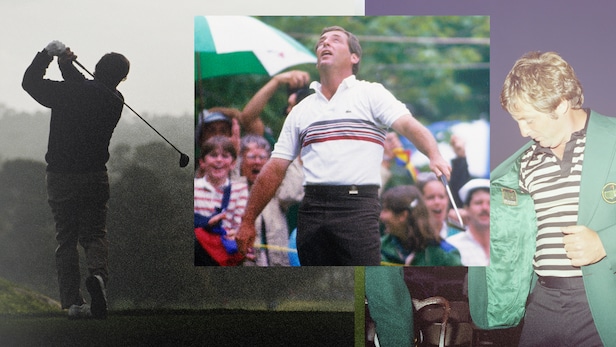
You would have liked Fuzzy Zoeller. He was a Hillerich and Bradsby kind of pro, a Louisville slugger, one of the very long drivers on tour who fought a bad back his whole career after getting submarined in a high school basketball game. It wasn’t the last time he got undercut.
I remember Dan Jenkins telling me Fuzzy laughed his way out of trouble. “It’s only my career, folks,” he liked to quip from deep in the woods. He had a throwback style—whistling when he wasn’t smoking, vodka in hand, always with a ready wisecrack, sliding down the fire pole of life, he was golf’s Dean Martin and just as talented. You probably know his story is unsatisfying, and his legacy should have had a better end.
Zoeller won the first sudden-death playoff for the Masters in 1979, but his greatest moment appeared to be in defeat. Watching Greg Norman hole a 40-foot putt on the 72nd green at Winged Foot in the 1984 U.S. Open, he thought it was a birdie to take the lead; actually it was for an improbable par. Fuzzy took the towel off his bag and waved a “white flag” of surrender–a noble gesture that won him the Bob Jones Award for sportsmanship in 1985. I recall the club wanted to put a plaque in the fairway, but settled for a photograph in the locker room.
The next day I walked the first fairway of the playoff with Norman and him. Zoeller hardly reached his ball in the right rough when he grabbed an 8-iron out of the bag and, like a rifle shot, knocked it on the green. Norman never knew what hit him. He three-putted three of the first five holes and Fuzzy won a lopsided 67 to 75. That’s the week he’d say in a press conference, “I don’t think of myself as a celebrity or a superstar. I’m just an ordinary guy who makes his living in a crazy way.” Scottie Scheffler with a certain thirst for humor.
He’d win a total of 10 PGA Tour events—a record that’s borderline hall-of-fame, but not to be for Fuzzy. He played the senior tour, won a couple more times; did a lot of hunting and fishing, but mostly retired to his hometown of New Albany, Indiana, and for 16 years hosted a tournament called the Wolf Challenge, raising millions for local charities. I played with him in a pro-am once, and he made it more fun for the amateurs than any pro I’ve ever been around.
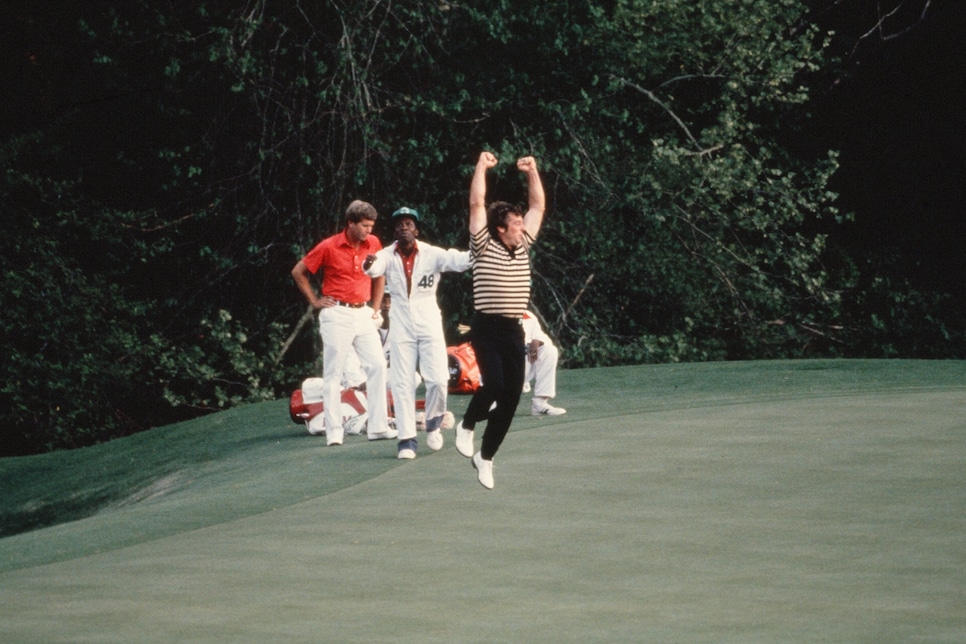
Augusta National
RELATED: Fuzzy Zoeller, two-time major champ, dies at 74
As a friend of his told me, he had more guns at home than golf clubs; “he was Boo Weekley before Boo Weekley.” Fuzzy was also known as a family guy who loved his Hoosiers and every day took care of his wife Diane at home, long past the time she could remember his name. After her death in 2021, you’d see him get a golf cart and a Diet Coke and go fishing by himself at the club he built, Covered Bridge.
There’s a bromide in journalism that when you make a giant misstep, you spend the rest of your days trying to bury it deeper into your obituary. Every good deed or accomplishment pushes it another paragraph lower into your life story. It’ll never be forgotten, and depending on your failings, maybe it shouldn’t be, but we all want to be remembered for our better angels. When Zoeller died at 74 in November, his worst moment didn’t surface until the seventh paragraph of his obit. That’s a testimonial to the overall good nature of his character.
Writing on GolfDigest.com, Joel Beall put his career in perspective before recalling the 1997 Masters: “Speaking to reporters in the shadow of [Tiger] Woods’ record-breaking win, Zoeller ended his interview by remarking, ‘So, you know what you guys do when he gets in here? You pat him on the back and say congratulations and enjoy it and tell him not to serve fried chicken next year. Got it?’ As Zoeller walked away he added, ‘Or collard greens or whatever the hell they serve.’”
Sponsors left him, death threats were made, and apologies followed. Lots of apologies. He was ahead of his time: one of the first targets of cancel culture—ostracized, publicly shamed and professionally punished for an offensive statement. Those words deserved it—they were stupid, racist—but I always thought Earl Woods should have taken pity on him, or come to his rescue a little sooner. Tiger was only a 21-year-old kid and his eventual statement came from his agent at IMG. They let Fuzzy dangle for two days before accepting his apology and hoping “everyone can now put this behind us.” My younger daughter tells me that’s blaming the victim; maybe so, but I’d call it compassion.
More than a decade later, Zoeller told Guy Yocom in Golf Digest: “If people wanted me to feel the same hurt I projected on others, I’m here to tell you they got their way. I’ve cried many times. I’ve apologized countless times for words said in jest that just aren’t a reflection of who I am. I have hundreds of friends, including people of color, who will attest to that. Still, I’ve come to terms with the fact that this incident will never, ever go away.”
I asked Guy what he remembered of that day. He said, “There was this marked pall of sadness about him. He’d chirp happily and make wisecracks when people came by our table, but immediately resume looking very sad. I think that Augusta episode broke him and he was never the same. He cried during that interview, real tears streaming down his face.”
The full measure of a man is revealed only when you consider him at his best and at his worst and judge the balance of days in between. Not many in golf knew higher highs than ol’ Fuzzy—a Masters and a U.S. Open, by gosh—and the lowest low caused by a lapse of 10 seconds in a lifetime. Zoeller wrote a cover story for Golf Digest back in 1984 with the headline, “Enjoy This Rude Game.” In the end, he deserved a better score.
More On Fuzzy Zoeller  News Recalling the worst professional golf competition ever, won by Fuzzy Zoeller (we think)
  Golf Digest Logo Fuzzy Zoeller talks frankly about bad backs, John Daly, rich guys, the Diane Rule and exploding pegs
  Eleven Questions With Fuzzy Zoeller
This article was originally published on golfdigest.com