
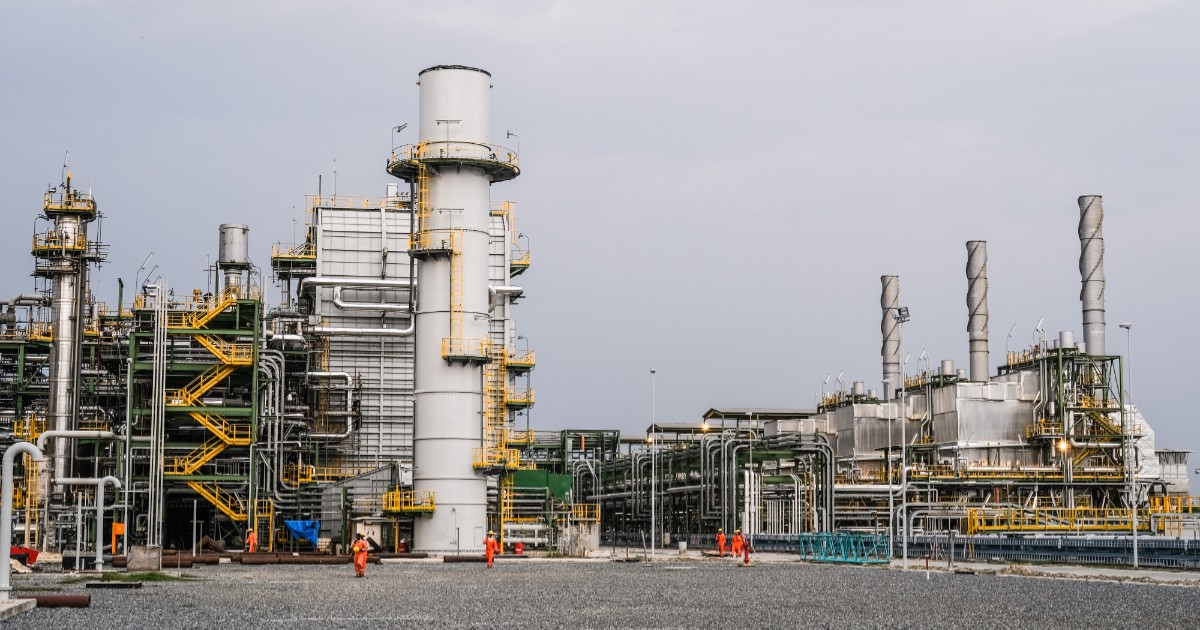
The country’s installed refining capacity now stands at 1.125 million barrels per day, although operational utilisation is 61.58 percent due to technical constraints and crude supply limitations.
Four private and modular refineries, Dangote, Aradel, Edo, and Waltersmith, currently account for 467,000 bpd of active capacity.
Fuel sufficiency improved modestly across several product categories in October 2025. National stock levels stood at 11 days for petrol, 38 days for diesel, 15 days for aviation fuel, 5 days for LPG, and 49 days for LPFO. Average indicative petrol prices ranged from ₦865.87 to ₦897.29 per litre, equivalent to $0.59–$0.61 per litre at the prevailing exchange rate.
Refinery rehabilitation remains mixed as the Port Harcourt refinery, which restarted operations in November 2024, shut down in May 2025 for maintenance. Warri refinery resumed briefly in December 2024 before a January shutdown, while Kaduna refinery remains under rehabilitation.
![A tanker discharges crude oil via single-point mooring (SPM) during a ceremony to mark the first delivery of crude oil to the Dangote Industries Ltd. refinery in the Ibeju Lekki district of Lagos, Nigeria, on Saturday, Dec. 9, 2023. [Photo: Benson Ibeabuchi/Bloomberg via Getty Images]](data:image/svg+xml;charset=utf8,%3Csvg%20xmlns%3D'http%3A%2F%2Fwww.w3.org%2F2000%2Fsvg'%20width%3D'790'%20height%3D'527'%20data-ring-placeholder%3D'1'%3E%3C%2Fsvg%3E "A tanker discharges crude oil via single-point mooring (SPM) during a ceremony to mark the first delivery of crude oil to the Dangote Industries Ltd. refinery in the Ibeju Lekki district of Lagos, Nigeria, on Saturday, Dec. 9, 2023. [Photo: Benson Ibeabuchi/Bloomberg via Getty Images]")
Nigeria’s gas sector also recorded significant activity, with total processing capacity at 17.2 billion standard cubic feet per day, though facilities operated at an average of 3.94 bscf/day in October.
The Presidential CNG Initiative continued to scale, with $0.99bn invested, 100,000 vehicles converted, and over 80,000 direct and indirect jobs created. Concessionary wholesale CNG pricing averaged $1.57 per MMBTU, supporting lower-emission transportation.
The NMDPRA noted that the verified data highlights a sector “strengthening domestic production, reducing imports, and building a future-ready energy ecosystem,” reinforcing confidence in Nigeria’s long-term energy transition agenda.