
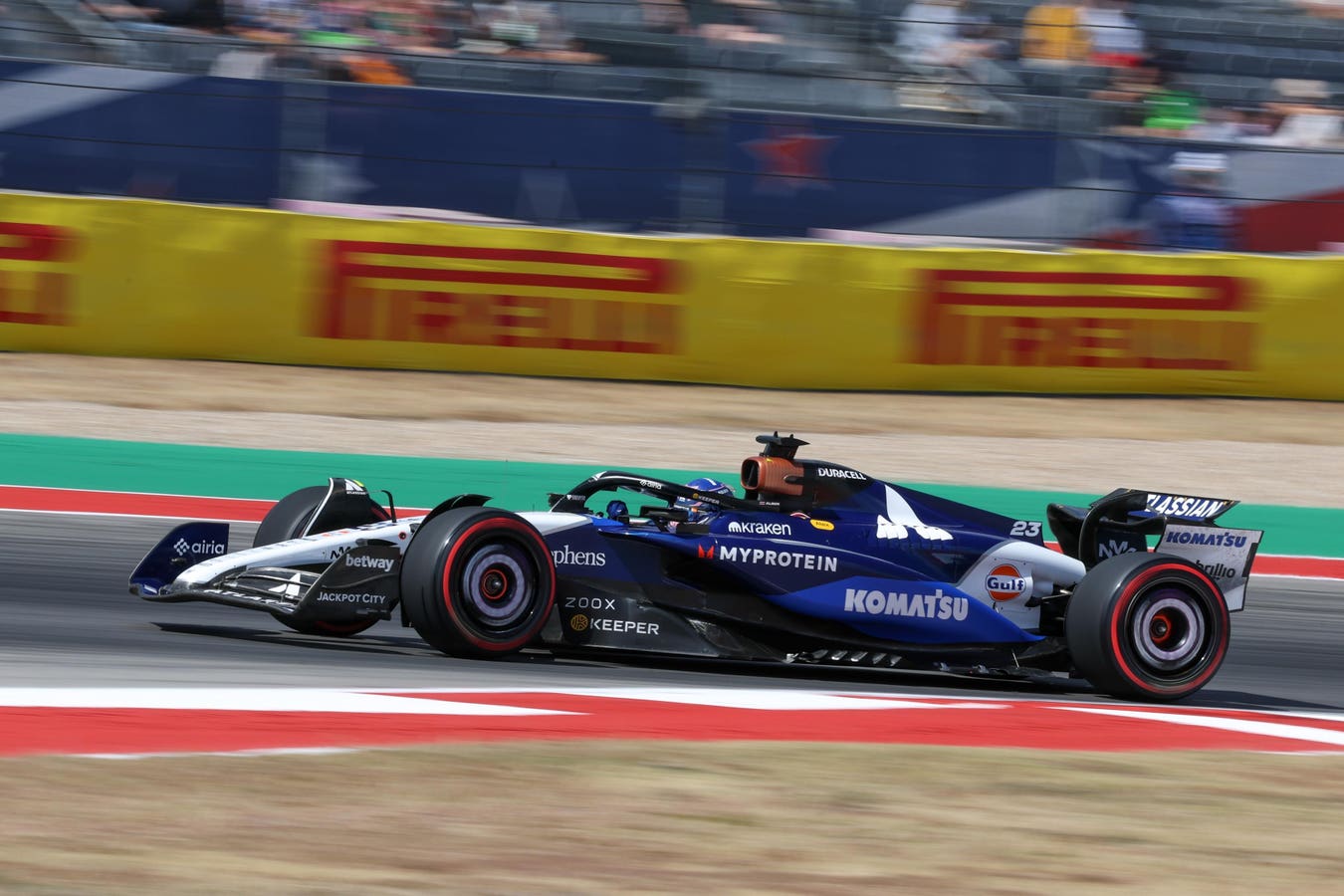
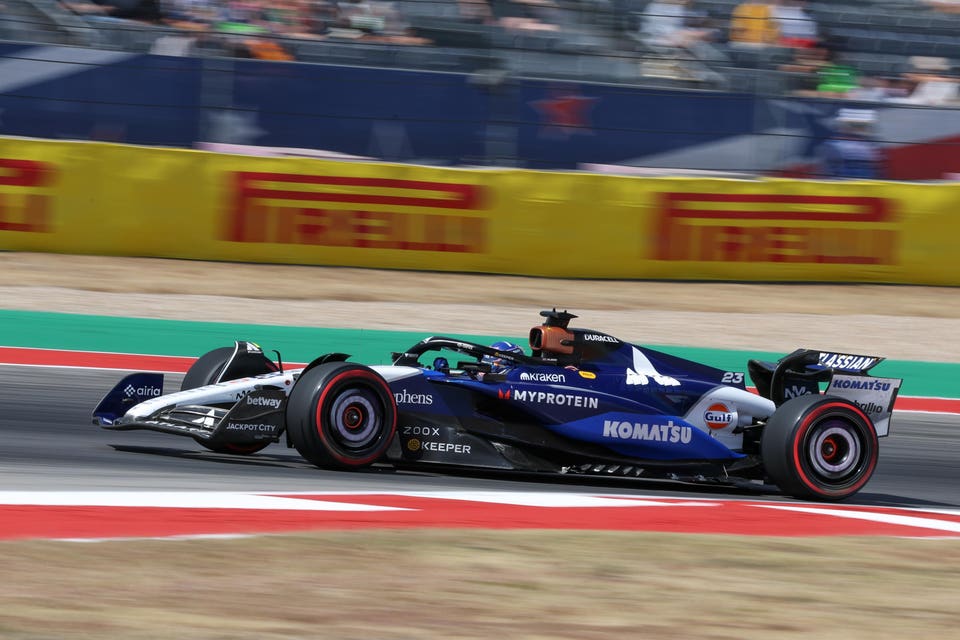
AUSTIN, TX – OCTOBER 17: Atlassian Williams Racing driver Alexander Albon (23) of Thailand speeds out of turn 15 during the first practice session of the Formula 1 MSC Cruises United States Grand Prix on October 17, 2025, at Circuit of The Americas in Austin, Texas.(Photo by David Buono/Icon Sportswire via Getty Images)
Icon Sportswire via Getty Images
Walk through the paddock at any Formula One Grand Prix, and you’ll see a who’s who of enterprise IT. Oracle, Dell, VAST Data, Lenovo, and NetApp, among other major tech players, all sponsor racing teams, trading dollars for logo placement, hospitality suites, and visibility with high-value customers. In return, teams get funding that doesn’t count against F1’s strict cost cap.
But occasionally something different emerges: a collaboration in which the teams and a technology sponsor use the technology operationally, the team is a genuine customer, and both parties have real skin in the game. The recent partnership between Atlassian and Williams Racing is one such case.
I recently had the opportunity to meet with both Atlassian and Williams in Austin to understand how their collaboration differs from traditional team sponsorships. What emerged is a case study that IT decision-makers should watch closely, even if they never attend a Grand Prix.
The Cost Cap Changed Everything
To understand why the Atlassian-Williams relationship differs from typical F1 sponsorships, you need to understand F1’s cost cap, introduced in 2021.
Teams are limited to spending no more than $135 million per year on everything from car development to IT infrastructure. While marketing and senior leadership salaries are exempt, software licenses, cloud computing, and collaboration tools all count against the cap.
This creates something enterprise IT leaders rarely face: every dollar spent on technology is a dollar not spent on aerodynamics, manufacturing, or hiring engineers. It’s a true zero-sum environment.
“Because of the cost cap, we can’t give Williams our products as part of the sponsorship,” Atlassian Customer CTO Andrew Boyagie explained. Williams Racing pays full market rate for every Atlassian license. There’s no discounted pricing or services-in-kind arrangements. It’s not allowed.
Atlassian’s software must compete for budget directly against everything required to design, build, and race. Convincing a team of race engineers to leverage a collaboration platform like Atlassian’s is a very different test than convincing an enterprise IT department to add another SaaS subscription to its stack.
What Gets Measured at 200 MPH
Williams Racing’s goal is simple. It needs to continuously improve lap time. To help meet that goal, the team uses a broad swath of Atlassian’s platform, including Jira, Confluence, Jira Product Discovery, and the AI-powered Rovo.
James Vowles, Williams’ Team Principal, described the organization’s adoption of Atlassian’s platform as “fundamental” to its competitive strategy.
James Vowels, Team Principal of Williams Racing, poses for a portrait during the Formula 1 testing at Yas Marina Circuit in Abu Dhabi, United Arab Emirates, on December 10, 2024. (Photo by Gongora/NurPhoto via Getty Images)
NurPhoto via Getty Images
Before retooling around Atlassian’s offerings, Williams used a hodgepodge of of techniques, including what Vowles described as “spreadsheets and clipboards.”
When asked where the partnership is heading, he said the technologies being developed together “are what will lead to the right foundation for us getting there.” Critically, the companies are actively collaborating to adapt Atlassian technology to the high-stakes environment of F1.
Building Together
Williams’ use of Atlassian’s tools centers on what Atlassian calls the “teamwork graph.” This is a knowledge layer that understands who you are, what team you work on, your goals, active work items, and your relationships across the organization. When someone asks Atlassian’s AI agent, Rovo, a question, the system results are tailored by role, permissions, and, most critically, context.
Williams is implementing similar capabilities across their aerodynamics knowledge base, engineering documentation, and manufacturing systems. The goal extends beyond searchability. The team wants to make decades of institutional knowledge instantly accessible while maintaining permission boundaries.
How The Atlassian-Willaims Partnership Is Different
Most enterprise software case studies follow a predictable pattern. A vendor works with a customer, that customer reports success using vendor-approved metrics, the vendor publishes a case study, and then the customer gets featured at the vendor conference. Everyone’s incentives align toward declaring victory.
The Williams partnership inverts this dynamic. Mike Cannon-Brookes, Atlassian’s co-founder and CEO, acknowledged the risk explicitly: “This is not one we get to hide from. It’s going to be very public about whether this worked or didn’t work in an insanely competitive space.”
Atlassian’s “system of work” philosophy holds that better teamwork and collaboration tools deliver a competitive advantage. If this philosophy works for Williams, the team should be consistently faster in 2026 and 2027 than they are today. Not just faster than their baseline, but faster than competitors’.
If it doesn’t work, everyone will know. The lap times are public. The championship standings are public. F1 journalists and analysts will scrutinize why Williams isn’t improving.
Because, as the company tells us, 80% of F1 teams reportedly use Atlassian products, the competitive dynamics become even more interesting. If everyone has access to the same collaboration platform, what actually drives advantage? This is the question that Atlassian and Williams are working together to address.
This is also a question enterprise IT leaders should ask about their own technology investments. If our competitors had access to the same tools, would we still have an advantage? Is the value in the software, or in how we use it? For Atlassian and Williams, the answer is in the implementation.
A Model for Tech/Sports Sponsorships
The Atlassian-Williams partnership suggests a more productive path forward for tech companies investing in motorsports sponsorships, one delivering both traditional marketing value and genuine product innovation.
Formula 1 teams operate in an environment of extreme constraints that most enterprises never face. The constraints, however, create an ideal testing ground for enterprise technology.
The key difference from traditional R&D partnerships is the forcing function of competition. Williams can’t afford to humor a technology sponsor’s pet theory if it doesn’t deliver real value. The cost cap and the stopwatch ensure honest feedback in a way that typical enterprise pilots rarely provide.
This creates a bilateral learning opportunity. Tech companies gain access to an extreme use case that stress-tests their products and reveals weaknesses that wouldn’t surface in typical enterprise deployments. Racing teams get access to cutting-edge technology and engineering resources that can help solve problems across the organization, not just in IT.
Atlassian isn’t alone in leveraging a performance sports sponsorship towards a greater end. NetApp recently expanded its partnership with the Aston Martin Aramco Formula One Team, announcing that Aston Martin now runs its entire data infrastructure on NetApp StorageGRID.
Outside motorsports, IBM’s longtime sponsorship of the US Open tennis tournament is another compelling example of a sponsorship turned collaboration. The US Open uses IBM’s wastonx portfolio to bring the power of generative AI to managing tournament data, commentary, and governance.
An On-Going Experiment
The Williams-Atlassian partnership remains an ongoing experiment. Williams’ team principal James Vowels believes that trading in “clipboards and spreadsheets” for Atlassian’s collaboration philosophy, and tools that make that collaboration real, will help his team excel. That those tools come from the team’s marquee sponsor is no accident.
Williams is currently in fifth place for the season, their best result in years. Vowles is careful not to claim victory prematurely, instead pointing to 2026-2027 as the timeframe when their transformation should deliver competitive results.
Vowles’s cautious framing is perhaps the most refreshing part of the story. In an industry built on inflated claims and carefully curated success metrics, here’s a vendor willing to say something different: “Check back in two years. The stopwatch will tell you if we delivered.”
That’s accountability that most enterprise IT vendors never face. And it’s precisely the standard IT leaders should demand.
Disclosure: Steve McDowell is an industry analyst, and NAND Research is an industry analyst firm, that engages in, or has engaged in, research, analysis and advisory services with many technology companies, including every company mentioned in this article _except_ the Willliams and Aston Martin F1 racing teams. No company mentioned was involved in the drafting of this article.