
There’s good news and bad news in the latest electricity price trends report from the Australia Energy Market Commission (AEMC). The good news: Electricity prices are on track to fall by 5 per cent over the next five years thanks the swathe of new renewable energy resources and big batteries continuing to join the grid.
The bad news: From 2030 on, further delays to the rollout of large-scale wind generation and major transmission upgrades, coupled with further reliance on unreliable, ageing coal-fired power plants and costly gas will send annual household electricity prices soaring in the other direction.
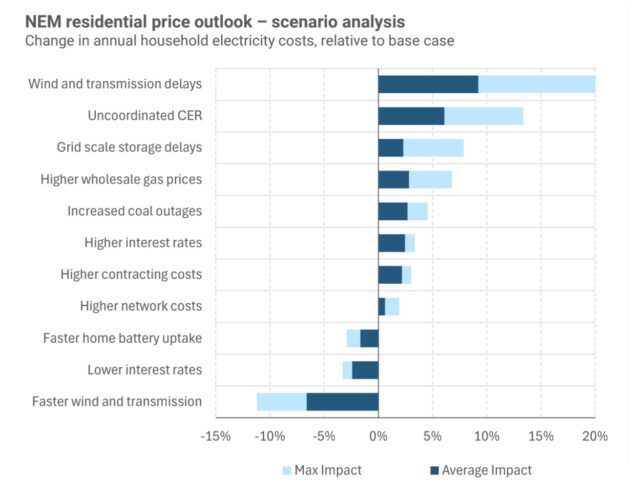
In its Residential Electricity Price Trends 2025 report, the AEMC says that more delays to building wind and transmission projects will add more pressure to annual household electricity prices, lifting them by as much as 20 per cent.
AEMC modelling found less wind and new transmission in the grid could cause wholesale energy market spot prices to almost double, by requiring expensive gas to step in more often during peak periods.
“Under our base case [the Step Change scenario in the 2024 Integrated System Plan], this build out is not projected to be fast enough… due to a tightening supply-demand balance in the wholesale market after 2030,” AEMC said in its Residential Electricity Price Trends report, a decade-long outlook.
“This is projected to increase reliance on more expensive gas generation, together with a slower CER uptake, raising costs to meet evening peak demand.”
The rule maker also issued a stern warning on any plans to keep coal fired power stations open for longer, such as are being adopted by the current Queensland state government.
“Prolonging the life of existing coal plants to meet future demand growth could pose significant price risks, with increased outages potentially adding up to 5 per cent to prices,” it said.
In response to this warning, federal energy minister Chris Bowen said the AEMC’s quiet part out loud.
“The Australian Energy Market Commission make clear slowing the renewables rollout and sweating ageing, unreliable coal will drive up energy bills and pollution. Yet this is exactly what the Coalition’s anti-renewables plan is designed to do,” he said in a statement.
“It’s simple when coal breaks down your bills go up – that’s why we’ve got to keep rolling out reliable renewables, and help more households embrace solar and batteries.
“The Coalition’s anti-renewables plan will cost Australians more.”
The Climate Council put that cost into actual numbers following the AEMC report, saying another major coal failure, such as the 2021 explosion at Callide station in Queensland which put one of its units out of action for three years, would lift bills by $606 for households and by $1,182 for businesses in 2030.
It also pointed out who is profiting from higher energy prices, saying companies exporting fossil gas made close to $100 billion in profits since the Russia-Ukraine conflict began in 2022, while at the same time more Australian households are struggling to stay on top of their power bills.
However, Australia could not only stop that price hike but reverse it by speeding up wind and transmission project delivery, with prices potentially falling by another 10 per cent to 2035.
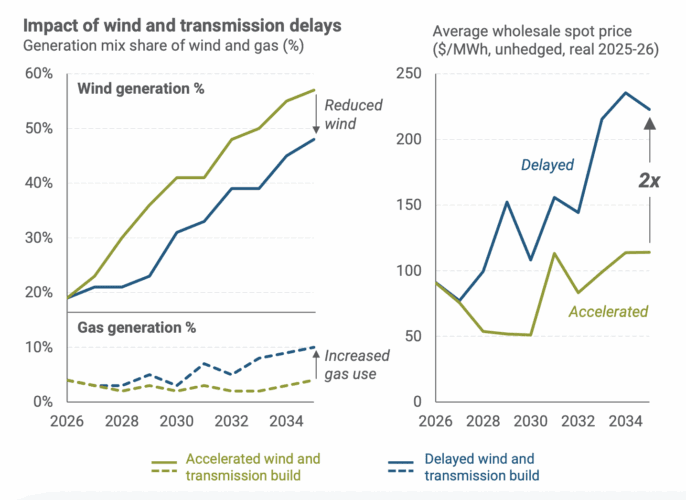
“Wind diversifies the electricity supply portfolio and provides a lower cost source of generation during times of high demand, thereby playing a critical role in the transition,” it says.
“Reduced wind generation increases reliance on more expensive gas generation in evening peaks.”
But households can shield themselves from gas price fluctuations by taking matters into their own hands and going electric, the commission says.
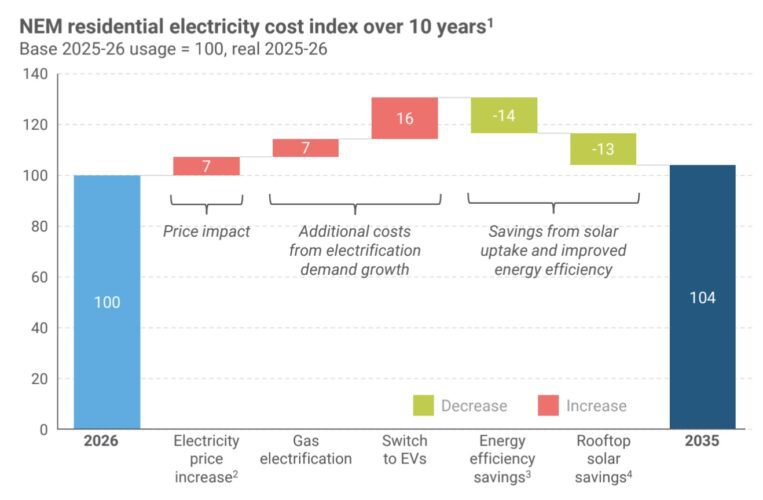
Dumping petrol in favour of electric cars can deliver around $1,400 in savings a year in fuel and maintenance, while getting rid of gas for heating or cooking delivers an equivalent annual saving.
Solar panels could deliver about $1,000-$1,200 per year in electricity savings and another $600-$900 per year when combined with a battery.
The AEMC estimates payback periods for a typical household are seven years for getting off gas entirely, six years for adding solar and switching to an electric car, seven years for a combination of battery, solar, getting off gas and going electric for transport.
“Full electrification, excluding the upfront cost of an EV, pays off in four years,” it says.
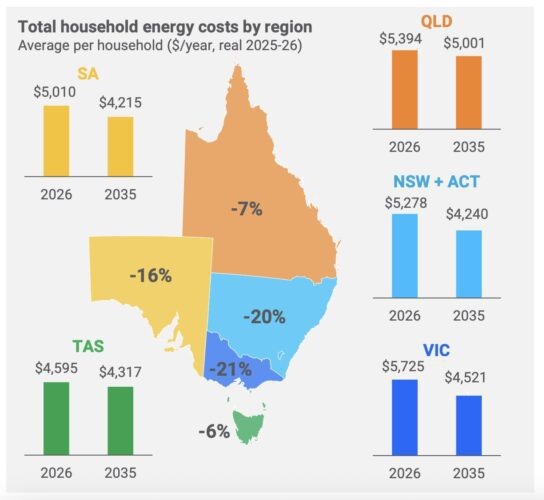
Total energy savings from 2026 to 2035 for households that embrace electrification.
“A household that fully electrifies could reduce total energy costs by up to 90 per cent, with typical payback periods of four years,” AEMC chair Anna Collyer said in a statement.
However, poor coordination of consumer energy resources could add to household electricity costs.
“Well-coordinated consumer energy resources, like charging electric vehicles during the middle of the day when there is plentiful solar, and using batteries to reduce evening demand when prices are higher, can lower costs and reduce network investment.”
These payback periods will be particularly useful for households in four states in particular – Victoria, Queensland, South Australia and Tasmania – which are projected to see electricity price increases in the years from 2030.
This is when electricity demand is expected to grow yet supply tightens.
With solar one of the bedrocks of the AEMC household energy price controls, Solar Citizens CEO Heidi Lee Douglas challenged the government to commit to doubling rooftop solar by 2035.
She says that must include rentals, apartment buildings, and commercial and industrial buildings and, following years of help for standalone homes, politicians must now work with the owners of those other buildings to remove the barriers to accessing rooftop solar and batteries.
AEMC has a wishlist to make all of the above happen faster.
For speeding up the transition to renewable energy and swapping out coal, these involve some basics such as acting on the National Energy Market (NEM) review recommendations, continuing to focus on social licence and ensuring the grid remains reliable.
But it also wants a nationally consistent regulatory framework for CER, long-promised and still being worked through by the CER Taskforce, and to speed up home electrification by dealing with barriers to buying electric cars and pricing electricity to better suit consumer usage.

Rachel Williamson is a science and business journalist, who focuses on climate change-related health and environmental issues.