
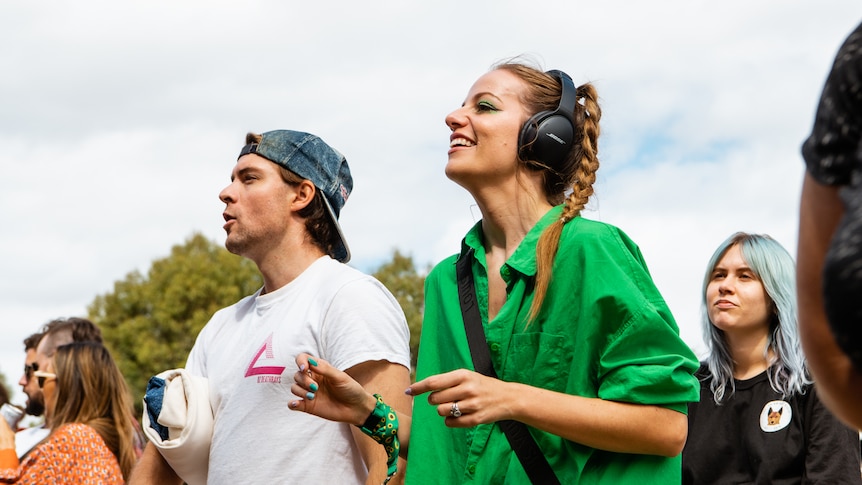
Chill out zones have existed at festivals — either formally or informally — for a few years, providing a space for people to take a break or a breather if they’ve over-indulged. But as inclusivity and awareness around sensory needs becomes more understood, dedicated spaces for people needing a low-sensory environment have emerged.
Dancewize NSW has led the charge for chill out zones at festivals for nearly a decade. The volunteer-heavy team funded by the NSW Health Department focused on providing harm reduction and safety for people using drugs and alcohol at festivals and events, largely through a space to get away from the high energy of a festival setting.
But in the last year, the team has had more people approaching their stall at festivals in search of a quiet space to decompress.
“Anecdotally, we’ve seen a bit of an increase of people seeking low-stim zones and low-sensory zones,” Dancewize coordinator Brodie Daniels said.
“We fit really well into that. If someone is intoxicated and maybe wants somewhere to chill out, then we provide that space for them. It’s a very similar need to someone who is neurodivergent and needs to have a chill space. We provide one already, which is fantastic.”
Brodie said they’ve been working with an external company to focus on the design of the Dancewize spaces at festivals, which has helped to inform framework around sensory needs.
“A lot of those changes have really helped us realise that we’re not just an alcohol or drugs (AOD) space,” they said.
“We are also more of a wider chill-out space for any festivalgoers who are feeling overwhelmed.”
Loading
Dancewize also works with festival teams on facilities and infrastructure, which allows the team to provide different spaces for different needs. If they’re unable to have separate rooms or tents for needs, the team will create dedicated zones inside the care space.
“It’s been good because what it allows us to do is really hone in on the design of the space as well as creating a calm environment,” Brodie said.
“Historically our space has obviously been used for mostly AOD use, and that has always been more of a high-stimulation space than a low-stim space. So, what we’ve been doing over the past year has been really drilling down on that this is a space to chill out for everyone.
“So, we do the low, dim lighting as possible as we can get, and soft colours and lights. We have a sensory guide and an entire framework for our volunteers to follow, that has ways to calm someone down, to do breathing and grounding exercises.”
Setting the standard for sensory needs at live music are Melbourne-born events Ability Fest and Groove Tunes. Both created to show how inclusive and accessible live music can, and should, be, these events are leading the charge and showing others how it’s done.
“We are trying to set a standard for the industry to learn what accessibility can look like on a more realistic budget for events in creative industries,” Groove Tunes and Tibi Access consultancy founder Dina Bassile said.
“Also when you’re working in a space that maybe is not built purposefully for having a sensory space.”
Loading
If venues or festivals aren’t able to have a dedicated low-stim space, offering sensory packs are a way that events can show they’re inclusive and supportive of people with sensory needs.
“Sensory spaces are not always either viable with the space that someone’s working with, or affordable,” Dina said.
“It is costly to set up a whole space with the right items that you need, so Tibi Access is about focusing on some of those more alternative options as well.
“If an event doesn’t have a sensory space, they can advertise that but they can say ‘hey, we don’t have the space but we do have sensory packs available.’ Which is a good way of an event showing that they’ve got something in place and they want to support the best they can.”
Meanwhile, Ability Fest has brought sensory spaces to outdoor events in Melbourne over the last five years (and expanding to Brisbane in 2024), making them not only highly visible but also a desirable option for large-scale sponsorship.
“The biggest benefit is more people come to experience Australian live music,” Zack Alcott from Ability Fest and the Dylan Alcott Foundation told triple j.
“And support a really important industry, which is our live music and event spaces. It goes both ways – it gives people with sensory needs the opportunity to enjoy live music. Then it also makes good business because you’re potentially selling more tickets.
“But if we think about the people that benefit from it, it takes out the anxiety and stress in going to a show.”
Loading
“How we’re also evolving [Ability Fest] is people understanding that viewing platforms are not just for wheelchair users or people who are mobility device users,” Zack said.
“So people that have non-visible disability, they might be wearing a sunflower lanyard, like they have just as much right to be up on that viewing platform as everybody else, which is fantastic.
“We’ve still got a ways to go with staff training and security training in particular, because there’s an in-room misconception that viewing platforms are only for people with a physical disability or physical access needs.”
While inclusive, accessible festivals and events like Ability Fest and Groove Tunes lead from the front with support for neurodivergence and sensory needs, other festivals have begun to follow suit in their own ways.
New players in the festival field are sister events Mode in Sydney (by Bizzaro) and Freeform in Melbourne (by Crown Ruler), have provided dedicated spaces for people to relax and re-ground throughout each of the high-octane dance music events.
Annalisa Lucca from Crown Ruler told triple j that the team’s intention was to have a space that is a sensory break while still feeling aesthetically entwined with the event.
“I think that there’s definitely a new audience getting around [dance] spaces, and a new stylistic trend towards really hard, fast music,” she said.
“With a younger generation as well that hasn’t come up through club culture because of COVID, you have a lot of young people diving into these spaces for the first time that are maybe a little less practised at pacing.
“So, I think these chill out zones prompt people to take a break, have some water, bring some food over to these spaces and recharge.”
At Mode Festival, that space was as much creative as it was intentional and functional. Grassy hills, rolling scented fog and crafted nooks filled one of the sheds on Cockatoo Island, giving people a place to escape, breathe, have a quiet chat and quite literally touch grass.
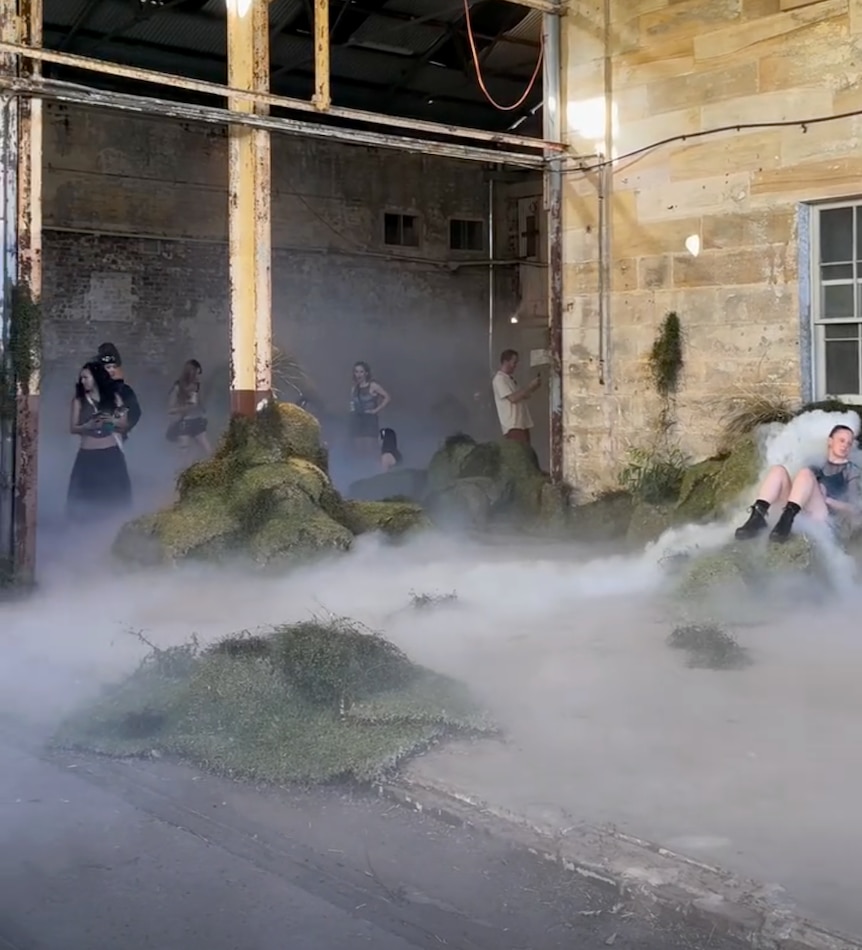
Created by TERRAIN’s founder Cristina Napoleone, the multi-sensory space created an escape from the crowds, sounds and lights of the festival.
“It was really beautiful to watch people climb all over that space and zone out,” Annalisa said.
“I think that the key to those spaces is making them really comfortable. As someone who’s neurodivergent myself, I really crave those spaces sometimes.”
It’s spaces like these that weave together artistry and functionality, proving that accessibility and inclusivity doesn’t exist at the expense of creativity and energy.
“I think when people look at accessibility, it’s seen as medical or through a very medical model,” Dina said.
“There are ways to be creative with accessibility and still keep the creative side of your event. As long as it’s achieving its goal and reaching what it needs for the audience, you can still keep that creative integrity.”