

Updated December 1, 2025 — 7:34pm,first published December 1, 2025 — 1:56pm
Save
You have reached your maximum number of saved items.
Remove items from your saved list to add more.
Save this article for later
Add articles to your saved list and come back to them anytime.
Got it
Australia’s medicines regulator has issued a safety warning over the risk of suicidal thoughts and behaviour linked to drugs known as GLP-1 receptor agonists, including Ozempic.
The Therapeutic Goods Administration also warned that a link between GLP-1 receptor agonist medication Mounjaro (tirzepatide) and reduced effectiveness of oral contraception could not be ruled out amid the reported rise of the so-called “Ozempic babies” internationally.
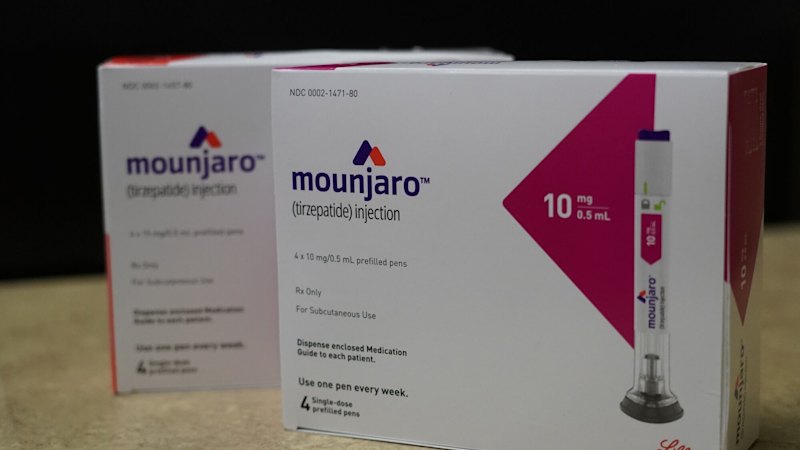
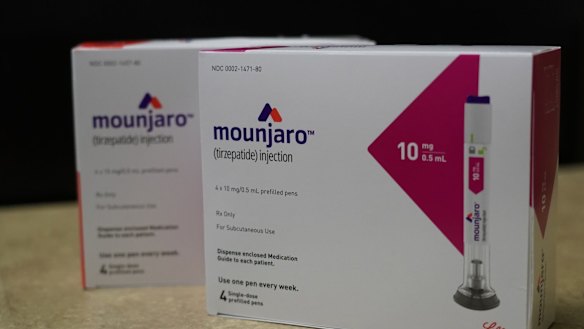 Eli Lilly GLP-1 medicine Mounjaro will come with a new product warning.Bloomberg
The TGA’s safety alert published on Monday said it had updated the product warnings for the class of high-profile drugs indicated for the treatment of type 2 diabetes and obesity (but known to be used for weight loss more broadly) following investigations by international regulators.
The affected drugs are:
Ozempic (semaglutide)Wegovy (semaglutide)Saxenda (liraglutide)Trulicity (dulaglutide)Mounjaro (tirzepatide)
“Patients taking these medicines should tell their health professional if they experience new or worsening depression, suicidal thoughts or any unusual changes in mood or behaviour,” the alert read.
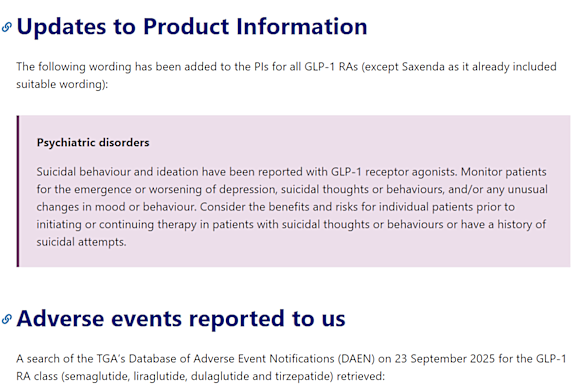 The updated wording that will appear in the product information for GLP-1 RAs.TGA
The TGA’s search of its Database of Adverse Event Notifications for GLP-1 RA medicines on September 23 retrieved 85 reports, including 72 for suicidal ideation, six for depressional suicide, four for suicide attempt, two for suicide and one of self-injurious ideation.
Its investigation included seeking advice from an independent expert group, the Advisory Committee on Medicines, which in June reported that there was insufficient evidence of a causal link between the medicines and suicidal ideation or behaviours.
But the advisory committee found there was a “complex interplay between mental illness and chronic endocrine disorders” (which GLP-1 RAs may be used to treat) and “the potential relationship between weight loss and suicidal or self-harm ideation”.
It noted that the product information across this class of medicines was inconsistent and should be “harmonised”. It recommended updating the safety advice after taking into account the advantages and disadvantages of doing so, including validating community concerns and the potential risks of causing undue alarm where evidence is lacking.
Related Article
Mounjaro’s product warning will also be updated after the TGA’s investigation found the drug’s potential to render oral contraception less effective “could not be ruled out”.
A 2024 review included one study that found tirzepatide reduced the amount of ethinylestradiol (synthetic oestrogen in the combined oral contraceptive pill) in the bloodstream by 20 per cent. Five other studies did not show a statistically or clinically significant difference.
Another study found that tirzepatide increased the time it took the ethinylestradiol to be fully absorbed into the bloodstream from two to four hours, which could be due to the drug’s effect of slowing stomach emptying because ethinylestradiol is mostly absorbed in the small intestine.
Patients will now be advised to switch to non-oral contraception or use a barrier method (such as condoms) for contraception for four weeks after first taking the medication and for four weeks after increasing the dose.
“None of the GLP-1 RAs should be used during pregnancy, and individuals of childbearing potential are advised to use effective contraception during treatment with a GLP-1 RA,” the alert reads.
The British medicines regulator issued advice in August to all individuals of child-bearing age to ensure they do not become pregnant while taking GLP-1 RAs because there is not enough safety data to know whether they can cause harm to fetuses. The regulator received more than 40 reports of unintended pregnancies by women using the drugs.
Ozempic owner Novo Nordisk said semaglutide had been subject to robust studies in clinical development programs.
“Considering the totality of evidence from clinical trials, post-marketing reports and observational studies, Novo Nordisk believes that the benefit-risk profile of semaglutide remains favourable,” the company’s clinical, medical and regulatory vice-president, Ana Svensson, said.
“We remain committed to patient safety and transparency by maintaining up-to-date safety information and collaborating closely with health authorities and regulatory bodies worldwide.”
Eli Lilly, the maker of Mounjaro, was contacted for comment.
If you or anyone you know needs support, call Lifeline 131 114, Beyond Blue 1300 224 636, or PANDA between 9am and 7.30pm on 1300 726 306.
Make the most of your health, relationships, fitness and nutrition with our Live Well newsletter. Get it in your inbox every Monday.
Save
You have reached your maximum number of saved items.
Remove items from your saved list to add more.
Most Viewed in NationalFrom our partners