
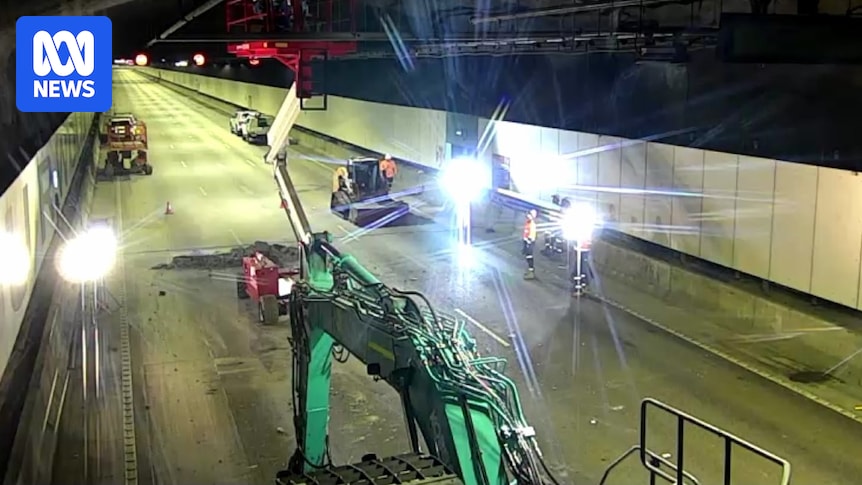
One of Sydney’s main arterial roads has reopened a day after roofing “bulges” shut lanes for emergency maintenance and brought traffic to a grinding halt.
Transport for NSW coordinator general Howard Collins said engineers found “a couple of large bulges” in the shotcrete, otherwise known as sprayed concrete lining, of the tunnel roof on Wednesday night.
The M4 tunnel has reopened in both directions between Haberfield and North Strathfield ahead of the peak period on Friday morning.
The section of the tunnel, which is part of the WestConnex toll network, had been closed in both directions overnight as emergency crews worked on infrastructure repairs.
So what caused this traffic gridlock in the first place?
What is shotcrete?
Shotcrete is a mixture of concrete, water and lots of sand or silt.
It is shot through a hose with force created by a pump and pressurised air.
As it moves through the hose, chemicals are added to speed up its setting time and bonding strength.
The high velocity helps the mixture bond quickly and strongly with the surface it is sprayed onto.
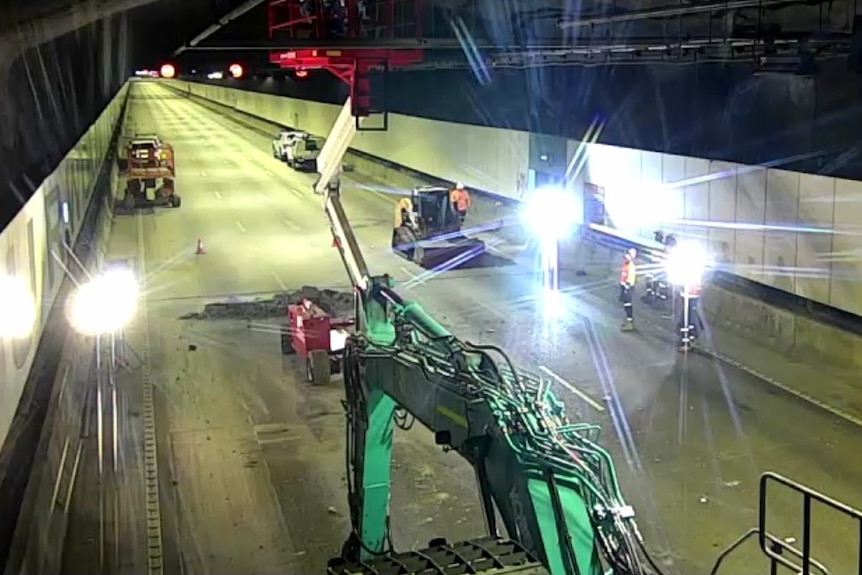
Roof repairs being undertaken on the M4. (Supplied: Transport Management Centre)
Permanent shotcrete can last 50 to 100 years without additional maintenance, but is still perfectly serviceable indefinitely and can be replaced with a new mix when needed.
It is used in countries around the world including the US, UK and France.
What is it used for?
Shotcrete is commonly used in Australia to help line walls in mines, subways and tunnels such as the one that comprises part of the M4.
It is also used to construct retaining walls and secure excavations, especially on slopes like the ones on either side of a road cutting through what used to be a hill.
It can stick to hard surfaces like sandstone or rock, or can be sprayed onto mesh wiring fitted to a more fragile surface.
The mixture is used instead of normal concrete because it works well on overhead or vertical surfaces due to its quick setting times.
It does not usually need a mould, can be quicker to cover larger areas, and is helpful for repair work.
Standard concrete takes more time and resources to spread, level and set.
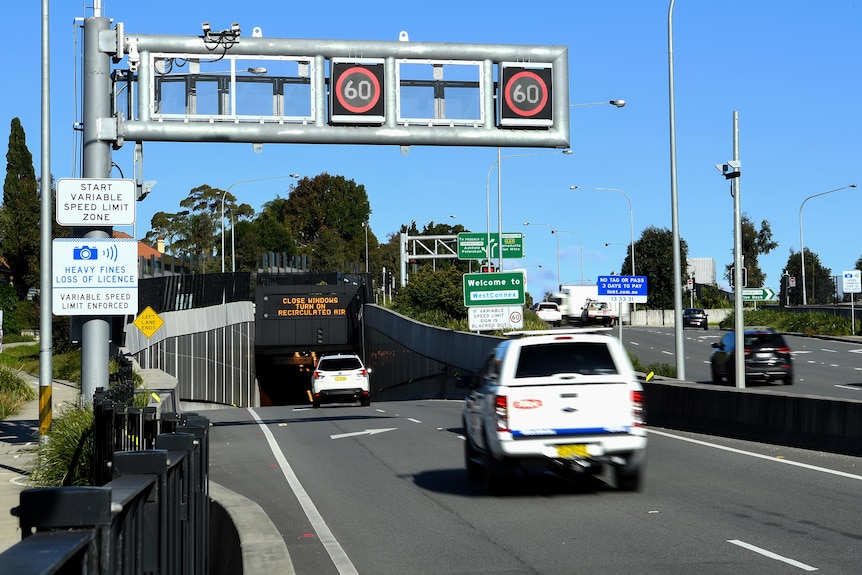
Some drivers say they were stuck in traffic for more than four hours. (AAP: Bianca De Marchi)
Is it reliable?
Geotechnical consultant and owner of Geotechnical Designs, Shaloo Puri, said shotcrete was “very reliable and very strong”.
She said a set of “rare conditions” were needed for it to start failing and that those geological problems were “such that nobody can predict”.
“Somebody has designed the wire mesh and shotcrete but [if] the load is coming on that more than what has been designed for, then it will definitely fail,” Ms Puri said.
“Either there’s a water problem or a rock is loose, putting pressure on the shotcrete.
“There is so much traffic going over the top and there are lots of vibrations around, so it happens sometimes.”
She said it was possible for the shotcrete to “crack” and “collapse” given the right circumstances and agreed with the decision to close the motorway.
What next?
Mr Collins told the ABC on Friday the tunnel was now fully opened and the area has been deemed safe.
“Last night the engineers removed the last remaining parts of what they call the shotcrete … and checked the tunnel, it’s been certified as safe,” he told the ABC.
“They will go back at some stage to deal with what appears to be a minor water leak and trying to ensure that water doesn’t remove anymore of that shotcrete lining.”
Mr Collins said shutting down the tunnel was the right thing to do.
“These tunnels are cut through the same stone, it’s a very stable material… [but] occasionally there are patches which leak and drip,” he said.
“It is important to remove the bulges, because they could fall down and that would have been a safety risk.”
Loading Instagram content
Transurban, the company which owns the tunnel, issued a statement on Friday morning apologising to customers.
“We apologise for the delays motorists incurred yesterday,” a spokesperson said.
“Safety is, and continues to be, our number one priority.”
Motorists affected by the traffic gridlock have been offered a toll refund through the Linkt app or its 133 331 phone line.