
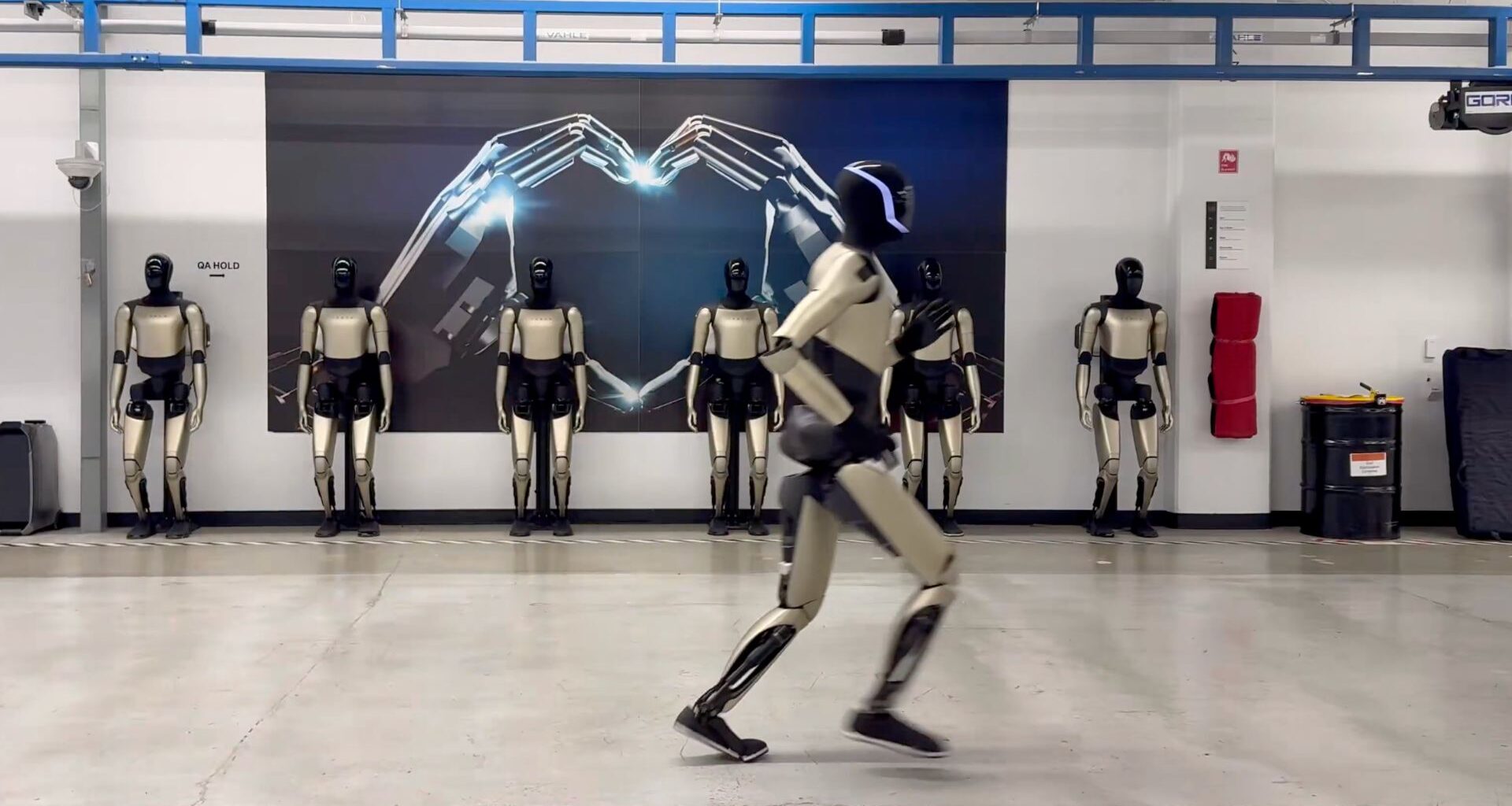
EV maker Tesla has shared a new update of its humanoid robot Optimus on X (formerly Twitter) on December 3.
The short clip shared by the official Tesla Optimus account and Elon Musk, showing Optimus running in a lab, is going viral on social media.
The video, captioned “Just a new PR in the lab,” shows the new performance record set by the robot.
The Tesla Optimus stands tall at 5 feet 11 inches and weighs 160 pounds, featuring over 40 degrees of freedom, including highly dexterous 11-DoF hands designed for human-like interaction.
It runs on a 2.3 kWh battery, enabling nearly all-day operation, with exceptional energy efficiency ranging from just 100W at rest to 500W while walking.
A significant development
The short video showed that Tesla Optimus has improved in balance, coordination, and gait control. Updates shared in the past focused on showing the robot mastering basic skills, such as controlled walking, object handling, and posture training.
Simultaneously, another 8-second split-screen video clip of the humanoid has gone viral, showcasing its progress from May 2023 to December 2025.
The first part of the video shows a group of Tesla robots taking their very first steps in a factory, with the latest progress video shown in the second part.
The new update on the running ability marks a significant development that will contribute towards Elon Musk’s broader vision of deploying 5,000 Optimus robots by the end of 2025.
A timeline of progress
By mid-2025, Tesla demonstrated that Optimus was performing increasingly complex tasks, including walking, lifting small objects, and executing scripted tasks such as pick-and-place operations and basic assembly work.
In early September, the automaker released its first demo of the humanoid, titled 2.5 Gen Optimus, in which the robot appeared sluggish when tasked with a simple task.
In October, the robot showed significant improvements in performing Kung Fu moves alongside a trained professional. The robot’s gait and full-body coordination became smoother, with improved whole-body control rather than isolated limb scripts.
Still under active development, Optimus is expected to enter mass production soon, according to Tesla. Elon Musk previously estimated that once manufacturing scales, the robot’s price could fall between $20,000 and $30,000.
Musk also outlined Tesla’s ambitious new manufacturing vision built around “self-replicating” technology. In the near future, he claimed, robots could build other robots, effectively removing humans from major parts of the production line.
The next frontier for the automobile?
Tesla’s Optimus’ rapid progress comes at a moment when the auto industry is reimagining its future. Carmakers are pivoting toward robotics because EVs and humanoid robots share the same foundational technologies – batteries, AI chips, sensors, and autonomous navigation.
Modern factories already rely heavily on industrial robots, and humanoids represent the next step: machines that can perform the tasks current robots can’t. As labor costs rise and global competition intensifies, automakers see robotics as both a cost-saving strategy and a new frontier of innovation.
Tesla’s ambitions may be bold, but the industry trend toward robot-assisted manufacturing is unmistakable.