
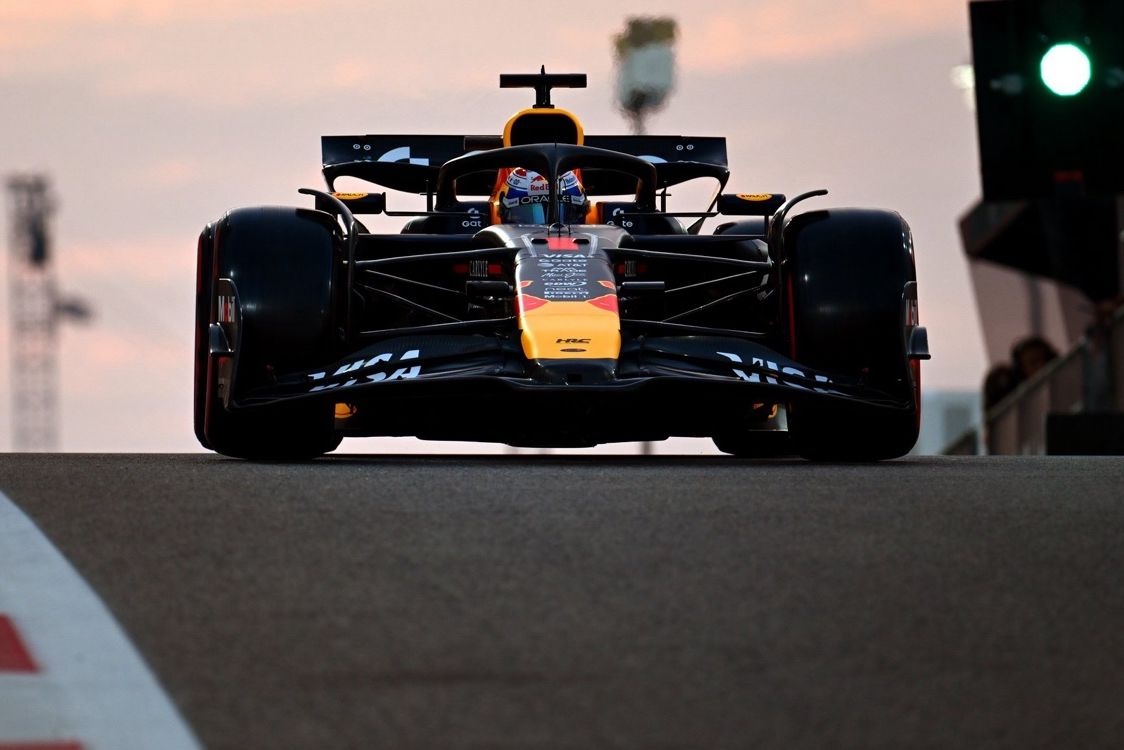
After the first practice session in Abu Dhabi, championship leader Lando Norris was just 0.008s faster than Max Verstappen – but that gap grew to 0.363s in the second session. That is concerning for Red Bull on two fronts: firstly that set-up changes between the sessions failed to have the desired effect, and also that the second session is far more representative than the first because track conditions are closer to those likely in qualifying.
Norris’s McLaren team-mate Oscar Piastri, now third in the championship but very much in contention on points, had to skip FP1 while Mexican IndyCar star Pato O’Ward completed the team’s mandatory rookie running. He then had a scrappy FP2 in which he was 11th fastest.
Last year Norris won from pole position while Verstappen, launching from fifth on the grid, clipped Piastri on the opening lap. The maths of the championship as it stands, with Norris 12 points ahead of Verstappen, mean that if Norris were to qualify on pole and take the lead at the start, Red Bull would require McLaren to fumble.
This is not out of the question, given the double disqualification in Las Vegas and the bizarre strategy misfire in Qatar. But Red Bull doesn’t want to be in a position to rely on McLaren dropping the ball again.
“We would be lucky, but we can’t rely three times on mistakes,” said Red Bull driver advisor Helmut Marko. “We have to fight from our own strengths.”
This is looking a tenuous proposition, but not out of the bounds of possibility given Red Bull’s track record of turning around its car overnight. But while the team habitually runs lower engine modes on Fridays, Verstappen’s key losses compared with Norris came in sector three, which is dominated by the kind of slow 90-degree corners where the RB21’s tendency to understeer is more of a factor.
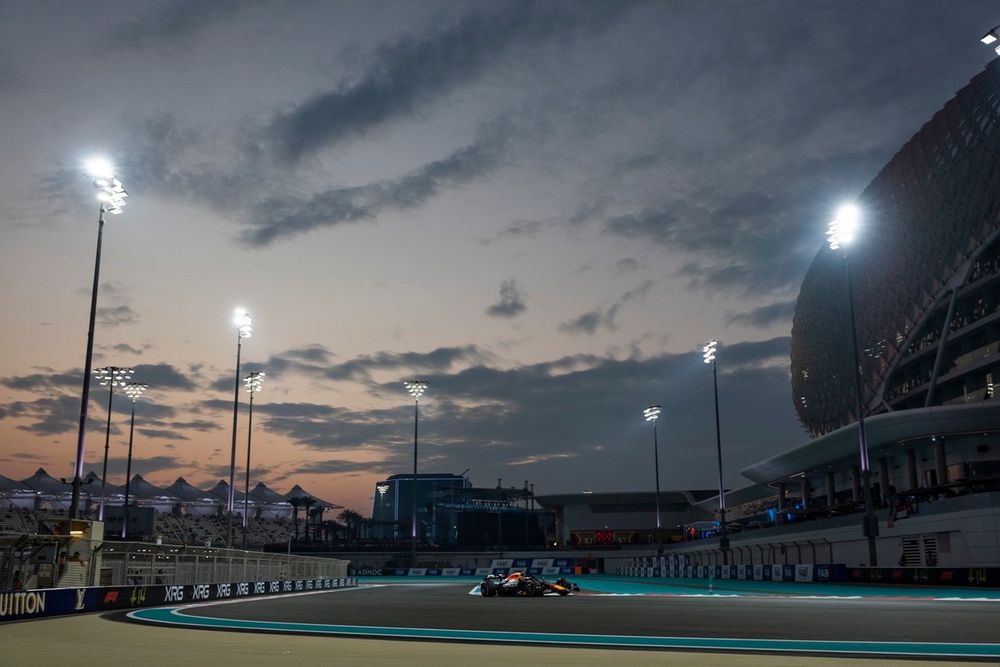
Max Verstappen, Red Bull Racing
Photo by: Sam Bloxham / LAT Images via Getty Images
Marko put the bigger gap in FP2 down to “set-up changes that didn’t deliver the effect we hoped for”, but pointed out that Verstappen has been further in arrears after practice before.
“We’re losing more time in sector three now,” he said. “There are several factors at play. But it’s Friday – we’ve had worse Fridays.
“He [Verstappen] came straight on and said the car is understeering. It was also a little bit bouncing. But we have another session and hopefully we go in the right direction. I wouldn’t say it [the gap of three tenths] is alarming, but it’s not a very comfortable situation.”
It could aid Verstappen’s cause if Mercedes and Ferrari were closer, and could potentially disrupt McLaren’s strategic choices or cost them points – as Charles Leclerc did in the US GP or George Russell did in Bahrain, for instance. But Marko dismissed the possibility, saying: “I don’t see any one of them as quick enough.”
That leaves tyre strategy as Red Bull’s main lever to pull. It saved an extra set of medium-compound Pirellis on Friday, while McLaren saved a set of hards by not running them in FP2 – but Verstappen had more degradation on the medium-compound tyres than Norris, reckoned Marko. On this track degradation is triggered by graining on the more heavily stressed front-right tyre, which then develops across both front wheels before the rears as the driver tries to slide the rear end more to combat the growing understeer.
Pirelli’s prediction is for the race to be a one-stop affair on the medium and hard tyres but doesn’t rule out two stops. As usual it is holding a candle for the soft tyre to become raceable if the support events lay down enough rubber.
“We will see what is better for the race,” said Marko. “But I mean it’s mainly Norris who is quicker. Unfortunately not Piastri – we would have preferred the other way around…”
Read Also:
We want to hear from you!
Let us know what you would like to see from us in the future.
– The Autosport.com Team