
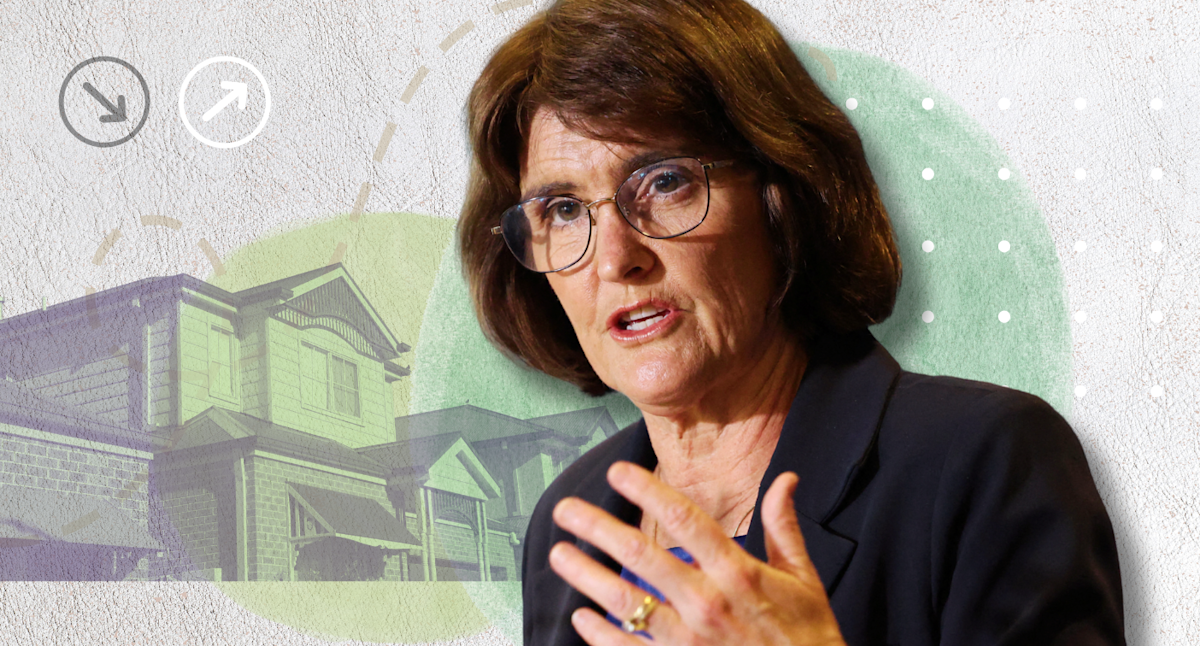
 The RBA has held the cash rate at 3.6 per cent at its final meeting for the year. (Source: Yahoo Finance)
The Reserve Bank of Australia (RBA) has unanimously kept the cash rate on hold at 3.6 per cent at its final board meeting of 2025. Hotter-than-expected inflation figures and solid economic growth poured cold water on hopes for further rate relief, with some forecasters predicting the next move will be up.
RBA governor Michele Bullock revealed there would be no interest rate cuts in the “foreseeable future”. She said the board did not consider the case for a rate cut “at all”, and while it didn’t “explicitly” consider the case for a December hike either, it did discuss what would be needed for it to hike in the future.
“I don’t think there are interest rate cuts in the horizon for the foreseeable future,” Bullock said in her post-meeting press conference.
“The question is, is it just an extended hold from here, or is it the possibility of a rate rise? I couldn’t put a probability on those, but I think they’re the two things that the board will be looking closely at coming into the new year.”
RELATED
While inflation has fallen since its peak in 2022, the RBA board noted it had picked up more recently. While some of the recent increase is down to temporary factors, the board said there were some signs of more broad pick up in inflation which may be “persistent” and should be closely monitored.
“The recent data suggest the risks to inflation have tilted to the upside, but it will take a little longer to assess the persistence of inflationary pressures,” the RBA’s post-meeting statement said.
“Private demand is recovering. Labour market conditions still appear a little tight but further modest easing is expected. The Board therefore judged that it was appropriate to remain cautious, updating its view of the outlook as the data [evolves].”
Do you have an interest rates story to share? Contact tamika.seeto@yahooinc.com
The latest Consumer Price Index showed inflation jumped to 3.8 per cent in the year to October, up from 3.6 per cent in September. Trimmed mean inflation, which is the RBA’s preferred measure, was 3.3 per cent, up from 3.2 per cent.
Financial markets now expect the next rate move to be up, with a 25-basis point hike priced in before the end of 2026.
Story Continues
“If inflation continues to be persistent and looks like it is not coming back down towards the target, then I think that does raise questions about how tight financial conditions are and the board might have to consider whether or not it’s appropriate to keep interest rates where they are or in fact at some point raise them,” Bullock said.
“But I wouldn’t put a timing on that. It’s going to be a meeting-by-meeting decision.”
Despite rates remaining on hold, a number of lenders have started hiking their fixed interest rates, including the likes of Westpac and Macquarie. As a result, the number of lenders offering a rate under the 5 per cent mark is beginning to shrink.
Finder research found that a homeowner with a $600,000 mortgage on an average rate of 5.52 per cent, who switched to the lowest 1-year fixed rate of 4.84 per cent, could save $4,079 over the next 12 months, but that’s assuming the cash rate remains on hold.
Finder head of consumer research Graham Cooke said a fixed interest rate could provide security and certainty over your repayments, but it was ultimately a personal decision based on your risk appetite.
“Trying to ‘beat the bank’ by fixing your rate is often a losing gamble because banks are experts at pricing in future rate movements,” Cooke said.
“If variable rates do drop, you could be stuck paying a higher fixed rate or face a penalty of thousands of dollars to get out.”
Whether you go fixed or variable, Cooke said it was important to make sure you were on the best rate possible. If not, see if you can refinance or negotiate to a better deal.
For the property market, Domain chief of research and economics, Dr Nicola Powell, said today’s hold was a “double-edged sword” for the housing market.
“It gives buyers and sellers more certainty around borrowing costs and may help to take some heat out of the rapid price growth we’ve been seeing, especially at the more affordable end,” she said.
“However, it doesn’t solve the deeper affordability issues. Mortgage holders are still managing repayments that are significantly higher than they were before the tightening cycle began in 2022.”
Get the latest Yahoo Finance news – follow us on Facebook, LinkedIn and Instagram.