
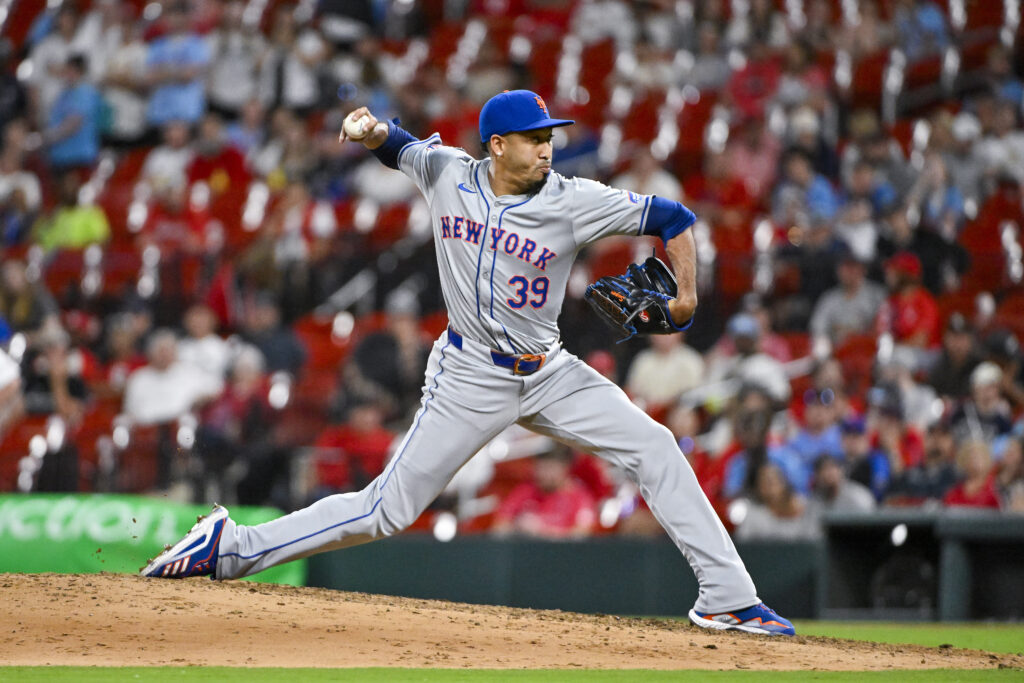
10:35am: It’s a $69MM guarantee for Diaz, reports Jeff Passan of ESPN. That $23MM annual value is indeed a new record for a reliever.
10:31am: The two sides have agreed to a three-year deal, Sammon and colleague Ken Rosenthal report. It’s presumably at a record-setting annual value for a reliever. Diaz currently holds that record with the $20.4MM AAV on the contract from which he just opted out last month.
10:20am: The Dodgers and right-hander Edwin Diaz have agreed to terms on a contract, reports Will Sammon of The Athletic. Joel Sherman and Jon Heyman of the New York Post reported not long before the agreement that Los Angeles had been showing interest in Diaz, who’s represented by Wasserman.

Diaz returned to the open market this winter, opting out of the final two seasons of the record-breaking five-year, $102MM contract he signed with the Mets the last time he was a free agent. The right-hander had been guaranteed $38MM over the final two seasons of that contract, so by opting out and testing the market, he secured himself an additional one year and $31MM in guarantees.
He’s spent the past seven years in Queens and, after a rocky first campaign, has turned in a collective 2.36 ERA (2.12 SIERA, 2.15 FIP) with a mammoth 40.8% strikeout rate and 8.9% walk rate. Diaz has piled up 144 saves in 332 appearances as a Met.
For the Dodgers, Diaz represents the most on-the-nose means of addressing a problem that nearly doomed them in the postseason: a lack of reliable bullpen help. Injuries to Evan Phillips, Tanner Scott, Brusdar Graterol and others left the Dodgers with a thin enough stock of trustworthy relievers that L.A. turned to Blake Snell, Tyler Glasnow and Yoshinobu Yamamoto (one day after he threw nearly 100 pitches) in pivotal high-leverage settings during their World Series run. That they even progressed to the World Series was largely attributable to historic performances from starters Yamamoto, Snell, Glasnow and Shohei Ohtani in the postseason’s earlier rounds.
The Dodgers have now signed the top reliever on the market in consecutive offseasons. They inked Tanner Scott to a four-year, $72MM pact last winter, though that deal contained $21MM worth of deferred money, thus knocking down the present value. Scott’s first year in L.A. didn’t go at all as hoped; he limped to a 4.74 ERA with improved command but lesser velocity and strikeout rates. After yielding 11 home runs in the 2022-24 seasons combined, Scott served up 11 round-trippers in his first season as a Dodger.
Certainly, they’ll hope for better results with Diaz, whose track record is lengthier and steadier than that of Scott. While he’s naturally had some year-to-year variance in his earned run averages — as is the case for any reliever — Diaz has been at 3.52 or better in each of the past five seasons, including three sub-2.00 campaigns. He’s punched out at least 34.6% of his opponents each season along the way, and since a shaky walk rate in 2021, he’s sat between 7.7% and 9.3% in that regard for four straight seasons.
Diaz will slot into the ninth inning, pushing Scott to a setup role alongside Scott, Alex Vesia, Blake Treinen, Anthony Banda, Brock Stewart and Graterol. Will Klein, Ben Casparius and Jack Dreyer all had solid or better seasons in 2025, but if everyone is healthy — far from a given — there’s only room for one of that trio in the final bullpen spot. Of course, injuries will inevitably create opportunities for many of the Dodgers’ overqualified depth arms, and each of Klein, Casparius, Dreyer and Edgardo Henriquez have minor league options remaining.
The Dodgers have paid the luxury tax in (more than) three consecutive seasons and are more than $60MM over the $244MM first-tier luxury threshold, meaning they’ll pay a 110% tax on the AAV on Diaz’s contract. However the annual salaries break down, he’ll cost them an additional $25.3MM in taxes alone. Assuming an evenly distributed $23MM per season, RosterResource, now projects next year’s Dodgers payroll at just over $359MM (although that does not account for substantial deferrals to Ohtani, Scott, Freddie Freeman, etc.).
The Mets would have been subject to those same penalties had they been willing to match this type of offer. Diaz reportedly entered the market seeking a five-year contract. When that didn’t materialize, he clearly pivoted to a record-setting, shorter-term arrangement. The Mets were reportedly also willing to offer three years, though ostensibly not at such a steep yearly rate.
While New York couldn’t have known when signing Devin Williams to a three-year, $51MM pact that Diaz would also sign for three years and a total of $18MM more, the results from those two high-end relievers will now be carefully watched by Mets fans for the next three seasons. If Williams returns to form, it’ll look like a savvy pivot to get a comparable reliever at a lesser rate. If not, there will be plenty of second-guessing and criticism from the fan base. Of course, owner Steve Cohen also clearly has the resources to have simply won the bidding on both relievers, but that’s ultimately not the route the front office chose.
The Mets will now bid farewell to Diaz, who rejected a $22.025MM qualifying offer, with only minimal compensation for his departure. Due to their status as luxury tax payors, they’ll receive a compensatory draft pick after the fourth round of next summer’s draft. The Dodgers, meanwhile, will surrender their second- and fifth-highest selections in next year’s draft. The league-allotted cap on their personal spending pool for international amateur free agents will also be reduced by $1MM.
More to come.