
Senate inquiry hands down university governance report as Pocock criticises ‘corporatised, broken model’ Krishani Dhanji
Universities in Australia have become too corporatised, and must increase transparency about the number of their casual staff, says a Senate report into university governance.
The Senate inquiry, which ran for almost a year, handed down its final report this afternoon, making eight recommendations – including that states and territories should review the acts governing universities in their jurisdictions to ensure institutions focus their work on public research and education, and to strengthen the powers of the higher education regulator.
It also recommended academic boards monitor courses and their staffing resources to ensure they are focused on education over profits, and that universities must report the proportion of teaching done by casual staff.
The inquiry’s interim report in September made several other recommendations including to cap vice-chancellors’ salaries and disclose how much universities are spending on consultants.
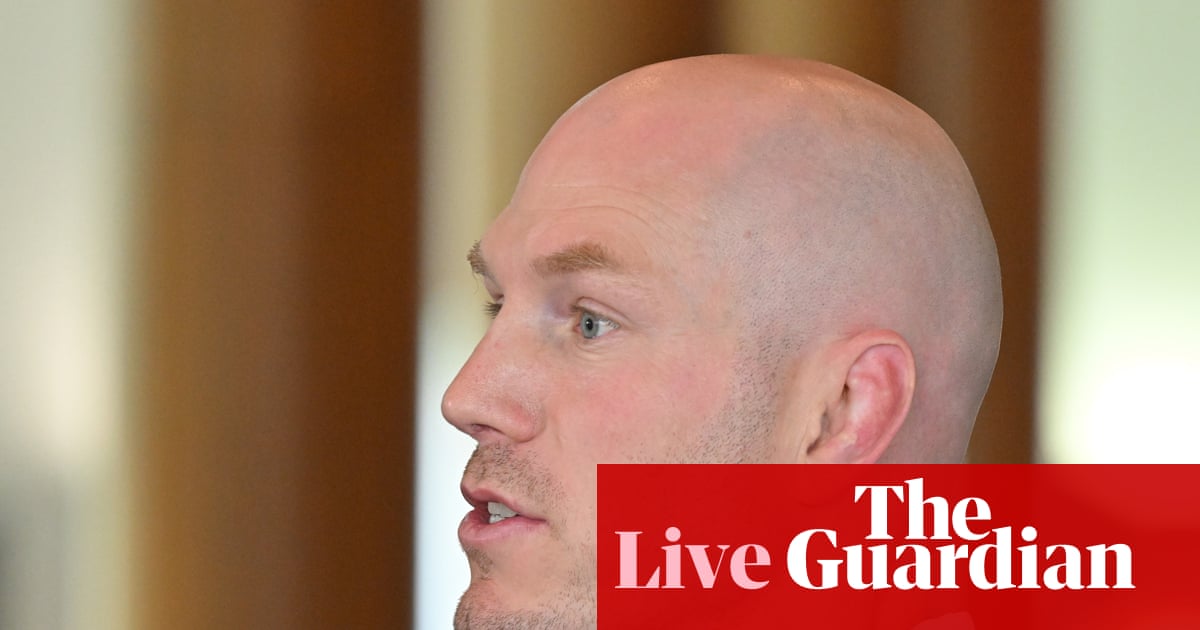
Independent senator David Pocock, who sat on the inquiry, made several other recommendations, including that the new Australian tertiary education commission should develop new models to “sustainably” fund universities and reform the “failed job ready graduates” scheme as a matter of urgency. He said:
My hope is that the work of the Committee, and all those who have contributed to it, can help chart a path back from a corporatised, broken model to rebuilding the kind of higher education system Australians need, want and deserve.
Updated at 23.33 EST
Key events
Show key events only
Please turn on JavaScript to use this feature
Tropfest opens for short film submissions after seven-year hiatus
The world’s largest short film festival, Tropfest, has opened for submissions as it prepares to return from a seven-year hiatus.
The festival is accepting original films no longer than seven minutes incorporating the “hourglass”, Tropfest 2026’s signature item.
The first, second and third prizes will be valued at $50,000, $30,000, and $20,000 respectively. Sydney’s Centennial Park will host the event on 22 February 2026, after submissions close on 8 January.
Margot Robbie, the Australian actor and producer, will lead the jury at the festival, which is being held 10 days after the release of her new film, Wuthering Heights. Read Guardian writer Hollie Richardson’s take on the Brontë adaptation here:
Updated at 01.18 EST
Bupa ‘deeply sorry’ after $35m fine
Following on from previous post:
The healthcare giant struck a remorseful tone on Thursday saying it had accepted the breaches, AAP reports.
“We remain deeply sorry for these errors and have apologised to our affected customers for the impact this has had on them and their families,” the company said in a statement.
Bupa said $14.3m in compensation had been paid to affected customers for more than 4,100 claims.
“The amount paid in remediation provides one numerical yardstick by which the court may be satisfied that the penalties totalling $35m … will have the necessary deterrent effect,” Justice David O’Callaghan said.
The unconscionable conduct, affecting 388 people, occurred after Bupa removed a safeguard in mid-2020. That safeguard – a weekly report – told staff when its automatic claim assessment system had wholly rejected certain hospital claims.
Medical providers and hospitals were also affected by Bupa’s conduct, including by being fleeced out of payments they were entitled to for claims. The value of the benefits denied or delayed averaged $900 and in one case amounted to about $103,000, the court found.
The second biggest health insurer in Australia controls more than a quarter of the market with about 4.5 million customers.
Updated at 01.06 EST
Bupa fined $35m for duping patients, hospitals
Private health insurance giant Bupa has been fined $35m after wrongly rejecting thousands of members’ hospital claims, AAP reports.
The federal court on Thursday found Bupa misled thousands of consumers about benefits they were entitled between May 2018 and August 2023.
In most cases, claims were for hospital treatment in which two or more procedures were performed at the same time. Where part of the treatment was covered by a member’s policy and another part was not, Bupa rejected the claim in whole.
Justice David O’Callaghan found the health insurer had engaged in “unconscionable conduct” between June 2020 and February 2021 for rejecting mixed coverage claims of two or more procedures at hospitals.
The contravening conduct was allowed to continue even after Bupa’s senior managers became aware that system changes were necessary to avoid incorrectly rejecting claims, the court found.
The Australian Competition and Consumer Commission, which took the case to court, said Bupa’s conduct forced many patients to cancel, delay or forgo necessary treatment. The ACCC deputy chair, Catriona Lowe, said:
We heard from Bupa members who suffered significant harm, including financial harm as well as pain, suffering and emotional distress as a result of Bupa’s conduct.
Private health insurance can be a significant expense for consumers and people rightly expect to receive the level of coverage they pay for.
Photograph: John Keeble/Getty ImagesShare
Updated at 00.53 EST
Canberra police shocked by ‘movie-like’ alleged theft of $10m in luxury goods
Police have described the alleged targeted burglary of $10m in luxury goods as “something like a movie,” revealing new details of the incident in the Australian Capital Territory.
Det Acting Insp Mark Battye from ACT police shared his surprise at the event with reporters this afternoon:
I’ve never seen a burglary of this magnitude occur here in Canberra and the manner in which it occurred with people [allegedly] flying over from the other side of the world to do this targeted burglary is something like a movie.
The French nationals alleged to be involved went to “so many lengths” to conceal their identities and avoid apprehension, Battye said, adding that it was common for offenders using hire cars to steal or swap number plates.
Detectives “really enjoyed investigating” the case and brought the alleged offenders back to Canberra from Sydney just four days after residents of a house in South Canberra first reported the burglary, Battye said.
Police had been surprised too by the high value of the allegedly stolen goods, Battye said.
We’ve got all walks of life here in Canberra and clearly we’ve got people with really wealthy lifestyles and assets and it’s the case here …
There’s some things I’ve never heard of before, and I wasn’t aware that we even had watches worth over $5m, but there’s a Richard Mille RM88 smiley watch that I believe is valued over $5m.
French police had recovered some of the allegedly stolen items, which had been sent to France via a freight forwarding company, Battye said.
Numerous allegedly stolen items were still yet to be recovered and Battye encouraged the public to alert police if they were aware of sales since October of high value jewellery, fashion apparel and handbags.
Richard Mille Smiley watch, one of a series of items allegedly stolen from a home in Canberra. Photograph: ACT PolicingShare
Updated at 00.47 EST
Interest rate rise by June more likely after unemployment holds, says UBS
Interest rates are on track to rise by June after unemployment came in lower than expected, according to economists at investment bank UBS.
As we reported earlier, data today showed the jobless rate held steady in November even though the number of employed Australians fell a surprise 21,300.
Markets had expected unemployment to rise to 4.4% but job numbers to rise by about 20,000. George Tharenou, a UBS economist, noted employment growth has now slowed to average just 10,000 new net jobs a month over the last three months, less than half the monthly average recorded over the previous year.
However, Tharenou said the data showed the jobs market was still pretty tight and could be adding to inflation, supporting UBS’s prediction of a rate hike by the June quarter, followed by a second in 2026:
The labour market likely needs to ease further ahead – ie the unemployment rate needs to increase – to reduce pressure on inflation.
NAB, ANZ and CBA each expect interest rates to stay where they are through 2026 while warning there’s a real chance the RBA could lift rates in February if inflations is proven to persist and broaden. CBA analysts said today’s data suggest the jobs market is “too tight for comfort for the RBA”.
Westpac, the outlier, thinks the RBA will still cut rates twice in the second half of next year.
Updated at 00.39 EST
Myer pumps up sales ahead of Topshop Australia return
Department store and clothing brand owner Myer has told shareholders it’s had a good start to the financial year with its biggest Black Friday sales on record and plans for big brands to return, AAP reports.
Total sales for the first 19 weeks of fiscal 2026 rose 3% to $1.52bn, led by the main Myer retail business. Homewares, womenswear and others brands’ mini-shops within Myer stores were among the strongest performers.
The group, which is more than 125 years old, is banking on a similar performance in the lead-up to the Christmas and Boxing Day sales.
Myer shares jumped over 11% to 46 cents on the news, but the price is still a long way from where it was a year ago, when it traded around $1.20.
The retailer elected not to pay shareholders a final dividend in September when it reported a 30% fall in underlying full-year net profit to $36.8m linked to still-unresolved issues at its national distribution centre.
Myer is also ramping up its local and international brand offerings, with 20 more set to come online in the second half of fiscal 2026, including the return to Australia of UK fast fashion stalwart Topshop. The brand closed its last stand-alone store in Australia in 2020.
Meanwhile, retail supremo Solomon Lew, who is Myer’s biggest shareholder, will join the board in April 2026. Lew is also chair of the listed apparel group Premier Investments, which off-loaded the Just Jeans, Jay Jays, Portmans, Dotti and Jacqui E brands to Myer under a cash and scrip deal.
Topshop closed its last stand-alone store in Australia in 2020 but is set to return. Photograph: Dean Lewins/AAPShare
Updated at 00.03 EST
 Caitlin Cassidy
National Tertiary Education Union labels proposed university reforms a ‘watershed moment’ for sector
The National Tertiary Education Union (NTEU) has strongly backed the final report into university governance, with its national president, Dr Alison Barnes, labelling it a “watershed moment” for Australia’s public universities:
We now have a clear blueprint to fix burning crises like corporatisation, casualisation and wage theft.
Barnes particularly backed the recommendation for academic governing bodies to have enhanced powers to set staffing levels for courses, and proper consultation with staff and students before major changes were announced as a strong measure to prevent unnecessary job cuts.
She said another recommendation, mandatory reporting of casual teaching rates, would also expose the “dirty secret” of over reliance on temporary staff to deliver core teaching.
The reforms recommended in this report have the potential to refocus universities on serving the public good rather than being run like corporate fiefdoms. NTEU members have campaigned tirelessly over many years to bring these issues to prominence. This report justifies their efforts. It marks a new dawn for higher education.
Updated at 23.46 EST
Caitlin Cassidy
Greens call for ‘systemic overhaul’ of university governance
The Greens say the university governance report “falls short” of providing recommendations that match the “systemic overhaul needed” to address issues facing the sector, including corporatisation and governance concerns.
They made a series of additional recommendations, including immediately reversing the Coalition’s job-ready graduates package fee hikes and funding cuts, making all university council and governing body meetings public and drastically overhauling the composition of university governing bodies to be democratically elected individuals with higher education experience.
They also recommended a federal government agency develop principles to limit the use of consultants and outsourcing at universities. The report noted widespread critique of JRG but made no recommendations to change it.
Greens deputy leader and higher education spokesperson, Mehreen Faruqi, said the final report “exposes the depth and breadth of failed leadership, corporate rot and consultant capture decaying our public universities”:
While the report is a scathing indictment on the corporatisation of universities and the severity of the crisis at hand, it falls short of providing remedies that match the systemic overhaul needed to end the era of managerial bloat and unaccountable opaque governance.
The failures of governance in universities go hand in hand with decades of underfunding by governments, most viciously exemplified by the fee hikes and funding cuts of the JRG scheme, which have been widely condemned and yet still not been reversed by the Labor government.
Greens senator Mehreen Faruqi. Photograph: Mick Tsikas/AAPShare
Updated at 23.38 EST
Senate inquiry hands down university governance report as Pocock criticises ‘corporatised, broken model’Krishani Dhanji
Universities in Australia have become too corporatised, and must increase transparency about the number of their casual staff, says a Senate report into university governance.
The Senate inquiry, which ran for almost a year, handed down its final report this afternoon, making eight recommendations – including that states and territories should review the acts governing universities in their jurisdictions to ensure institutions focus their work on public research and education, and to strengthen the powers of the higher education regulator.
It also recommended academic boards monitor courses and their staffing resources to ensure they are focused on education over profits, and that universities must report the proportion of teaching done by casual staff.
The inquiry’s interim report in September made several other recommendations including to cap vice-chancellors’ salaries and disclose how much universities are spending on consultants.
Independent senator David Pocock, who sat on the inquiry, made several other recommendations, including that the new Australian tertiary education commission should develop new models to “sustainably” fund universities and reform the “failed job ready graduates” scheme as a matter of urgency. He said:
My hope is that the work of the Committee, and all those who have contributed to it, can help chart a path back from a corporatised, broken model to rebuilding the kind of higher education system Australians need, want and deserve.
Updated at 23.33 EST
 Luca Ittimani
Thanks Nick Visser and good afternoon – I’ll take you through the rest of today’s breaking news.
Updated at 23.45 EST